
Kathmandu, Sept 2: The death toll from Nepal’s devastating flash floods rose to 1,127 on Wednesday, with nearly 4,900 still missing, as rescuers battled rain and debris, while Prime Minister Balendra Shah said the disaster’s link to climate change must be strongly raised with the international community.
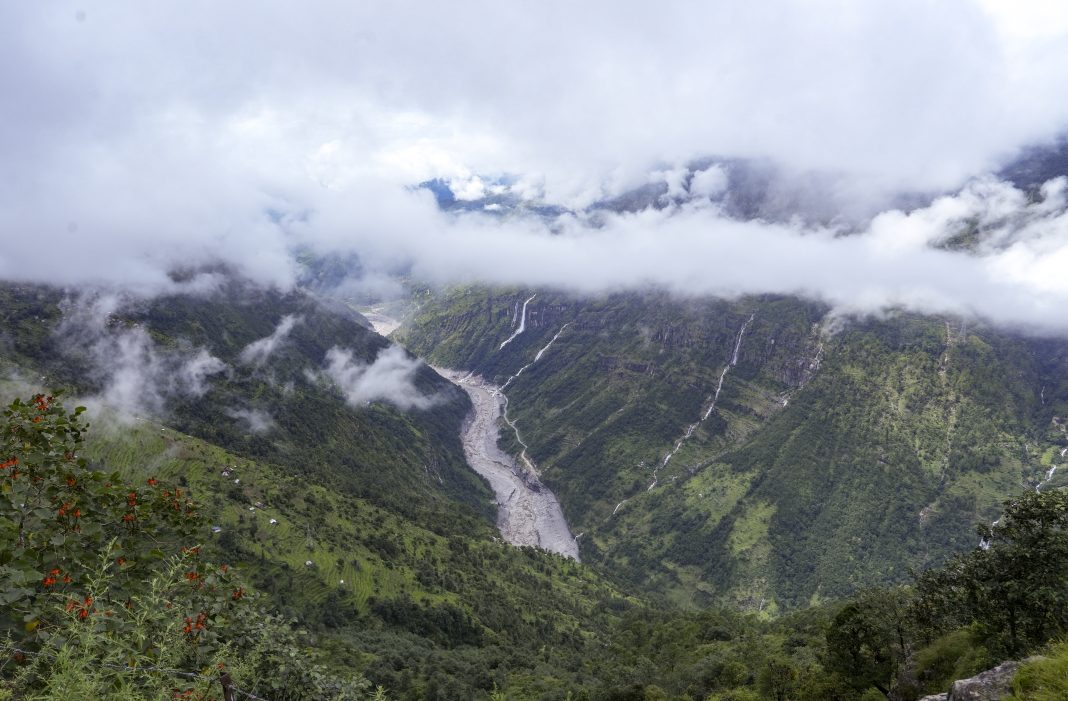
The flash floods, triggered by an ice-rock avalanche near the Nepal-Tibet border on August 26, devastated towns and villages in northern and central Nepal, leaving a trail of destruction and thousands of people missing.
Addressing the House of Representatives, PM Shah said the scale and nature of the disaster raised serious questions about the growing risks faced by people living in the Himalayan region due to climate change.
“According to experts, the flash flood in Bhotekoshi of Rasuwa district was caused by an ice-rock avalanche in the Himalayas. This incident shows the increasing risk the people of the mountain region have to bear with the occurrence of climate change,” he said.
“Therefore,” Shah stressed, “We need to present the fact in a strong manner to the international community that the disaster is linked to climate change.”
There is a global contribution behind climate change. And the responsibility to manage and minimise its effects also rests with the global community, the prime minister said.
According to the Nepal Police, 348 bodies were recovered from Chitwan, 217 from Nawalparasi East, 190 from Nawalparasi West and 155 from Nuwakot.
Another 66 bodies were recovered from Gorkha, 59 from Dhading, 45 from Rasuwa and 38 from Tanahu.
Police said postmortem and legal identification procedures have been completed for 1,113 bodies, while 95 have been handed over to relatives.
Details of 911 unidentified bodies have been uploaded on the Nepal Police website to help families identify missing relatives.
Security forces have so far rescued 6,541 people from affected areas, while search operations are continuing for 4,858 people reported missing, police said.
Authorities have deployed 7,912 police personnel to flood-hit areas for search and rescue operations, relief distribution and management of recovered bodies.
Rescue teams are also moving families from high-risk areas to safer locations, clearing roads blocked by debris and coordinating relief and search operations with local authorities and residents.
However, continuing rain is disrupting search and rescue operations in Rasuwa and Nuwakot.
Meteorologist Rojan Lamichhane of the Department of Hydrology and Meteorology said moderate rain was possible in Bhotekoshi flood-affected areas, including Rasuwa, Nuwakot and Dhading, on Wednesday afternoon.
The department recorded 60.2 mm of rain at Nosyam Pati in Sindhupalchok in the past 12 hours, the highest rainfall recorded during the period.
Heavy rain is also possible at a few places in the mountainous areas of Koshi, Bagmati and Gandaki provinces on Wednesday night, authorities said.
The weather has further complicated efforts to reach missing workers believed to be trapped at hydropower projects along the Bhotekoshi and Trishuli rivers.
National Disaster Risk Reduction and Management Authority (NDRRMA) executive chief Dharma Raj Uprety said rainwater has filled a hydropower tunnel, creating additional obstacles for search and rescue teams.
Teams comprising the Nepali Army, Armed Police Force, foreign technical experts and project employees have been searching the tunnels but have so far failed to locate the missing workers.
Ganesh Karki, former president of the Independent Power Producers’ Association, Nepal, said rescue efforts have also been slowed by difficulties in transporting equipment and even locating tunnel entrances.
“The material carried by the river has reached over the tunnels,” he said, adding that it has become difficult even to determine the exact location of the entrances.
Addressing the Parliament, Prime Minister Shah said the government had mobilised security forces immediately after receiving information about the flash floods and kept helicopters on standby for search, rescue and relief operations.
He said there was “no question” of refusing international assistance given the magnitude of the crisis, adding that Nepal had coordinated with the international community from the beginning.
Countries including India, Pakistan, China, Bangladesh, Sri Lanka, the US, Australia, Qatar, Switzerland, the UK, Japan and Singapore have provided assistance, he said. (PTI)