
Berlin, Oct 22: Commerce and Industry Minister Piyush Goyal on Thursday called for setting a bold bilateral trade target of 310 billion euros between India and Germany, urging businesses from both countries to identify opportunities to maximise benefits from the India-EU trade agreement once it comes into effect.
Addressing an event here, he also expressed hope that the free trade agreement, finalised between India and the 27-nation European Union (EU), would be signed before the end of this year and may come into force in 4-5 months.
“An eminent mathematician in India invented the word zero… (it) was invented by Aryabhata in India. We have 31 billion euros (bilateral trade at present)… if we were to be able to add a zero to that, make it three hundred and ten (310), how would that sound?” he said.
He also said this is the “time we need to see businesses probably start doing sampling, exchanging notes of quality required, exchanging pricing, get everything in order so that when the trade agreement comes into effect, you being the first off the block, get the maximum advantage of this agreement”.
The minister said the ambitious trade target can be achieved if the two countries align their efforts, draw up concrete plans and identify key sectors for greater cooperation.
“Where is the comparative advantage that Germany enjoys when it should give priority to German businesses to work with India? What is it that India can offer best to Germany? What do we need to learn from Germany?… How can we bring in the apprenticeship or the skilling programmes that Germany is so, so very, very erudite at?” the minister said.
He noted that the two countries can navigate global uncertainty together as such a crisis opens up doors for greater collaborations.
“And honestly, it may sound very, very bold to make a comment like a 310 billion euro target… That’s for the businesses to decide. That’s for the businesses to come up with a plan,” Goyal said, adding that Germany’s precision engineering, technical skills and quality, combined with India’s infrastructure, digital capabilities and skilled workforce, can shape an outstanding future for the two countries in the evolving global order.
Talking about the India-EU free trade agreement, he said, although it was under negotiations for 20 years, the agreement really got finalised in the last 13 months.
On January 27, the two regions announced conclusion of negotiations for the agreement, under which 93 per cent of Indian shipments will enjoy duty-free access to the 27-nation bloc, while imports of luxury cars and wines from the EU will become less expensive.
“It (the agreement) will move very rapidly towards signature. Closure was announced on January 27 this year… after going through the process of (EU) Parliament, entire 27 nations have unanimously supported…,” he said, adding, “I would not be surprised if… (in the) next four or five months, it will be operational. Which is why such a large business delegation has accompanied me”.
Goyal is leading a 100-member business delegation here.
He asked businesses of both sides to forge partnerships and connect to potential customers, collaborators, and investors.
On ways to boost trade and investment ties, he suggested strengthening economic security, collaborations in green transition, and emerging technologies.
“We need to have open borders, but we need to have economic security where both can work together, particularly between sides,” he said.
He added that in the present global trade environment, “Trust” is the hardest currency.
The minister also inaugurated the India centre here to hand-hold businesses.
Speaking at the event, Katherina Reiche, Federal Minister for Economic Affairs and Energy of Germany, said huge potential is there between the two countries to boost trade and investment.
She suggested looking at doubling bilateral trade and reducing red tape.
“You (Indian industry) are more than welcome here,” she added.
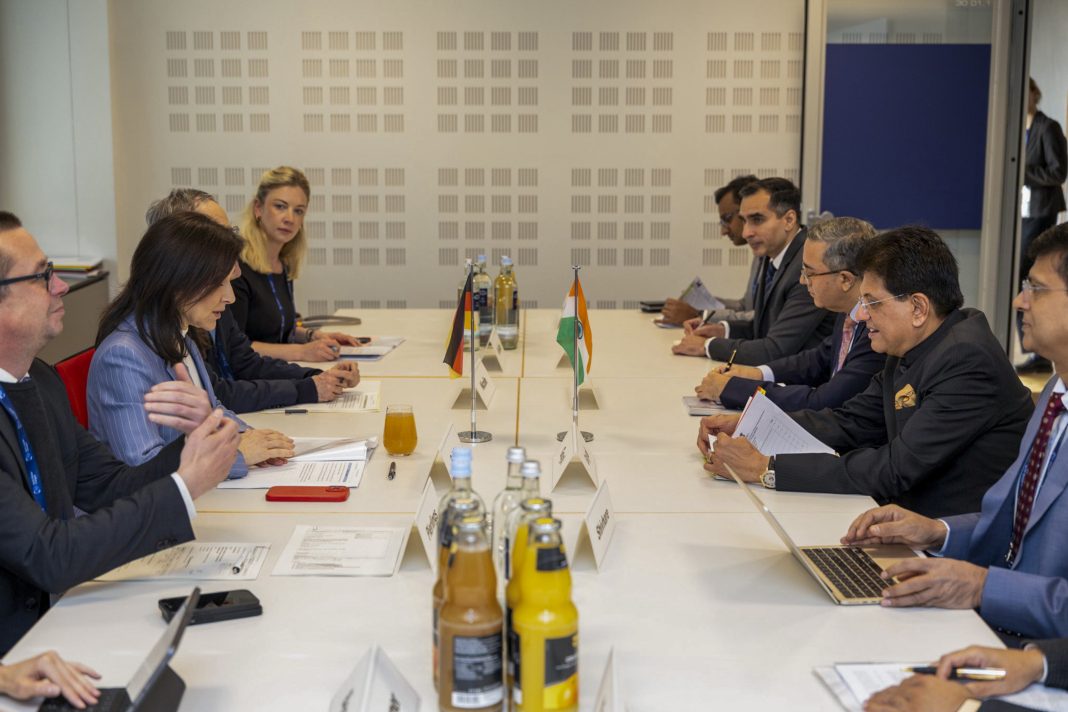
Both ministers also held a bilateral meeting and discussed opportunities in AI, semiconductors, advanced manufacturing, critical minerals, green hydrogen, renewable energy, energy storage, and resilient supply chains, as well as increased investment in India’s industrial and digital ecosystems. (PTI)