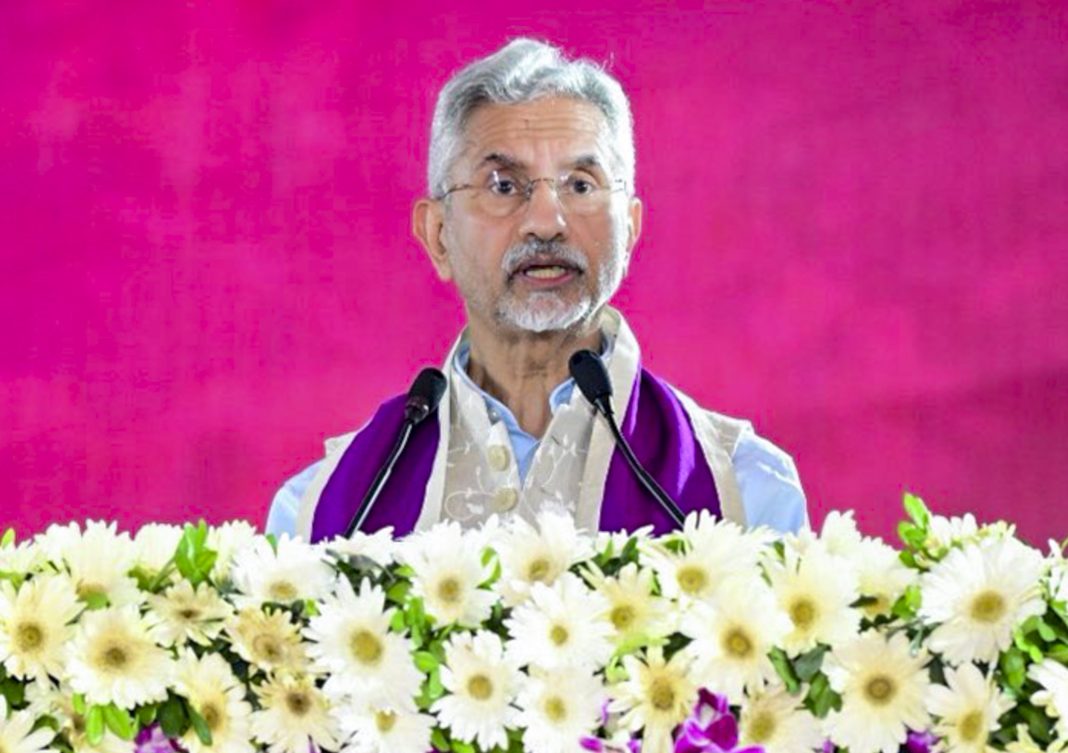

Raipur, Apr 4: India has emerged solidly as a resilient global power, successfully navigating a series of external shocks that have tested the nation’s economic and diplomatic strength, External Affairs Minister S Jaishankar asserted on Saturday, in an apparent reference to the ongoing West Asia conflict.
Addressing the 15th convocation ceremony of the Indian Institute of Management (IIM) Raipur, Jaishankar identified the triple challenges of the COVID-19 pandemic, ongoing global conflicts, and climate change as the disruptions of the decade, asserting that India has emerged solidly from these shocks.
He said that these three factors have impacted daily lives to an “unimaginable degree.” While the pandemic transformed global work and life, the minister said that current conflicts have deeply impacted even distant societies, a testimony to the depth of globalisation.
He noted that India’s ability to manage domestic and international challenges has solidified its position among the world’s top five economies.
“We are now among the top five economies. No one can dispute that multiple global shocks have recently tested our resilience, and India has come through that solidly,” he said, adding, “We have managed both domestic and external challenges fairly successfully.”
More inclusive growth, representative politics and decisive leadership have created a new foundation from which the country can now harbour higher aspirations, he said.
“We have not only embraced the digital revolution enthusiastically, but actually purposefully applied it through our lives. Even many developed societies have not done so,” the EAM said.
Jaishankar stressed that there is no getting away from building robust national capabilities, which he noted is the most effective way to de-risk and develop leverage.
“Building national capabilities has become more critical in the light of the global trends that I have mentioned. This is particularly so for large nations. You would note that even in the developed world, the earlier mantras of globalisation have now given way to a new awareness about self-reliance,” he pointed out.
In India, this is expressed as ‘Atmanirbhar Bharat’, the value of which is obvious when it comes to food, health, energy security or national security, he said.
“We must endeavour to secure within our control as many capacities as we can. Obviously, some domains will be more difficult than others. In such cases, the answers lie in reliable or trusted partnerships and diverse sourcing. Building robust national capabilities is the most effective way of de-risking and indeed even developing leverage,” Jaishankar said.
The global order is changing with visible shifts in relative power and influence of countries, and the turbulence in the world is currently structural in many ways, he opined.
“The politics of some societies find it difficult to come to terms with these changes. New developments in technology, energy, military capabilities, connectivity, and resources have encouraged risk-taking in an increasingly competitive environment. Everything today is being leveraged, if not actually weaponised,” he said.
The world is then confronted with the prospect of securing itself in an increasingly volatile and unpredictable environment, which has necessitated a larger inclination to hedge, to de-risk, and to diversify, whether it is a business choice or a foreign policy one, the external affairs minister said.
Asserting that nation-building is an extremely complex task with many dimensions, he highlighted the role of business and enterprise.
“A cross-cutting aspect is the strength and dynamism of our businesses. You will note that in our endeavour to catch up for the lost decades of the past, a crucial initiative is now making it easier to do business. Even that is possible when the enabling environment is more positive,” he said.
There has been significant improvements in ease of living and access to opportunities, particularly for entrepreneurs, startups and small businesses, while the expansion of educational institutions and increased focus on skill development have further strengthened India’s human capital, he added.
Referring to the triple challenges of the COVID-19 pandemic, ongoing global conflicts, and climate change as the disruptions of the decade, he said the growing frequency of extreme climate events and the steady erosion of natural habitats pose both short-term and long-term concerns.
Jaishankar said the graduating class at the event must count itself as fortunate because it is destined to achieve the goal of ‘Viksit Bharat’.
“You are the beneficiaries of a solid decade of progress. You have gained from access to technology and to information that would have been inconceivable barely a generation ago. Today, India is poised to leapfrog in its journey of development, and your cohort will be amongst those that will lead this effort,” he said.
Outlining the evolving role of India’s foreign policy, Jaishankar said it is increasingly focused on expanding market access for Indian producers, securing critical resources and technologies, and supporting Indian citizens abroad, especially during times of crisis.
It promotes “Brand India” globally, essential to the perception of the country as a reliable and trusted partner, he added. (PTI)