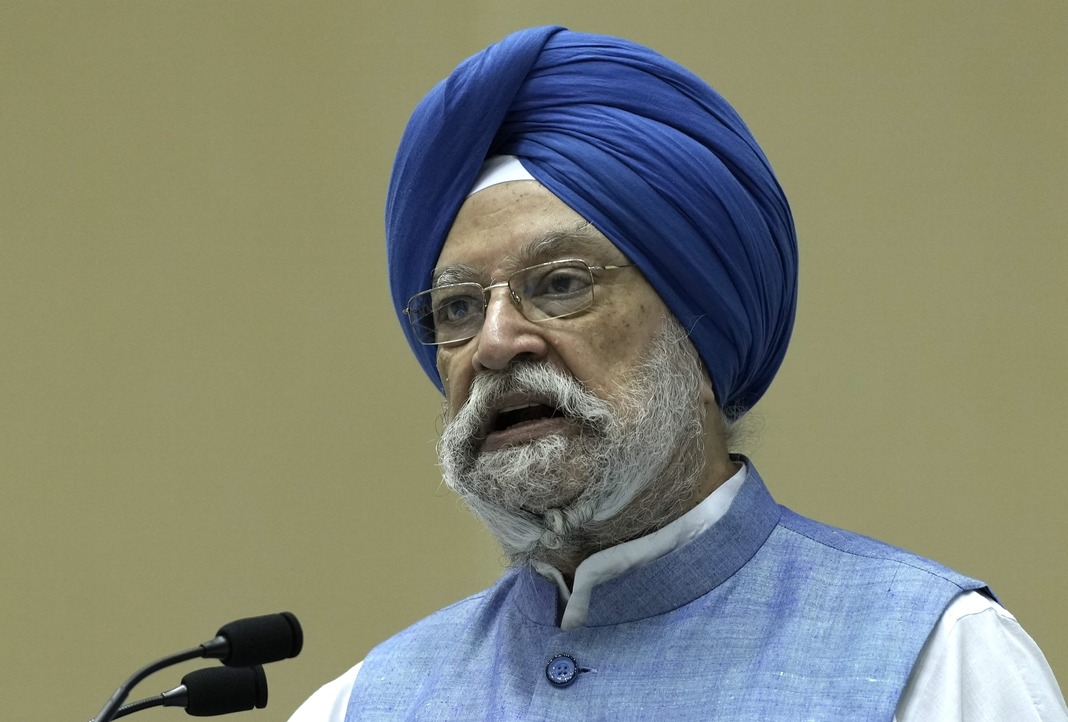

New Delhi, May 12: With two months of fuel stockpiles, India faces no supply concerns despite disruptions to global energy flows, Oil Minister Hardeep Singh Puri on Tuesday said, while warning that state-run fuel retailers face losses of as much as Rs 1 lakh crore in a single quarter if elevated crude prices persist and retail fuel prices remain unchanged.
He said that at some stage an assessment needs to be made on how long retailers can sustain losses from selling petrol, diesel and cooking gas LPG below cost, but refused to speculate if rates would be raised anytime soon.
“We have no supply-side problems,” the minister said at CII’s Annual Business Summit here, adding that India began the crisis with “more than enough” crude oil and LPG inventories and had since ramped up domestic LPG production to 54,000 tonnes per day from about 36,000 tonnes previously.
At the same time, the minister acknowledged growing fiscal stress from keeping retail fuel prices unchanged.
“My oil companies are losing Rs 1,000 crore a day,” he said, adding that cumulative under-recoveries had climbed to nearly Rs 1.98 lakh crore and that a single quarter of losses of Rs 1 lakh crore could wipe out the sector’s annual profits.
Since the war broke out in West Asia 10 weeks ago, state-owned oil marketing companies (OMCs) have ensured uninterrupted supplies of petrol, diesel and cooking gas LPG at rates that are way below the cost, unlike many global energy systems that imposed rationing or passed through steep price increases.
This has resulted in the three OMCs – Indian Oil Corporation (IOC), Bharat Petroleum Corporation Ltd (BPCL) and Hindustan Petroleum Corporation Ltd (HPCL) – running record-high under-recoveries (the difference between benchmark international cost and retail selling price).
Puri said the combined under-recovery on petrol, diesel and cooking gas LPG is about Rs 1.98 lakh crore for the current quarter, while the actual loss is about Rs 1 lakh crore.
The losses in one quarter, he said, are enough to wipe out profits that oil companies earn in the entire year.
Without saying if widening losses could result in a price increase anytime soon, he said, “How long will the oil companies be able to take it (losses)… frankly, that’s something that worries me”.
Puri said there has been no increase in petrol and diesel prices in the last four years.
“Today, we are in a situation where we don’t know how long the blockades or counter-blockades will continue. But I can tell you categorically that today, we are in a situation where, unlike other countries in the world which have had to either face problems in terms of availability and supply or where prices have gone rampant, we have had stable prices and supplies.”
Despite a 50 per cent surge in input crude oil prices, petrol and diesel continue to be priced at a two-year-old rate of Rs 94.77 a litre and Rs 87.67 per litre, respectively.
Domestic cooking gas LPG prices were raised in March by Rs 60 per cylinder, but they are still way lower than the actual cost.
The oil companies are currently losing Rs 14 per litre on petrol, Rs 42 a litre on diesel and Rs 674 a litre on cooking gas LPG.
Puri termed Prime Minister Narendra Modi’s call for moderation in energy consumption as a “visionary” long-term approach rather than signalling imminent restrictions.
“It’s not that any lockdown is going to happen tomorrow,” he said.
“But if this (disruption due to war in West Asia) continues, we have to start thinking about measures to lessen the fiscal strain.”
He urged industries and households to accelerate the shift from LPG to piped natural gas where possible, saying India was rapidly expanding gas pipeline infrastructure and LNG availability.
“We have no shortage of pipe gas,” he said.
“It is cleaner, cheaper and helps us scale up the energy transition.”
The government is also reassessing strategic energy storage policies after the current crisis exposed vulnerabilities in global supply chains, the minister said, adding that India would need to build larger reserves over time.
“The experience since February 2026 means you have to rethink everything,” he pointed out.
Modi had on Sunday urged for fuel conservation and lower imports as surging global energy prices pressure India’s foreign exchange reserves, while also calling for restraint in gold purchases to ease external vulnerabilities.
“The Prime Minister’s statement is very visionary. It looks to the future – that if this (war) were to continue, we also have to (see) what we can do in terms of life changes,” Puri said.
“There are certain activities which we can curtail.”
This, he said, does not mean any drastic thing like lockdown or rationing was to happen. “There is absolutely no cause for anxiety.”
The minister said India has done well in managing the situation, considering the large magnitude of dependence on Gulf supplies that it had in the pre-war era.
These had been quickly replaced with sourcing from alternate places without any disruption or dryouts.
“We have done very well, and I have no reason to believe that we will not do well in the future. But, we should (curtail) certain activities” that can help reduce consumption, he said.
Puri said India had turned the crisis “into an opportunity”, ensuring uninterrupted fuel supplies even as geopolitical tensions raised concerns over the Strait of Hormuz, through which nearly 20 per cent of global energy supplies transit.
India, the world’s third-largest oil consumer, is also the third-largest refiner and fourth-largest exporter of refined products, he said, pushing back against what he described as “false narratives” around shortages, import disruptions and possible lockdowns.
“There are no shortages anywhere,” he said. “Every petrol pump in the country has had petrol and diesel. LPG supply is more than enough.”
The minister said India had not raised fuel prices in the last four years despite global energy shocks and elevated crude prices, describing it as an unprecedented achievement among major energy-importing economies.
“Tell me one country where prices have remained the same, and there has been no shortage anywhere,” he said.
The remarks come as global crude prices surged amid uncertainty over shipping disruptions and escalating regional conflict.
The minister said around 60 per cent of India’s LPG imports had previously moved through the Strait of Hormuz, while 88 per cent of the country’s crude oil requirement is imported.
He said the government and state-owned oil companies had been conducting continuous “war-room” reviews of supply and refining operations, with officials monitoring the situation “hour by hour”.
India currently holds around 60 days of crude oil supplies, 60 days of LNG inventories and 45 days of LPG reserves, he said, adding that there was “absolutely no cause for anxiety”.
Fuel demand has remained resilient during the crisis, with petrol consumption rising around 6 per cent, while LPG demand has moderated to about 75,000 tonnes per day from nearly 90,000 tonnes earlier, partly because of seasonal factors.
The minister said refiners had increased LPG output while supplementing supplies through kerosene and biofuels, helping India reduce dependence on imported cooking gas.
“We are no longer import-dependent on our refineries, and that is where our strength has come from,” he said.
India plans to expand refining capacity to 320 million metric tonnes annually by 2030 from around 260 million currently, positioning the country as one of the world’s major refining hubs, the minister said.
He also signalled a more aggressive push toward domestic oil and gas exploration, saying the government has amended exploration rules, increased outreach to global oil majors and expanded acreage offered under exploration licensing rounds. (PTI)