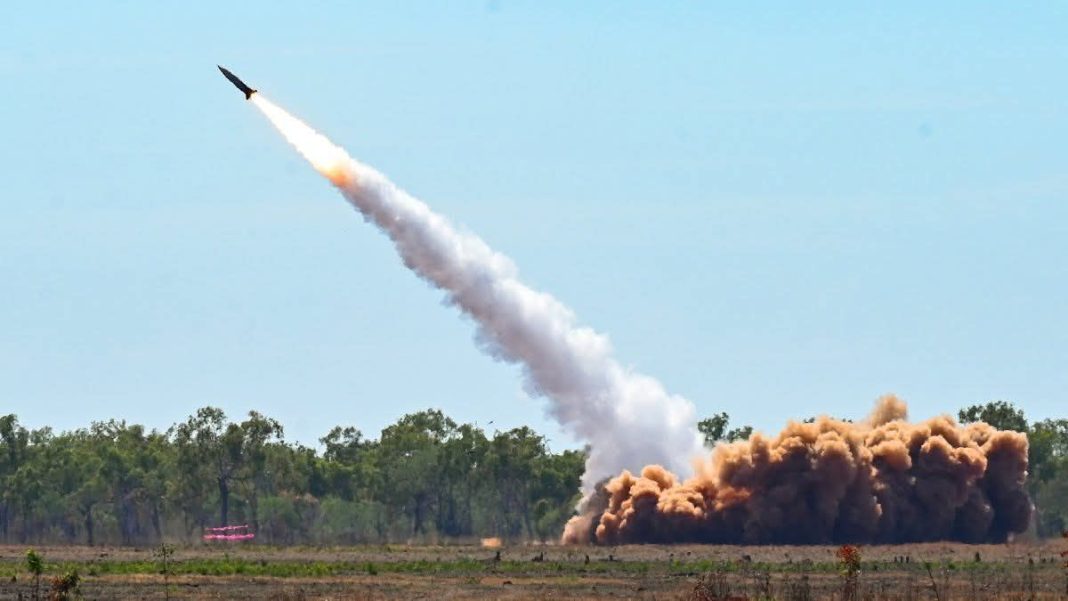

Dubai, Apr 3: Iran fired missiles at Israel and some Gulf nations, setting alight a refinery in Kuwait, while explosions could be heard around Tehran and the central Iranian city of Isfahan on Friday, as the United States prepared to further reinforce its already significant military forces in the Middle East.
As the war that began Feb. 28 was to enter its sixth week, Israel, Bahrain, and Kuwait warned about incoming missile fire, although it was unclear if anything was struck. Activists reported strikes around Tehran and the central city of Isfahan, but it wasn’t immediately clear what was hit.
Iranian drones struck Kuwait’s Mina al-Ahmadi oil refinery on Friday, sparking fires at the facility. The state-run Kuwait Petroleum Corp. issued a statement on the attack, the third so far since the war began, and said firefighters were working to control the blazes. There were no injuries reported, the company said.
Iran’s attacks on Gulf region energy infrastructure and its tight grip on the Strait of Hormuz, through which a fifth of the world’s oil and natural gas transits in peacetime, have sent oil prices skyrocketing.
Oil prices surged while Asian financial markets rose moderately during cautious trading. Benchmark US crude rose 11.4 per cent to USD 111.54 a barrel. The price of Brent crude, the international standard, jumped 7.8 per cent to USD 109.03 per barrel.
US President Donald Trump said US forces will keep hitting Iran “very hard” in the next two or three weeks.
The largest American aircraft carrier in service sailed out of Split, in Croatia and “remains poised for full mission tasking in support of national objectives in any area of operation,” the Navy’s 6th Fleet announced.
It was unclear where it was going. The USS Abraham Lincoln remains in the Arabian Sea, and the USS George H. W. Bush aircraft carrier departed Norfolk on Wednesday to head to the Mideast.
Former CIA director warns Strait could become we break it, you own it’
Former CIA director Bill Burns is warning that the crisis over Iran’s chokehold on the Strait of Hormuz could become a case of “we break it, you own it” for America’s allies.
Burns, a former State Department diplomat, made the observation in a podcast by Foreign Affairs magazine.
He noted US President Donald Trump could try a ground operation to take Iran’s Kharg Island, its main oil terminal, or territory along the strait, but both carry significant risks.
“Then there’s the third option, which is effectively declaring victory and the inversion of the old Colin Powell Pottery Barn rule, which was we break it, we own it,’” Burns said, referencing a comment attributed to former US Secretary of State Colin Powell before the 2003 US-led invasion of Iraq.
“Instead, it would be, we break it, you own it, and it’s over to you guys,’ whether it’s European allies or Gulf Arabs or anybody else to ensure safe passage through the Strait of Hormuz.”
Former CIA director calls Iran campaign a war of choice’
Former CIA director Bill Burns has described the US-Israeli war launched against Iran as “a war of choice” that may have only further empowered the most hard-line elements within its theocracy.
Burns, a former State Department diplomat, made the observation in a podcast by Foreign Affairs magazine.
“This is a regime that is inept at many things like managing its economy, but it is designed to preserve itself and designed to repress its own people and designed to withstand even the decapitation of its senior leadership,” said Burns, who secretly negotiated with the Iranians ahead of the 2015 nuclear deal with world powers during the Obama administration.
Burns also disagreed with US President Donald Trump’s assessment that there had been a “regime change” in the airstrike campaign killing top leaders, including Supreme Leader Ayatollah Ali Khamenei.
“In some ways, it’s certainly a much weaker regime, but it’s also one that’s even nastier and more radical and, you know, less open,” he said.
He added that Iran’s theocracy thought “victory is survival.”
“I’ve believed for a long time that this is a regime that’s on a kind of one-way street to its eventual collapse, but I worry that, you know, in this war, what we’ve done rather than accelerate that moment of collapse is slow it down a little bit,” Burns said.
French and South Korean presidents agree to help reopen the Strait
French President Emmanuel Macron and South Korean President Lee Jae Myung agreed Friday to work together to help reopen the Strait of Hormuz and ease global economic uncertainties caused by the war in the Middle East.
In a televised briefing after their meeting in Seoul, Macron underscored the need for France and South Korea to cooperate to help reopen the strait and de-escalate Middle East animosities.
Lee said the two affirmed “their resolves to cooperate to secure the safe shipping route in the Strait of Hormuz.”
The two leaders did not elaborate on how they would help reopen the strait and took no questions.
Macron was making his first visit to South Korea since taking office in 2017.
Bangladesh implements austerity measures
Bangladesh is curtailing office hours and enforcing early closure of malls and shops beginning Friday to handle its energy crisis related to the war.
The country’s cabinet ordered 30 per cent spending cuts for fuel and power at government offices, suspended some staff training and stopped purchases of new vehicles, ships and aircraft. Decorative lighting will not be allowed for celebrations.
Bangladesh, a nation of more than 170 million people, is seeking alternative fuel sources and USD 2.5 billion in external financing for imports, which account for 95 per cent of its fuel.
Australia urges weekend motorists to refuel in cities
Australian Energy Minister Chris Bowen on Friday urged motorists getting away for a long weekend during the Easter holiday to fill up in cities because most of the nation’s fuel shortages are in rural areas.
Among 2,400 gas stations in New South Wales, Australia’s most populous state, 182 had run out of diesel by Friday.
In Australia’s second-most populous state, Victoria, 76 gas stations were out of diesel. In the remaining states, ranked by the most populous first, Queensland had 75 stations without diesel, Western Australia had 37, South Australia had 28, and in Tasmania, there were seven.
“For those Australians planning a road trip this weekend, given our shortages are predominantly in rural and regional Australia, it makes sense to fill up in the city to help the country if you can,” Bowen said in Sydney.
The government, which blamed regional shortages on panic buying and distribution problems, is concentrating on delivering fuel to farmers for planting crops. (AP)