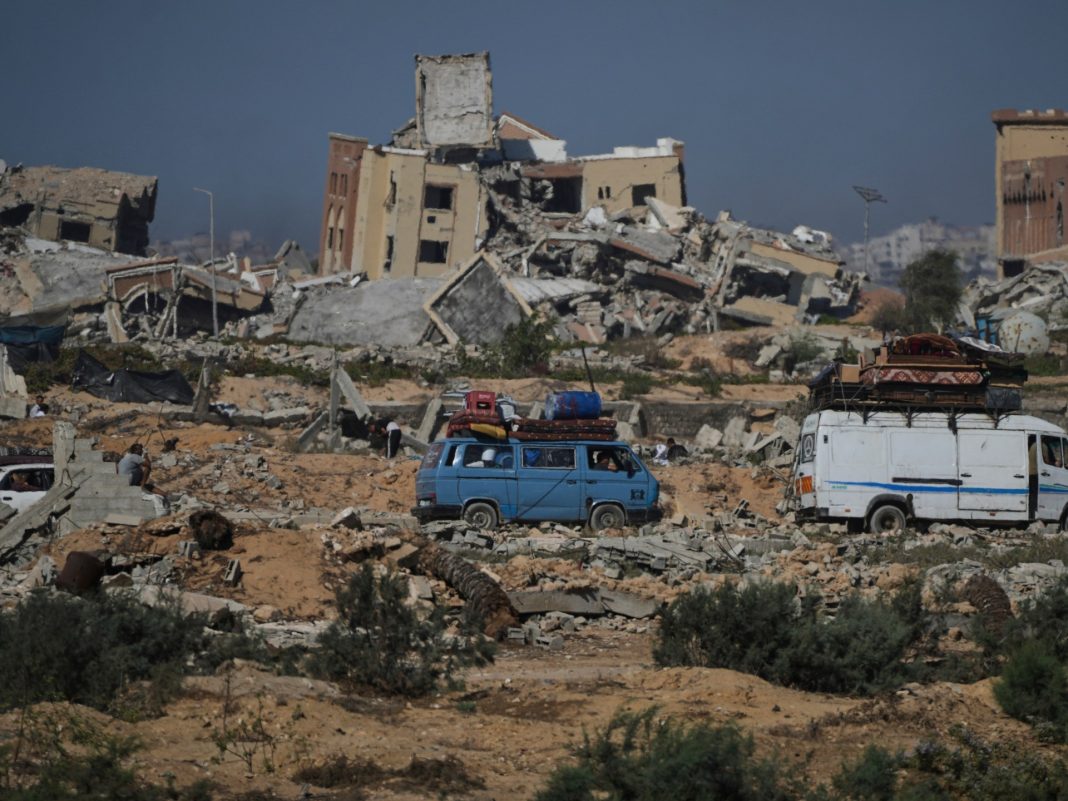

Sderot (Israel), Oct 6: One by one, Israelis peered through the tourist-style binoculars at the shattered Gaza town of Beit Hanoun, a distance of several football fields away, where buildings tilted in the rubble like broken teeth. The only noticeable movement was dust kicked up by Israel’s military.
The Israelis squinted for a few moments and gestured others over. The lookout is a rare place where they can confront the Palestinian territory firsthand, and some celebrate its devastation.
An Israeli documentary released this year included one onlooker exclaiming, “Wow, destroyed beautifully.” The Associated Press heard similar sentiments there.
On October 7, 2023, Hamas-led militants killed some 1,200 people in southern Israel and abducted 251 others, leading to a devastating war and, eventually, a fragile ceasefire.
Three years on, a visit to the communities attacked that day made clear: It’s too soon for many residents to see the Palestinians next door as anything other than a threat.
Barbecue reminds one woman of the smell of ‘hell’
The highway running parallel to Gaza, where militants gunned down people trying to flee, is dotted with memorials. Victims’ smashed and bullet-pocked cars are assembled elsewhere, rusting and piled a half-dozen high. Portraits of young female military spotters, whose warnings about a potential attack were disregarded, mark their deaths that day.
One resident, Deganit Bar Hay, said she still can’t barbecue because the smell of burnt flesh — “the smell of hell” — is a trigger.
Globally, there is shock and condemnation over how Israel has conducted the war, and how Gaza remains in ruins and cut off from the world a year since the ceasefire. Over 74,000 Palestinians have been killed, according to Gaza’s Health Ministry, and the vast majority of its 2 million residents live in rat-infested tent camps or among the debris.
But empathy for them is still unthinkable for many in Israel, with memories raw. Israeli media report little on the Palestinians of Gaza, and Israelis rarely if ever hear their voices unless they seek them out.
A new Israeli documentary, “NAZA,” in which military insiders describe what they said was the systemic killing of Palestinian civilians in Gaza, has sparked outrage at the filmmakers, not the government. Everywhere in Israel — at train stations, beaches, the Gaza viewpoint — are dozens of stickers in memory of the hundreds of soldiers killed on Oct. 7 and in the ensuing war.
“We are post-traumatic, all of us,” said Ziporah Livneh, outside a cafe catering to tour groups and soldiers a short drive from Gaza. Much of her family died in the Holocaust, and she came to Israel at the age of 2.
Now, she said, the answer for Gaza is to keep believing in people’s humanity but respond strongly to acts of evil. A society and a country can’t be built on revenge, but for the world to think “we can be Mother Teresa, it is a hypocrisy.”
‘Many people around the globe don’t understand us’
Many Israelis are still turned inward. They say their story isn’t being heard or understood. They assert that Palestinians in Gaza receive more attention, even as Israel’s government still prevents journalists from entering the territory except under rare, highly managed visits — and very few Palestinians can leave.
From the day the war began, Israeli news and hearts were focused on the dead and the hostages taken into Gaza, a land that despite being an hour’s drive from Tel Aviv has long felt remote. Cross-border contact had been severely limited since Hamas seized power in 2007. Then, on Oct. 7, militants ripped the fence apart.
This is the first anniversary since the attack that all remaining hostages are out of Gaza, alive or dead.
There is rebuilding in the Israeli communities where militants went home to home, burning and shooting. There is also the insistence on keeping Oct. 7 memories alive, with hope that the outside world will come to understand how Israel’s sense of security was smashed.
“I know many people around the globe don’t understand us,” said Mor Izreal, director of an Oct. 7 virtual reality exhibit in the border city of Sderot. She said over 10,000 people have visited since it opened a year and a half ago, most from overseas. Reactions range from sadness to rage to connectedness, she said.
The first election since the war brings fresh anger
This year, for the first time since the attack, there is also an election, a momentous and angry one.
Prime Minister Benjamin Netanyahu’s government is deeply divisive. Many Israelis accuse him of failing to prevent the Oct. 7 attack and not securing the hostages’ release sooner, before many of them were killed. He is also accused of corruption and threatening democratic institutions.
But there has been little criticism of how his government has treated the Palestinians in Gaza, where Israel’s military now controls over 60 per cent of the territory, squeezing them into an ever-smaller space.
Next to a bullet-pocked rocket shelter outside Sderot, a man held a banner calling for an official inquiry into the security failures surrounding the Oct. 7 attack. Netanyahu has long resisted one.
Amit Gurfinkel said he spent Oct. 7 in a safe room with his daughter in the nearby community of Netivot, holding a knife and expecting the worst.
Gurfinkel is a minority in a population that has long supported Netanyahu. Posted across Sderot are campaign banners for his far-right allies, Bezalel Smotrich and Itamar Ben Gvir — the national security minister who has called for killing “30 to 40” people in targeted assassinations in Gaza each night.
Security is paramount, especially in Sderot, where residents have just 10 seconds to seek shelter when rockets are fired from Gaza. But Gurfinkel sees Israel’s reputation as crucial, too. He shook his head over the passing drivers who shouted their support for Netanyahu, whose government is isolated over the destruction in Gaza and who has been indicted by the International Criminal Court.
“This is pathological. I don’t know,” Gurfinkel said. “Sociologists and psychologists will have answers in the years to come.”
There is little discussion of Palestinian civilians
Some Israelis argue there are no real civilians among Palestinians in Gaza, pointing to Hamas’ entrenchment. Some Palestinians feel the same way about Israelis, noting that military service is mandatory for most Jewish men and women.
“Death to Arabs” is written inside a rocket shelter across from the Sderot police station that was besieged and then destroyed. “Hamas is still in Gaza” is scrawled on a guardrail on the highway where bodies spilled from vehicles on Oct. 7. “Make Gaza Jewish Again” is on a banner in a public square in Jerusalem’s Old City.
There is little public discussion about how everyday Palestinians are doing after three years of war.
“I think about them, and it’s complicated,” Adi Marmelstain said of the people in Gaza. She was visiting the sprawling memorial for the Nova music festival, where hundreds of people were shot dead on Oct. 7.
Her 20-year-old daughter, a member of the security forces like many young Israelis, stood in shorts and a tank top, her rifle slung across her. Both knew people who had been killed.
Marmelstain recalled waking up another daughter on Oct. 7 and sending her to war with bottled water and cookies. She later asked herself what she had been thinking. Three years later, life is not much easier to contemplate.
The world doesn’t see Israel in the right light, she said. And the Palestinians in Gaza?
“I think they have the right to live, but they choose not to,” she said. (AP)