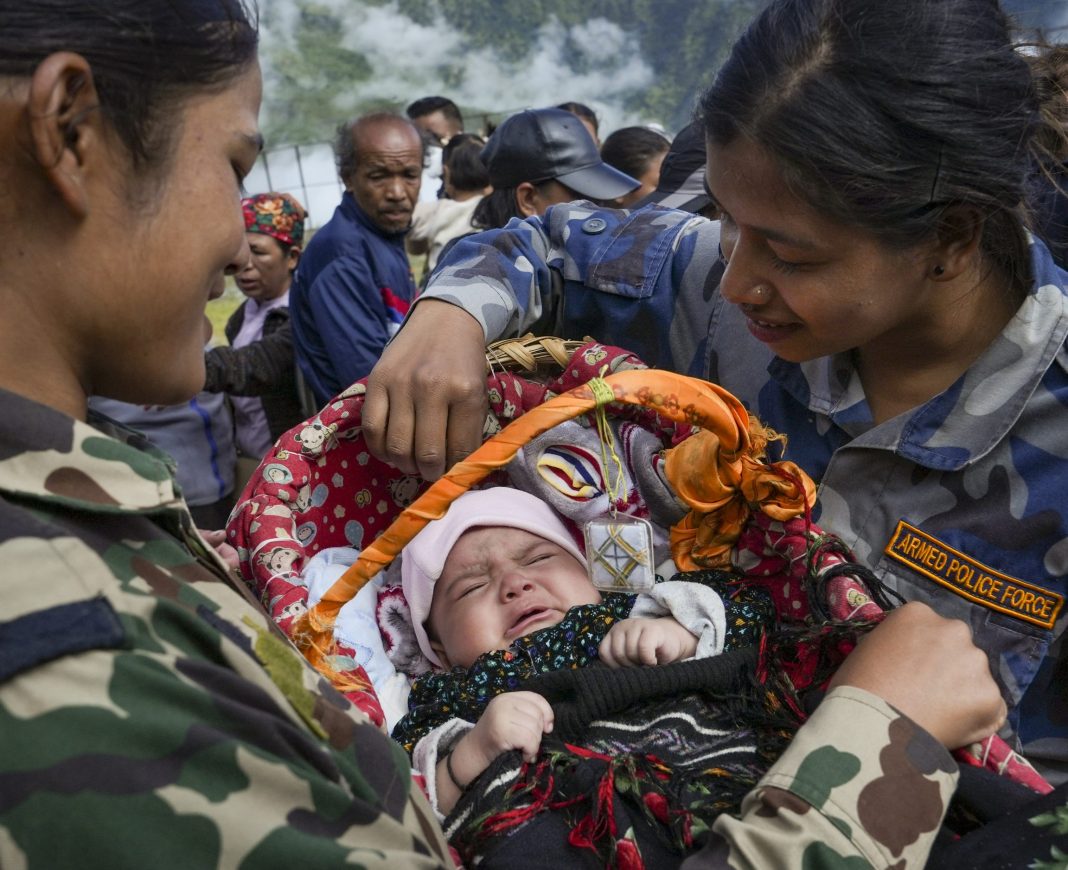

Kathmandu, Sep 1: Children waking from nightmares believing the flood has returned, adults struggling with fear and anxiety, families separated by raging waters desperately trying to find one another — Nepal’s devastating floods have left behind a psychological toll that is only now beginning to emerge.
As the country grapples with its deadliest floods in a decade, mental health workers are seeing the first signs of a trauma that is less visible than the destruction around them.
With the death toll crossing 900 and nearly 4,000 people still missing, the trauma of loss, displacement and uncertainty is settling in among thousands of survivors, prompting the government to step up its mental health response.
To address the psychological impact of the disaster, the government has deployed around 50 psychiatrists, psychologists and psychosocial counsellors across the worst-hit Rasuwa and Nuwakot districts, The Kathmandu Post newspaper reported on Tuesday, quoting officials.
Another 64 trained counsellors are on standby in Bagmati Province as authorities prepare for a potentially prolonged need for psychosocial support, the report said.
The response is being stepped up at a time when more than 11,000 people have been rescued and entire settlements, homes, roads and bridges have been destroyed by the floods.
Mental health professionals involved in the response said Psychological First Aid (PFA), which is generally introduced after the immediate phase of a disaster, is now beginning in the worst-affected areas.
Pomawati Thapa, senior consultant and medical generalist at the Department of Health Service, said about 10 of the 50 professionals deployed in Rasuwa and Nuwakot are directly providing PFA, while a four-member team has been sent to Uttargaya in remote Rasuwa, an area without road access.
The department has prepared a deployment plan and is coordinating placements to areas where support is required, she said.
The initial response was focused on PFA and volunteer mobilisation while officials assessed the situation on the ground. As the scale of the disaster and needs of affected communities became clearer, the Health Ministry expanded the deployment, Thapa said.
The response is being supported by organisations including the Nepal Red Cross Society, the Centre for Mental Health and Counseling Nepal, and several other NGOs.
The government has also expanded access to psychosocial support through telephone helplines.
Ministry of Health and Food Safety deputy spokesperson Samir Kumar Adhikari said the 1115 hotline provides general health counselling and coordination, with staff working on the line also trained to provide basic psychosocial support following the increased need after the floods.
A dedicated psychosocial service is available through 1166, operated from Patan Mental Hospital. Calls are routed there irrespective of where they originate and connected to psychosocial counsellors. Seven counsellors currently work in rotation to provide round-the-clock services, Adhikari said.
The ministry is also facilitating the 1098 Child Helpline.
On the ground, however, mental health professionals say most survivors are still in the early stages of coping with the disaster and formal counselling has barely begun.
Psychologist Gopal Bohara, who is working with a four-member psychosocial team from the Centre for Mental Health and Counseling Nepal in Bidur, Nuwakot, said survivors were displaying visible signs of shock and distress.
“Most of them are currently in shock, unable to articulate their problems,” Bohara said.
Two children at the holding centre have repeatedly woken up at night, experiencing nightmares and crying out that the flood has returned, he said.
Adults have shown anxiety, heightened fear and an exaggerated startle response, Bohara said.
His team, comprising two psychologists and two psychosocial counsellors, is working alongside medical teams and coordinating with local health authorities.
Psychiatrist Nirajan Bhattarai, part of a Health Ministry team deployed in Bidur Municipality, said immediate priorities remained safety, basic needs and coordination.
“Safety and basic needs have to come first,” he said.
His team is providing emergency medication to people whose psychiatric treatment was disrupted by the flood and those suffering from severe sleep disturbances. PFA and other interventions will follow as the immediate crisis stabilises.
For now, much of the work involves reconnecting families, linking survivors with services and helping them access shelter and medical care rather than formal counselling.
Bhattarai said many adults were reluctant to interact with responders, while children appeared more willing to engage.
Mental health professionals caution that the psychological impact could become more visible only after the immediate crisis has passed.
Bohara said survivors were coping not only with fear and grief but also with the loss of their communities.
For now, mental health workers say the focus remains on keeping survivors safe, reconnecting separated families, restoring access to psychiatric medication and providing PFA. (PTI)