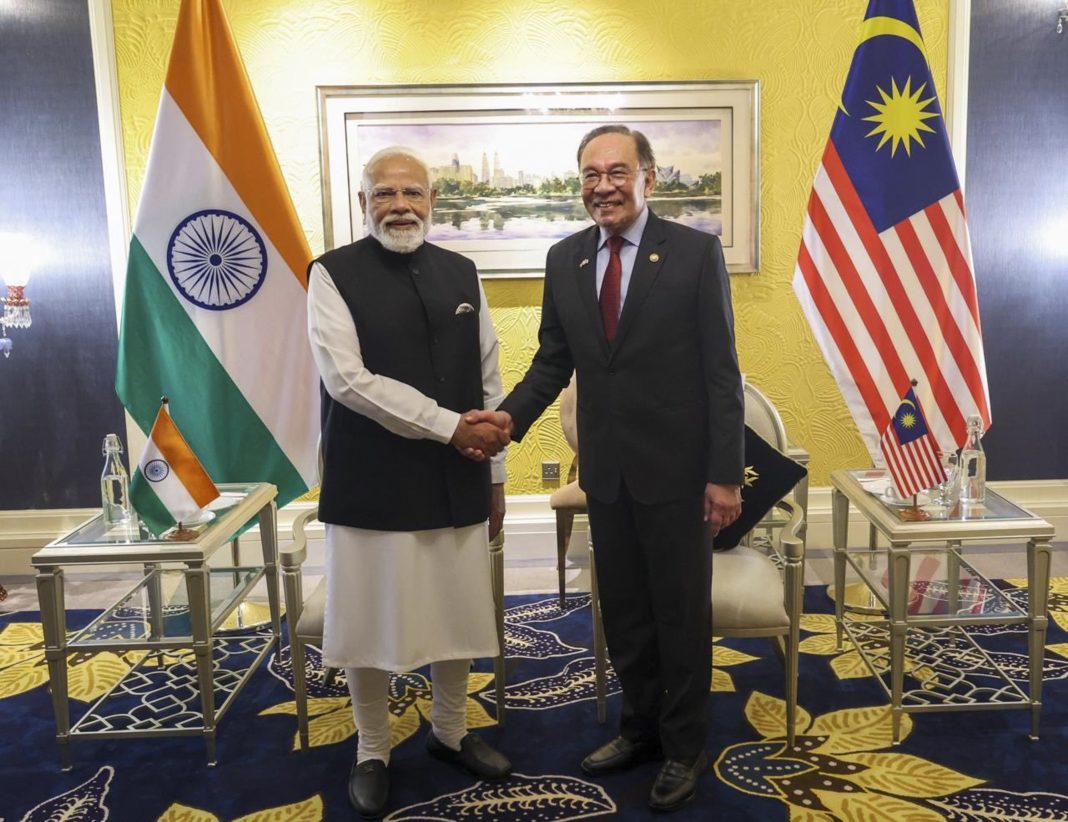

Kuala Lumpur, Feb 8: India and Malaysia on Sunday vowed to expand their ties in the high-priority sectors of trade and investment, defence, energy, advanced manufacturing and semiconductors with Prime Minister Narendra Modi asserting that both sides are committed to peace and stability in the Indo-Pacific.
Following his wide-ranging talks with Malaysian Prime Minister Anwar Ibrahim, Modi reiterated India’s position on combating terrorism as he said: “Our message on terrorism is clear; no double standards, no compromise.”
The two sides inked a total of 11 agreements and documents to expand cooperation in a range of key areas, including a framework pact for deeper engagement in the semiconductor sector.
Both Modi, who arrived in Kuala Lumpur on Saturday, and Ibrahim appreciated efforts to promote the usage of local currencies — the Indian Rupee and Malaysian Ringgit — for trade settlement.
“We will pave the way for economic transformation through strategic trust,” Modi said, describing the India-Malaysia relationship as “special”.
“We are maritime neighbours. For centuries, our peoples have had deep and cordial ties,” he said in his media statement.
Modi also announced India’s decision to establish an Indian Consulate General in Malaysia.
In his remarks, Ibrahim noted India’s economic growth and said his country would benefit immensely if it could secure more ways and opportunities to collaborate with New Delhi.
“It (India’s economic growth) is one spectacular rise in the international eco and trade scene,” he said, describing the decision to use local currencies for bilateral trade as “remarkable”.
In the talks, Malaysia extended its support for India’s permanent membership in a reformed UN Security Council.
Elaborating on engagement in the security domain, Modi said cooperation in counter-terrorism, intelligence sharing, and maritime security will be strengthened, adding that both sides will further expand defence ties.
“Along with AI and digital technologies, we will advance partnerships in semiconductors, health, and food security,” he said, noting that the discussions at the CEO Forum opened new opportunities for trade and investment.
The prime minister touched upon India’s position on Indo-Pacific and its steadfast views on the 10-nation grouping ASEAN’s centrality in the region.
“The Indo-Pacific region is emerging as the world’s growth engine. We, along with ASEAN, are committed to development, peace, and stability throughout the Indo-Pacific region,” he said.
“With the support of friendly countries like Malaysia, India will further expand its relations with ASEAN ( Association of Southeast Asian Nations). We agree that the review of the ASEAN-India Trade Agreement, ITIGA, should be completed expeditiously,” he added.
Modi said he and Ibrahim also had a “meaningful discussion” on regional and global issues.
“In this environment of global instability, the growing friendship between India and Malaysia is of vital importance to both countries.”
“We share the view that reform of global institutions is essential to address today’s challenges. We will continue to support all efforts for peace. And our message on terrorism is clear: No double standards; no compromise,” he added.
“We appreciate your commitment to India-Malaysia relations. Let us together realise your dream of a prosperous Malaysia and our resolve for a developed India,” he said.
The two prime ministers also “unequivocally and strongly condemned” terrorism in all its forms, including cross-border terrorism and called for “zero tolerance” of terrorism, according to a joint statement.
The two leaders also called for concerted global efforts to combat terrorism in a comprehensive and sustained manner and agreed to work towards countering radicalisation and violent extremism.
They also resolved to work towards combating financing of terrorism, prevent use of new and emerging technologies for terrorist purposes.
The two leaders reaffirmed commitment to strengthen bilateral and multilateral cooperation in countering terrorism, including in the UN and FATF(Financial Action Task Force), the statement said.
Modi and Ibrahim also agreed to strengthen cooperation in multilateral fora, including at the UN, and support reforms of international institutions.
“They pledged to work together to enhance multilateralism, reflective of contemporary realities so as to make international organisations, including the UN Security Council (UNSC), more representative,” the joint statement said.
“Reflecting the strong spirit of mutual support in multilateral forums, the two Leaders discussed mutual support for various international candidatures. India deeply appreciated Malaysia’s support for India’s permanent membership in a reformed UNSC,” it said. (PTI)