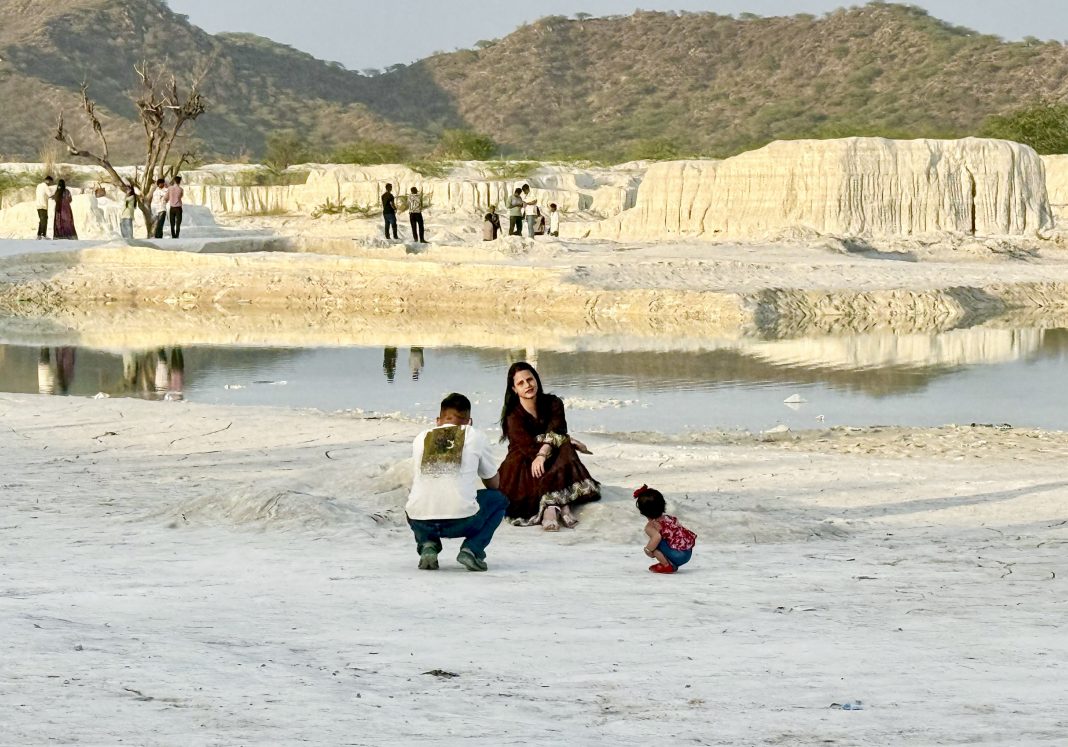

Kishangarh (Raj), March 29: Endless white plains glowing under the sun, no pine trees, no chill in the air, yet the scenery looks straight out of a winter postcard. Many confuse it for Bolivia’s Salt Flats, snow-clad Gulmarg or even picturesque Switzerland.
This scenic location, which has become a popular reels destination, is Asia’s largest marble waste dumping yard in Kishangarh in the Ajmer district of arid Rajasthan.
The dumping site, where over 700 tankers carrying around 22 lakh litres of marble slurry are emptied every day, attracts at least 5,000 visitors on a daily basis, with the footfall going up to 20,000 on weekends and holidays.
Due to its pristine white appearance, the dumping yard, spread over 350 acres, has also become a popular destination for pre-wedding and commercial shoots. Environmentalists and health experts, however, have flagged it as not just a health hazard but also a pollution hotspot.
Scientific studies conducted by the Central University of Rajasthan have flagged it as a “toxic tourist destination”, documenting the health and ecological impacts of this unregulated dumping. The concerns also reached the National Green Tribunal (NGT), which set up a joint committee, including members from the state and the Central Pollution Control Board.
“Despite its scale and impact, the dumping yard is being operated in rampant violation of basic environmental safeguards. There is no engineered liner system, no decanting wells, no dust suppression mechanisms, no monitoring of air or groundwater, and no protective green belt.
“These failures have led to severe contamination of groundwater, degradation of agricultural land and high levels of fugitive dust pollution, thereby endangering public health,” Laxmi Kant Sharma, an Environmental Science professor at Central University of Rajasthan, told PTI.
Sharma noted that the university’s studies have found that the toxic contamination of water sources in the vicinity is reflected in total dissolved solids escalating 10 times the safe limit in a 6-km radius of the dumping site.
“The concentration of lead silicate in soil and nitrate and fluoride concentrations in water were found several times higher than normal, indicating extreme contamination. Our study also found that the concentration of PM 2.5 exceeds the limit of ambient air quality standards for PM 2.5,” he said.
“Since the waste particles are smaller than 75 micrometres, they can spread far and wide, making the soil infertile. Several people may be suffering from silicosis. The government needs to take immediate action to prevent the situation from getting out of hand,” he added.
The Kishangarh marble industry was established in the 1980s. Some 30 years ago, the Rajasthan State Industrial Development and Investment Corporation (RIICO) allotted two dumping plots to the Kishangarh Marble Association (KMA). And that is when the first marble waste was dumped here, and the slurry accumulated to the extent that it formed white plateaus and mountains.
Today, there are over 1,200 marble cutting units in the city.
For years, nobody paid attention. The location shot into the limelight after comedian Kapil Sharma shot a song here for his debut film “Kis Kisko Pyaar Karoon” in 2016.
Then, more and more celebrities started turning up. Nora Fatehi shot her song “Chhor Denge” here, Honey Singh and Nushrratt Bharuccha came for the “Saiyaan ji” music video, and Tiger Shroff and Shraddha Kapoor shot the song “Dus Bahane” for Baaghi 3.
The place also caught the attention of pre-wedding photographers, who started bringing couples here to capture them against the white landscapes and blue ponds.
The KMA came up with an innovative model of turning the dumping yard into a tourist destination, which also has a helipad now.
While entry for visitors is free, they do need to obtain a pass from the KMA office, about a kilometre away. A visitor entering with a single digital camera must pay Rs 500, a pre-wedding shoot costs Rs 5,100 a day and a commercial shoot costs up to Rs 21,000 a day.
“The revenue is used to maintain the dumping yard. We have made changing rooms for those coming for shoots. There is a helipad too. There are restaurants and options for recreational activities. The dumping yard has put Kishangarh on the national tourism map,” said KMA president Sudhir Jain. (PTI)