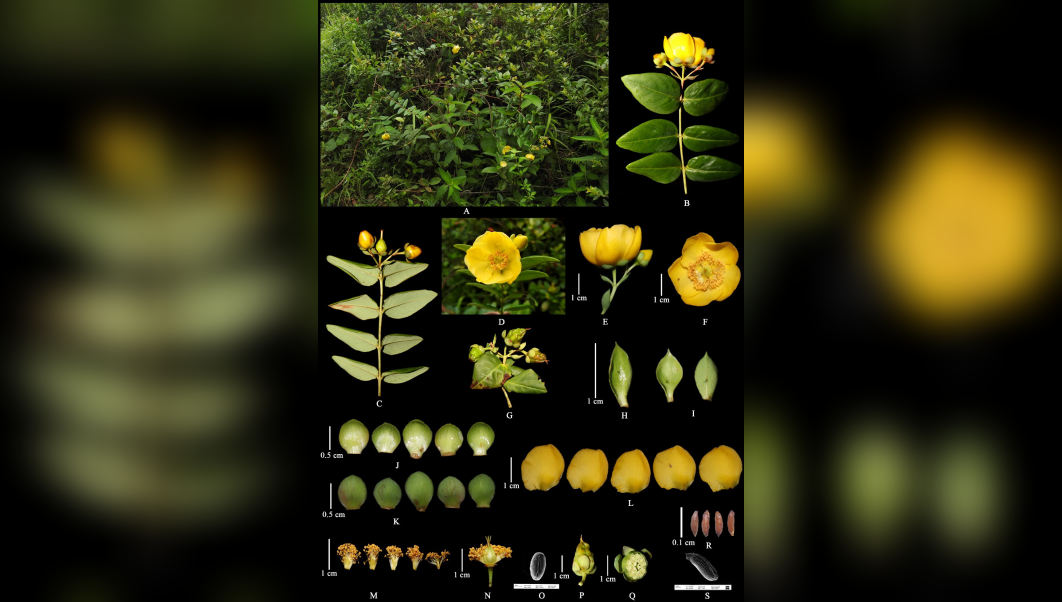

Guwahati, Dec 15: In a remarkable botanical breakthrough, scientists have rediscovered Hypericum lobbii, a rare flowering plant endemic to Meghalaya, more than 133 years after it was last recorded by science. The plant was found growing in Mawphlang in East Khasi Hills—the same locality where it was first collected in the late 19th century—marking one of the most significant rediscoveries of an endemic species in the region in recent decades.
The rediscovery was made by researchers from the Botanical Survey of India (BSI), Eastern Regional Centre, Shillong, during field surveys conducted in 2022 and 2023. Until now, Hypericum lobbii was known only from its original “type collection” made by British plant collector Thomas Lobb in the 1890s. Despite more than a century of botanical exploration in the Khasi Hills, the species had never been recorded again—leading many botanists to fear it may have vanished altogether. The research team comprised of Harekrushna Swain, Yalatoor Mahesh, Ramalingam Kottaimuthu under the leadership of Deepu Vijayan.
The genus Hypericum L. is represented by 26 species in India with largest concentration in Himalayas of which 13 species are found in Meghalaya.
The findings have been formally reported in a peer-reviewed scientific journal, confirming that the species still survives, albeit in an extremely restricted range. According to the researchers, the newly found population consists of only around 30–40 individual plants located within a radius of about one kilometre on grassy slopes near forest patches at elevations between 1,700 and 1,900 metres in Mawphlang.
Belonging to the genus Hypericum—globally known for species with medicinal value, including antidepressant properties—Hypericum lobbii is a shrub with striking golden-yellow flowers that bloom between April and June. Fruiting occurs later in the year, from October to November. While other species of Hypericum are widespread across the Himalayas and beyond, H. lobbii is a strict Meghalaya endemic, found nowhere else in the world.
Scientists have cautioned that the rediscovery, while encouraging, also highlights the plant’s vulnerability. The species is currently known from a single location, making it highly susceptible to habitat disturbance, land-use change and climate-related pressures. Due to insufficient historical data on population trends, the plant has been categorised as “Data Deficient,” but researchers stress that priority conservation attention is urgently needed.
The discovery once again underscores Meghalaya’s extraordinary botanical richness and the global importance of its hill ecosystems. Conservationists say it also reinforces the need to protect ecologically sensitive areas such as Mawphlang, which is already renowned for its sacred groves and cultural heritage.
Researchers have recommended seed collection and long-term monitoring to safeguard the species, warning that without timely intervention, this rare plant—rescued from obscurity after more than a century—could easily slip back towards extinction.