
By Dipak Kurmi
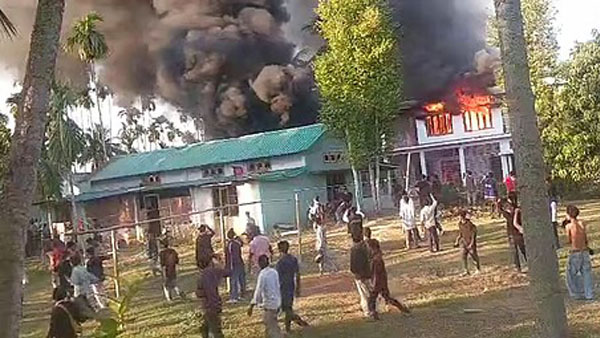
The recent eruption of violence in West Karbi Anglong over the non-eviction of settlers from Professional Grazing Reserve and Village Grazing Reserve land has exposed the fragile underpinnings of land governance in Sixth Schedule areas of Assam. What began as a protest demanding the removal of alleged illegal settlers rapidly degenerated into violent clashes between sections of the Karbi community and non-indigenous residents. Arson, mob attacks, and a serious breakdown of law and order followed, culminating in the burning of the residence of Karbi Anglong Autonomous Council Chief Executive Member Tuliram Ronghang at Dongkamukam and the torching of shops and houses in Kheroni market. That police and paramilitary forces were compelled to resort to firing and lathi charge to control the situation reflects not merely a momentary lapse in order, but the depth of accumulated anger and institutional failure simmering beneath the surface.
At the heart of the agitation lies the emotionally charged and historically sensitive issue of land alienation of indigenous communities. For the Karbi people, PGR and VGR lands are not abstract legal classifications but essential community resources tied to cattle rearing, subsistence, and cultural continuity. These lands symbolise indigenous security in a region where demographic change and economic pressures have long generated anxiety. Protection of grazing reserves is therefore perceived as inseparable from the protection of identity itself. Yet the present crisis also demonstrates that sentiment, however deeply rooted, cannot override constitutional processes and judicial oversight. The continued tension despite prohibitory orders and heavy deployment of security forces has underscored the urgent need for lawful, transparent, and inclusive resolution rather than coercive or impulsive action.
The immediate trigger for the violence was the circulation of rumours that protestors sitting on an indefinite hunger strike had been arrested. These protestors were demanding immediate eviction of settlers they alleged were illegally occupying PGR and VGR land. The rumour proved incendiary in an already volatile environment, fuelling suspicion and outrage. Chief Minister Himanta Biswa Sarma clarified that the hunger strikers had not been arrested but shifted to Guwahati Medical College and Hospital due to health complications. However, this clarification came after violence had already erupted, highlighting how misinformation can act as a catalyst in regions burdened by historical mistrust. Both the Chief Minister and KAAC CEM Tuliram Ronghang reiterated that immediate eviction was not legally feasible due to an interim stay imposed by the Gauhati High Court, stressing that the issue required dialogue rather than confrontation.
The events have reaffirmed a fundamental democratic principle that violence has no legitimacy as a means of redress. Karbi Anglong’s past is scarred by ethnic conflict, insurgency, and the killing of civilians, memories that remain uncomfortably close. Over the last decade, sustained efforts have been made to move the region away from armed conflict through peace accords, militant surrenders, and promises of accelerated development. Allowing present unrest to spiral unchecked would not only erode these gains but risk dragging the autonomous council areas back into instability and economic stagnation. Restoration of peace and normalcy must therefore be the immediate priority, without which even well-intentioned dialogue risks being rendered ineffective.
The legal roots of the crisis lie in the eviction order issued by the KAAC in February 2024, directing the removal of unauthorised occupants from PGR and VGR land across the council’s jurisdiction. The order cited Supreme Court directions to states to evict illegal occupants from land reserved for common use by villagers. Framed as a measure to protect indigenous rights and community resources, the order nonetheless encountered legal challenge. Petitioners approached the Gauhati High Court, contending that the lands they occupied were not legally notified as PGR or VGR. Taking cognisance of this claim, the High Court directed the KAAC to file an affidavit clarifying the notification status of the land and imposed an interim stay on eviction until such clarification was provided. The matter thus entered the judicial domain, rendering unilateral administrative action untenable.
This judicial intervention has placed the burden squarely on the KAAC to establish, with documentary evidence, the legal status of the contested land. The need for expeditious filing of affidavits and transparent disclosure of land records has become central to resolving the dispute within constitutional bounds. Beyond the immediate legal contest, however, the situation exposes a deeper malaise in land revenue administration within Sixth Schedule areas. If PGR and VGR lands were properly notified and protected, how did alleged encroachments persist, possibly for years, without timely detection or enforcement. This raises troubling questions about administrative oversight, land demarcation, record maintenance, and accountability within autonomous council governance.
The implications extend far beyond Karbi Anglong. Other Sixth Schedule areas in Assam, including the Bodoland Territorial Region and Dima Hasao district, possess similar grazing reserves and community lands vulnerable to encroachment due to weak enforcement and legal ambiguities. Without urgent reforms, clear notifications, updated land records, and institutional capacity building, disputes over common land could ignite comparable unrest elsewhere. In regions already marked by ethnic sensitivities, such conflicts carry the potential to destabilise fragile social balances.
The crisis also invites scrutiny of the functioning of the Sixth Schedule itself. Conceived as a constitutional safeguard by leaders such as Gopinath Bordoloi, the Sixth Schedule was intended to grant tribal communities real autonomy over land, culture, and resources. In practice, however, autonomy often exists more convincingly on paper than on the ground. Financial dependence on the state, administrative overrides, delayed approvals, and the presence of parallel authorities frequently constrain the effective exercise of council powers. This disjunction between constitutional promise and lived reality has fostered a sense of betrayal among many indigenous communities, who feel that autonomy has been diluted through procedural inertia rather than overt repeal.
For tribal societies, land and forest are not merely economic assets but the foundation of identity, inheritance, and survival. Continued pressure on these resources through encroachment, environmental degradation, and uneven governance deepens perceptions of injustice. When violations appear to persist without consequence, while protests are met with swift coercive response, confidence in the neutrality of governance erodes. India’s environmental jurisprudence, grounded in principles of public trust and intergenerational equity, recognises that natural resources must be preserved for future generations. Yet on the ground in Karbi Anglong, communities observe forests shrinking, water sources stressed, and ecological balance disturbed, often without meaningful consultation or transparency.
Cultural erosion compounds these anxieties. As land fragments and economic control shifts, customary practices weaken, languages recede, and younger generations feel increasingly unanchored. This erosion is gradual and quiet, but deeply corrosive. Autonomy under the Sixth Schedule was meant to preserve continuity and dignity, allowing communities to evolve on their own terms. When that autonomy weakens, cultural loss follows not through force, but through attrition.
Violence against police personnel and destruction of property, as witnessed in the recent unrest, cannot be justified under any circumstance and deserves unequivocal condemnation. At the same time, such incidents also reflect the burden placed on law enforcement to manage the consequences of long-standing policy failures. Police officers often become the most visible representatives of a state perceived as distant or inconsistent, absorbing public anger while structural issues remain unresolved. This dynamic is neither fair to the police nor sustainable for society.
Ultimately, the unrest in Karbi Anglong signals not a rejection of constitutional order but a plea for its faithful implementation. The people are not seeking privilege, but fidelity to constitutional safeguards, environmental protection, and commitments made in good faith. As calm is gradually restored, the deeper challenge will be whether long-standing grievances translate into timely, transparent, and credible action. Order can be imposed through authority, but trust can only be rebuilt through justice, consistency, and respect for the rule of law. Karbi Anglong’s present crisis stands as a warning that autonomy without effective governance breeds frustration, and development without trust invites instability. The choice before the administration is stark, and history will remember which path was taken.
(the writer can be reached at dipakkurmiglpltd@gmail.com)