
By Dipak Kurmi
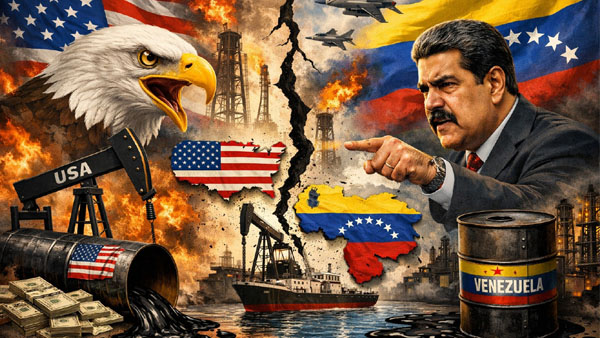
Oil has long been inseparable from geopolitics, and Venezuela stands as one of the most striking examples of how energy wealth can both empower and destabilise a nation. The recent capture of Venezuelan President Nicolás Maduro by the United States on January 3 has once again placed oil at the centre of international controversy. While Washington has publicly justified its dramatic intervention on political and legal grounds, it is difficult to ignore the central role played by Venezuela’s vast petroleum reserves. Soon after Maduro’s arrest, US President Donald Trump openly declared that the United States would take control of Caracas’s oil sector, promising that American oil majors would invest billions of dollars to revive a collapsing industry and repair infrastructure battered by years of sanctions, mismanagement, and economic crisis. The statement made clear what many analysts had already suspected: oil was not merely a background factor, but a driving force shaping Washington’s approach to Venezuela.
What Trump did not emphasise, however, is that the revival of Venezuela’s oil industry is neither quick nor straightforward. Years of underinvestment, compounded by sweeping US sanctions and a broader economic meltdown, have left the country’s oil infrastructure in a state of deep decay. Refineries, pipelines, storage facilities, and export terminals require massive capital infusion and sustained technical expertise to return to optimal functioning. Industry experts point out that even with the participation of the world’s largest American oil companies, it would take several years of continuous work before Venezuelan output could rise significantly. Moreover, despite Trump’s confident pronouncements, American oil majors themselves have so far remained silent on any concrete long-term commitments, suggesting that the political rhetoric may be running ahead of commercial realities.
The scale of Venezuela’s oil wealth makes this situation particularly striking. The country possesses the largest proven oil reserves in the world, estimated at over 300 billion barrels, roughly a fifth of global proven reserves. In comparison, Saudi Arabia, the world’s leading oil exporter, ranks second in terms of reserves. Yet Venezuela’s actual production tells a very different story. The country currently produces around one million barrels per day, a negligible figure when set against global oil output of over 100 million barrels per day. As a result, Venezuela accounts for less than one percent of global oil production, a staggering underperformance given its geological endowment. This disconnect between potential and reality lies at the heart of the current debate over the future of Venezuela’s oil sector.
One immediate question raised by Maduro’s capture is whether it will disrupt global oil markets. On this front, most experts are sceptical. Venezuela’s limited current production means that even sudden changes in its output are unlikely to have an immediate or dramatic impact on international oil prices. The global oil market is relatively well supplied, and demand growth remains subdued due to a combination of economic uncertainty, energy transition policies, and efficiency gains. This helps explain why recent US actions against Venezuela, including a blockade and the seizure of Venezuelan oil tankers, failed to significantly move global oil prices. Paradoxically, if the United States succeeds in exerting effective control over Venezuela’s oil industry and facilitating higher exports, the long-term effect could actually be bearish for prices, as additional supply enters an already well-supplied market.
For India, the world’s third-largest consumer of crude oil, the immediate implications appear limited. Indian refiners currently do not import Venezuelan crude, and with global prices unlikely to face sharp upward pressure in the near term, there is little reason to expect a direct shock to India’s energy bill. This is particularly important given that India depends on imports to meet over 88 percent of its oil needs, making it highly sensitive to price volatility. An oversupplied global market, combined with Venezuela’s marginal current role, suggests that New Delhi is well insulated from short-term disruptions arising from events in Caracas.
However, the longer-term picture could be more complex and potentially advantageous for India. If the Trump administration manages to secure a political arrangement with Venezuela’s new leadership that leads to the easing or removal of sanctions, Venezuelan oil could once again flow freely into global markets. Such a development would reopen opportunities for Indian refiners, who were once significant buyers of Venezuelan crude. It could also create space for renewed Indian investment in Venezuela’s oil and gas sector, a prospect that has been frozen for years by sanctions and political uncertainty.
The story of Venezuela’s oil sector over the past decade is inseparable from the impact of US sanctions. These measures, particularly those targeting the oil and gas industry, have severely constrained Venezuela’s ability to export energy and attract foreign investment. The sanctions coincided with, and exacerbated, a severe domestic economic crisis marked by hyperinflation, currency collapse, and the breakdown of basic services. As a result, production steadily declined as infrastructure deteriorated and skilled personnel fled the country. Trump’s stated ambition to bring American oil majors into Venezuela is explicitly aimed at reversing this decline, injecting capital and expertise to unlock what he has described as enormous untapped value, not only for Venezuela but also for American corporations.
According to industry experts, if these ambitions are translated into a coherent and sustained policy, Venezuela could eventually re-emerge as a much larger oil supplier. Increased investment could restore production capacity and open the sector to participation by companies from multiple countries, not just the United States. Over time, this would add new supply to the global market, exerting downward pressure on prices. Yet such outcomes are inherently long-term. Reviving Venezuela’s oil industry would require billions of dollars in investment, extensive repairs to ageing infrastructure, and a stable political and regulatory environment, conditions that cannot be conjured overnight.
Trump’s own words underscore both the ambition and the uncertainty of the project. At a press conference following Maduro’s capture, he remarked that Venezuela had been producing almost nothing compared to what it could have produced, and that American oil companies would step in to fix the badly broken infrastructure and start making money for the country. The statement reflects a vision of rapid transformation driven by private capital, but it glosses over the political, legal, and social complexities that have historically plagued Venezuela’s energy sector.
From India’s perspective, developments in Venezuela are being watched with cautious interest. If sanctions are eased, Indian companies could stand to gain significantly. ONGC Videsh, the overseas arm of India’s state-owned Oil and Natural Gas Corporation, has over 500 million dollars’ worth of dividends stuck in Venezuela due to sanctions. The company holds a 40 percent stake in the San Cristobal project and an 11 percent stake in the Carabobo 1 project, both of which have been effectively frozen. In 2024, ONGC Videsh sought special approvals from the United States to operate these projects, but such approvals have yet to materialise.
ONGC Videsh has expressed interest in operating under what is known in the industry as the Chevron model. This arrangement allows foreign companies to operate in sanctions-hit Venezuela after obtaining specific licences from the US Treasury Department’s Office of Foreign Assets Control. Chevron was the first major company to operate under this framework, which grants foreign firms substantial control over finances, operations, production, and marketing, even though Venezuela’s state-owned oil company PDVSA remains the majority shareholder. For companies like ONGC Videsh, this model offers a potential pathway to recover investments and resume operations, albeit under strict US oversight.
India’s private sector also has a history with Venezuelan oil. Before sanctions were imposed in 2019, Reliance Industries was a regular buyer of Venezuelan crude, and Venezuela ranked as India’s fifth-largest oil supplier that year, exporting close to 16 million tonnes of crude to Indian refiners. Imports ceased following sanctions but briefly resumed in late 2023 when the US eased restrictions for six months, allowing oil exports without limitation. When the waiver expired amid disagreements over Venezuelan elections, imports stopped again. Reliance managed to restart imports later under a specific waiver, only to halt them once more in the summer of 2025 after the Trump administration threatened higher tariffs on countries buying Venezuelan crude. As of now, no Venezuelan oil has entered India for months.
These shifting policies illustrate the uncertainty that continues to surround Venezuela’s oil sector. While the capture of Maduro and Trump’s subsequent declarations suggest a dramatic reorientation, translating political power into stable energy flows will be far from simple. The future of Venezuelan oil will depend not only on American intentions but also on global market conditions, the willingness of international companies to invest, and the ability of Venezuela’s institutions to recover from years of erosion. In this sense, oil remains both Venezuela’s greatest asset and its most persistent vulnerability, shaping the country’s fate as profoundly today as it has for decades.
(the writer can be reached at dipakkurmiglpltd@gmail.com)