
Roopak Goswami
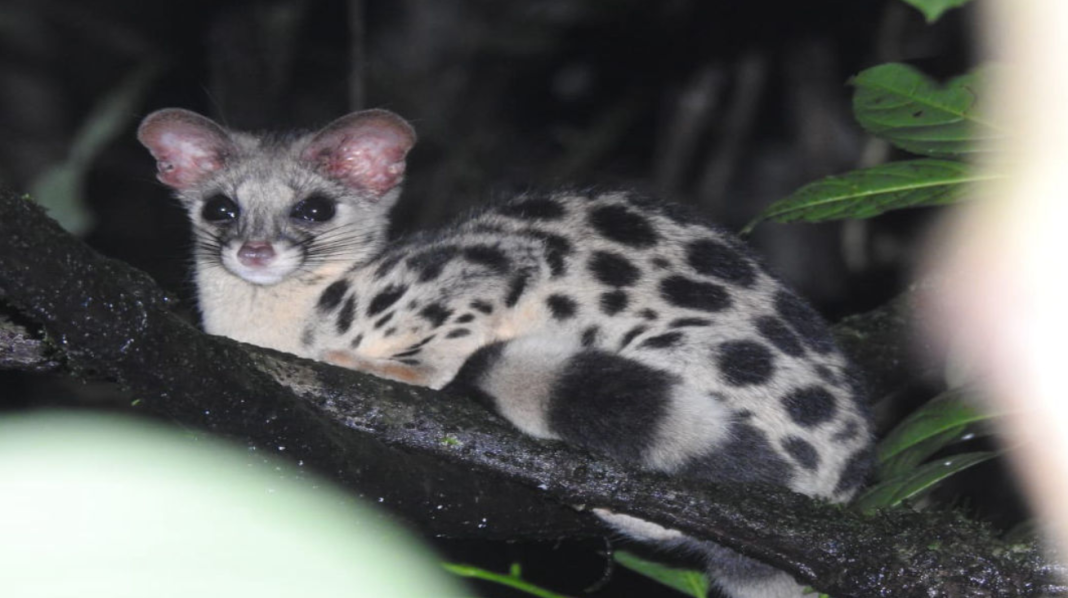
Shillong, Jan 12: In an encouraging development in conservation in Meghalaya, the spotted linsang (Prionodon pardicolor) has been sighted first time in the wild in the state.
Sighting of the elusive carnivore, rarely seen in the wild, was recorded inside a community-managed forest in West Garo Hills district.
Apart from an incident of a rescued spotted linsang in Ri-Bhoi district in the past, scientists say, this is the first confirmed direct sighting of the animal in the wild in Meghalaya.
The animal was recorded during extensive mammal surveys carried out by scientists from the Salim Ali Centre for Ornithology and Natural History (SACON). The team included Sanyukta P. Kasbekar, Gautam Kadam, Honnavalli N. Kumara, Siddhesh Sitaram Bhor, P. V. Karunakaran and S. Babu.
The sighting took place on 10 October 2021, when the animal was seen moving swiftly along tree branches nearly 20 metres above the ground in dense evergreen forest. Researchers say the behaviour matches what little is known about the species’ semi-arboreal lifestyle.
Photographs taken during the encounter allowed scientists to confirm the animal’s identity from its distinctive dark blotches and long, ringed tail.
Despite being protected under Schedule I of India’s Wildlife (Protection) Act, the spotted linsang remains one of the country’s least-documented carnivores. Most previous records from north-eastern India have come from hunted animals, market remains or chance encounters.
“Our record from Daribokgre is the first confirmed wild sighting from Meghalaya,” the researchers said, noting that earlier assessments of the state’s mammals did not include the species due to a lack of field evidence.
The discovery also marks the south-western edge of the species’ known distribution, suggesting that it may have survived undetected in the Garo Hills for decades because of its nocturnal habits and preference for life high in the forest canopy.
Daribokgre Community Reserve lies within the wider Nokrek Biosphere Reserve landscape, an area known for its ecological richness and relatively low levels of human disturbance.
According to the researchers, this strengthens the case for community-managed forests as critical refuges for rare and cryptic wildlife in Meghalaya.
The spotted linsang was not captured by camera traps during the surveys, highlighting the challenges of studying arboreal and nocturnal mammals using conventional monitoring methods. The researchers have called for more targeted approaches, including canopy-level camera trapping, to better understand the species’ distribution and population status.
Globally listed as “Least Concern”, the species may still face local threats that remain poorly understood. For Meghalaya, the finding is a reminder that some of its most important wildlife stories are unfolding quietly — in community forests, high above the forest floor, and beyond the reach of routine surveys.