
By Dipak Kurmi
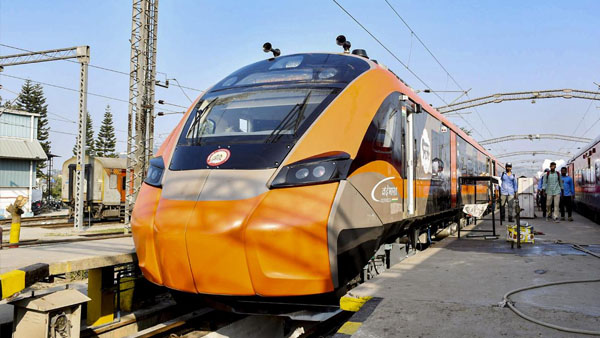
The introduction of the country’s first Vande Bharat sleeper train between Guwahati and Kolkata marks a significant milestone in the long and complex history of railway communication between the Northeastern region and the rest of India. More than just a new train service, this development symbolises an evolving national commitment to integrate the Northeast more closely with India’s economic, social and cultural mainstream. For a region whose relationship with railway connectivity has been shaped by colonial interests, geopolitical disruptions and prolonged neglect, the arrival of a modern, semi-high-speed sleeper train carries both symbolic and practical importance, promising greater comfort, speed and dignity for long-distance travellers.
The story of railways in the Northeast begins in the late nineteenth century, deeply intertwined with colonial economic priorities rather than public mobility. In 1881, the first train in the region ran from Dibrugarh to Margherita in upper Assam, initiated under the leadership of Dr John Berry White, a renowned civil surgeon of the British era. White had established the Assam Railway and Trading Company, primarily to facilitate the extraction and transportation of coal needed to sustain the rapidly expanding tea industry. Railways, at this stage, were not instruments of regional integration but tools of resource exploitation, designed to serve colonial commercial interests rather than local populations.
This utilitarian approach to railway development continued into the early twentieth century. In 1904, the Assam Bengal Railway Company established the Lumding–Badarpur Hill Section, a technically challenging yet strategically vital line that connected the hills of southern Assam to the broader railway network. This line was eventually linked to Dibrugarh, enabling coal from upper Assam to be transported efficiently to the Chittagong port for export. Around the same period, Guwahati was connected to Kolkata via Dhubri, further consolidating Assam’s role as a supplier of raw materials to colonial markets. These early railway links, while limited in their social reach, laid the foundational infrastructure upon which future connectivity would be built.
However, the trajectory of railway communication in the Northeast suffered a severe disruption with the political upheavals surrounding India’s independence. In 1947, as the rest of the country celebrated freedom from colonial rule, Assam and the broader Northeastern region faced an unexpected setback. The creation of East Pakistan, comprising the erstwhile Eastern Bengal, abruptly severed the most direct railway links between the Northeast and mainland India. Overnight, what had once been an integrated network was fragmented by new international borders, plunging the region into a period of isolation that had profound economic and psychological consequences.
For nearly five years, the Northeast remained cut off from the rest of India by rail, relying on limited and inefficient alternatives for movement of people and goods. It was only through the development of the Siliguri Corridor, often referred to as the Chicken’s Neck due to its narrow geographical width, that railway connectivity was gradually restored. This corridor became, and remains, the lifeline linking the Northeast to the rest of the country. While the restoration of rail links through Siliguri marked a critical step towards national integration, the region continued to lag behind in terms of railway infrastructure, speed, comfort and security compared to other parts of India.
Against this historical backdrop, the introduction of the Vande Bharat sleeper train between Guwahati and Kolkata represents a transformative shift. Unlike earlier trains that often symbolised neglect and compromise, this modern service embodies technological advancement, passenger comfort and a renewed focus on long-distance rail travel. The sleeper variant of the Vande Bharat is particularly significant for the Northeast, where journeys to major metropolitan centres typically involve overnight travel spanning long hours. Enhanced speed, modern amenities and improved safety standards promise to redefine the travel experience for thousands of passengers who regularly commute between Assam, West Bengal and beyond for education, employment, healthcare and trade.
The economic implications of this development are equally important. Kolkata has historically served as the principal commercial and cultural gateway for the Northeast, a role dating back to the colonial era. Improved rail connectivity between Guwahati and Kolkata can strengthen trade flows, support small and medium enterprises, and facilitate greater movement of tourists and professionals. For students, business travellers and ordinary citizens alike, a reliable and comfortable sleeper train reduces the physical and psychological distance between the region and one of India’s major metropolitan centres. In this sense, the Vande Bharat sleeper is not merely a train, but a bridge reinforcing national cohesion.
Yet, even as this milestone deserves celebration, it also brings into sharper focus long-standing challenges faced by passengers travelling from the Northeast to other parts of India, particularly northern destinations such as New Delhi. Despite paying for reserved and often premium-class travel, passengers frequently report harassment, overcrowding and insecurity as trains pass through certain stretches, especially in Bihar. Social media platforms are replete with accounts of express trains being treated as de facto local passenger services, with unreserved travellers occupying reserved coaches, blocking aisles and compromising safety and comfort.
What exacerbates this problem is the perceived indifference of railway officials and security personnel. Many passengers allege that objections raised by those who have paid for luxury or reserved travel are met not with support, but with hostility or administrative apathy. In some cases, protesting passengers claim to have faced intimidation, discouraging them from asserting their legitimate rights. Such experiences undermine the very purpose of modernising railway services and erode public confidence in the system, particularly among travellers from regions that already feel marginalised.
This issue is not merely about inconvenience; it speaks to a deeper question of equity and governance within India’s vast railway network. When passengers from the Northeast, who often undertake longer and more expensive journeys, are subjected to such treatment, it reinforces feelings of neglect and alienation. The introduction of high-profile trains like the Vande Bharat sleeper will have limited impact if fundamental issues of law enforcement, passenger security and administrative accountability remain unresolved on key routes.
Addressing this challenge requires more than ad hoc measures. It calls for a coordinated response involving the Railway Ministry, Indian Railways’ security apparatus and elected representatives from the Northeast. Stronger enforcement of reservation norms, increased deployment of railway protection forces on sensitive stretches, and clear accountability mechanisms for officials who fail in their duties are essential. At the same time, there must be sensitivity to the socio-economic realities of different regions, ensuring that solutions are firm yet fair, and grounded in respect for all passengers.
The role of political representation is particularly crucial. Elected representatives from the Northeast must consistently raise these concerns in Parliament and engage with the Railway Ministry to ensure that policy announcements translate into real improvements on the ground. Infrastructure development cannot be judged solely by new trains and tracks; it must also be measured by the quality of experience it delivers to ordinary citizens. A modern railway system must guarantee safety, dignity and comfort for all, regardless of where passengers come from or where they are headed.
In a broader sense, the launch of the Vande Bharat sleeper train should be seen as part of a continuing journey rather than a final destination. It reflects the progress India has made in reconnecting the Northeast after decades of historical disruption, but it also highlights unfinished tasks. True integration requires not only physical connectivity, but also institutional responsiveness and social empathy across regions.
As the rails once laid to serve colonial commerce are repurposed for national integration, the challenge before India is to ensure that technological advancement is matched by administrative integrity and human consideration. The Vande Bharat sleeper train between Guwahati and Kolkata offers a glimpse of what is possible when intent, investment and innovation align. It now remains the responsibility of the system as a whole to ensure that every journey undertaken on India’s railways, especially by those from historically peripheral regions, is marked by safety, respect and a genuine sense of belonging.
(the writer can be reached at dipakkurmiglpltd@gmail.com)