
By Dipak Kurmi
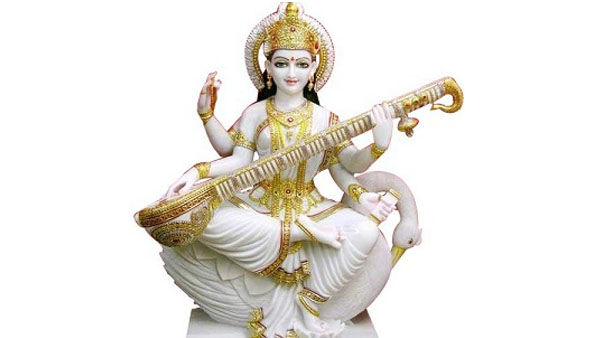
Exploring the symbolism embodied in the depiction of Mother Goddess Saraswati reveals distinct attributes. Draped in immaculate white attire and gracefully mounted on a white Swan, she epitomizes purity, Buddhi (discriminate intelligence), and Akasa (the space filled with the eternal element of consciousness). The transparent white hue symbolizes the essence of unsullied truths intertwined with nature. Accessing and comprehending these truths necessitates an approach with a pure and uncluttered mind, devoid of any egotistical preconceptions.
Without cultivating a mindset free from the influence of relative perception, discerning the subtle boundary between truth and falsehood becomes a challenging endeavor. Analogous to diluted milk that appears indistinguishable from its pure form, our minds, clouded by subjective viewpoints, might struggle to recognize the nuanced differences. However, akin to a Swan selectively consuming the pure milk and rejecting the adulterated water, the symbolism of Saraswati’s mount becomes evident in its practical significance. In essence, attaining a genuine understanding of truth necessitates the presence of a pure and untainted mind, allowing it to manifest in its entirety.
The presence of the Veena, a stringed musical instrument, in the hands of the Mother symbolizes her role as the custodian of all Sabdas – encompassing both spoken and written words carrying profound meanings. The significance lies in the orderly arrangement of letters to give words meaning. This underscores the importance of pleasant demeanor in fostering positive relationships and harmony. Without such harmonious interactions, life may encounter disruptions. A pertinent Vedic verse comes to mind, highlighting the genesis of words and their meanings: “Prajapatiravaiidamasit, Tasyavagdwitiyaasit, Vagvaiparamam Brahman.” In essence, it suggests the primordial existence of Prajapati, the creative matrix, accompanied by Vak, portrayed as second to Him, as She is initially potential and then manifests as Sakti; and the word itself is Brahmana.
The resonance of a similar concept can be found in the 4th Gospel, stating, “In the beginning was the Word, and the Word was with God, and the Word was God.” In the context of ancient Indian perceptions, Vak is considered the Sakti, or the Power, of the creator. According to this viewpoint, the initial motion at the Primal Source, known as pranava, sparked the primal sound Om. This resonance, when further attracted, gave rise to energetic streams emerging from the seeds of creation, resulting in the manifestation of differentiated sounds. Among these, the audible root syllables, termed as Bija mantra in the Indian sense, encompass the 50/51 alphabets of the Devnagari script. The harmonious symphony of these root syllables played a pivotal role in forming words with names and forms. Importantly, all these words find their intrinsic existence in Akasa, the space filled with the eternal element of consciousness.
In the ancient Indian worldview, Akasa was considered the foremost element to emerge in the universe’s creation. This aligns with scientific understanding, which asserts that post the Big Bang, space was the initial entity to surface, laying the foundation for the subsequent evolution of the excited energy chain. According to this perception, Akasa is believed to cradle the supra-sensual power of sound within its essence. This sonic energy, as it travels through the air, comes into contact with vocal chords, giving rise to audible words for human ears. Metaphorically, the Veena, Mother Goddess Saraswati’s musical instrument, signifies the embodiment of words, portraying the profound connection between sound, space, and the manifestation of language.
In her depiction, the Mother holds a sacred book, symbolizing the Veda. This signifies her role as the guardian of eternal truths – the self-revealed design principles intricately woven into nature, steering the course of existential order. Importantly, these truths transcend individual judgment, existing beyond the realm of personal interpretation.
Within this framework, the wisdom encapsulated in Rumi’s words holds paramount significance: “Somewhere beyond right or wrong, there is a garden.” This underscores the necessity to approach truth with a mindset that transcends conventional notions, urging us to move beyond the constraints of mental limitations. The essence conveyed is that genuine knowledge and wisdom are attainable solely through a pure and untainted mind, liberated from all forms of limitations.
The Mother is depicted with a rosary in her other hand, suggesting the significance of persistent contemplation on acquired knowledge for a deeper understanding of the subject matter. This aligns with the verse: “Sastra sunishcit puni-puni dekhi,” emphasizing that continual reflection on a subject consolidates our insights.
(the writer can be reached at dipaknewslive@gmail.com)