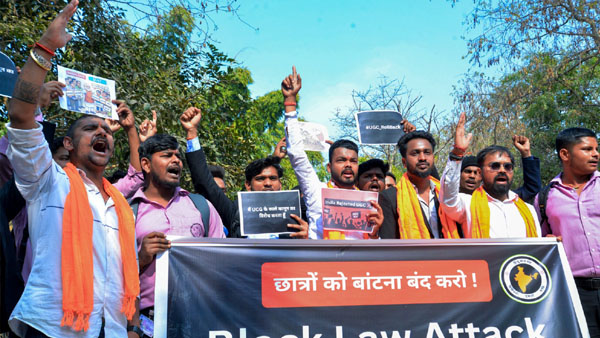

New Delhi, Jan 27 : The new Promotion of Equity in Higher Education Institutions Regulations, 2026, of the University Grants Commission (UGC) which has triggered protests and demonstrations at several places aims at replacing a 2012 anti-discrimination framework and making it binding for higher education institutions (HEI) to implement it.
Widespread protests have erupted against the regulations in the country, including on social media.
A plea has also been filed in the Supreme Court challenging the recently notified University Grants Commission (UGC) regulations. The petition alleges that the regulations have adopted a non-inclusionary definition of caste-based discrimination and exclude certain categories from institutional protection.
Union Education Minister Dharmendra Pradhan on Tuesday assured that there would be no discrimination against anyone.
“I want to humbly assure everyone (that) no one is going to face any harassment. There will be no discrimination and no one will have the right to misuse the regulation in the name of discrimination,” Pradhan told reporters at Didwana in Rajasthan.
Here is an explainer about the new regulations:
The government on January 13 notified new regulations mandating all higher education institutions to form “equity committees” to look into discrimination complaints and promote equity, according to officials.
The UGC (Promotion of Equity in Higher Education Institutions) Regulations, 2026, mandated that these committees must include members of the Other Backward Classes (OBCs), the Scheduled Castes (SCs), the Scheduled Tribes (STs), persons with disabilities (PwDs) and women.
A draft of the regulations was made public for feedback in February last year.
The document was issued after the Supreme Court told the UGC to submit the new regulations while hearing a plea by the mothers of Rohith Vemula and Payal Tadvi, questioning the implementation of the 2012 UGC regulations.
The objectives in the regulation say it is aimed at eradicating discrimination based on “religion, race, gender, place of birth, caste or disability, particularly against the members of Scheduled Castes and Scheduled Tribes, socially and educationally backward classes, economically weaker sections, persons with disabilities, or any of them, and to promote full equity and inclusion amongst the stakeholders in higher education institutions”.
It replaces the UGC (Promotion of Equity in Higher Educational Institutions) Regulations, 2012, which was largely advisory in nature, while the new regulation is binding and provides for creating a Centre and a Committee, as well as helplines to ensure there is no discrimination, along with an overall monitoring mechanism.
The new regulation has been met with protests, primarily from the general or unreserved categories, who have argued that the regulations could be discriminatory towards them.
A plea was also filed in the Supreme Court challenging the regulation, alleging that it has adopted a non-inclusionary definition of caste-based discrimination and excludes certain categories from institutional protection.
The plea submitted that Regulation 3(c) of the recently notified UGC (Promotion of Equity in Higher Education Institutions) Regulations, 2026, is “non-inclusionary” and fails to protect students and faculty who do not belong to reserved categories.
Regulation 3(c) of the regulation defines “caste-based discrimination” as discrimination “only on the basis of caste or tribe against the members of the Scheduled Castes, Scheduled Tribes, and Other Backward Classes”.
Further, Regulation 3(e) defines “discrimination” as any unfair, differential, or biased treatment or any such act against any stakeholder, whether explicit or implicit, on the grounds only of religion, race, caste, gender, place of birth, disability, or any of them.
According to the regulation, the HEIs shall not permit or condone any form of discrimination and it shall be the duty of the head of the institution to see that these regulations are duly observed.
It also says every HEI shall establish an equal opportunity centre to oversee the effective implementation of policies and programmes for disadvantaged groups; to provide guidance and counselling regarding academic, financial, social, and other matters; and to enhance diversity within the campus.
The equal opportunity centre shall have an equity committee constituted by the Head of the Institution, which must have representation of OBCs, PwDs, SCs, STs and women.
The Centre’s tasks include ensuring equity and equal opportunity to the community at large in the HEI and to bring social inclusion; promote equity among the students, teaching and non-teaching staff; disseminate information related to schemes and programmes for the welfare of the socially disadvantaged section; establish coordination with the government and other agencies and organisations to mobilise academic and financial resources to assist students belonging to disadvantaged groups.
The Centre would maintain an online portal for reporting any incident of discrimination, and an ‘Equity Helpline’ would also be operated.
It also provides that HEIs that do not comply with the regulations will face enquiry, and if the non-compliance is established, they will be debarred from participating in UGC schemes offering programmes and will be removed from the list of HEIs.
Critics, meanwhile, have said the regulation lacks any provision to safeguard against malicious complaints and have also claimed that the definition of discrimination remains vague. The equity committees not having any provision mandating representation from the ‘general’ category has also been criticised.
The plea challenging the regulations in the Supreme Court has said that by limiting the scope of “caste-based discrimination” only to SC, ST and OBC categories, the UGC has effectively denied institutional protection and grievance redressal to individuals belonging to the “general” or non-reserved categories who may also face harassment or bias based on their caste identity. (PTI)