
By Dipak Kurmi
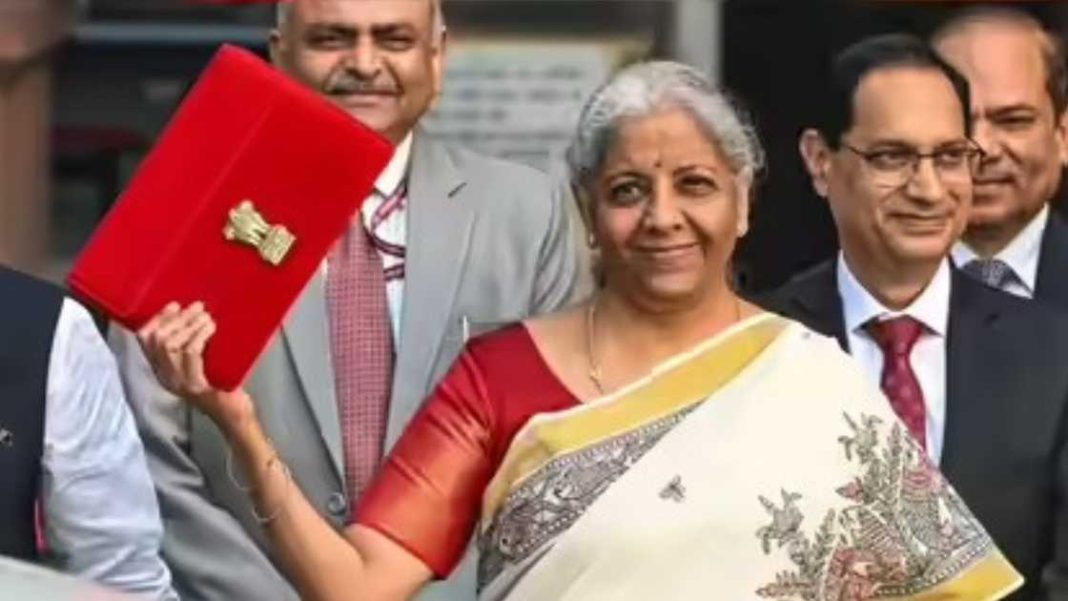
When Finance Minister Nirmala Sitharaman rises to present the Union Budget for the financial year stretching from April 2026 to March 2027, she will be performing a familiar ritual that nevertheless unfolds under unusually tight constraints. On the surface, the Union Budget appears to be a fresh annual exercise in which the government lays out its expectations for economic growth, details its proposed expenditure across schemes and departments, outlines how much revenue it hopes to raise from taxes and non-tax sources, and finally discloses the extent of borrowing required to bridge the inevitable gap between income and expenditure, formally known as the fiscal deficit. Yet the idea that each Budget begins on a blank slate is largely an illusion. In reality, every Budget is deeply conditioned by the legacy of previous years, the rigidity of committed expenditures, and the state of the economy as it stands at the close of the outgoing financial year in March 2026.
A large portion of government spending is effectively pre-committed, leaving limited room for dramatic manoeuvre. Salaries and pensions of government employees cannot be adjusted at will, interest payments on past borrowings are non-negotiable, and major welfare schemes acquire a political and social inertia that makes abrupt withdrawal difficult. Similarly, tax rates cannot be radically altered every year without generating uncertainty and disrupting compliance. As a result, what the Finance Minister can realistically do in any given year is often dictated less by ideological ambition and more by fiscal arithmetic inherited from the past. Equally important is the economic performance of the year just ending. If a particular sector has been badly hit, whether by external shocks such as a surge in US tariffs hurting Indian exports or by domestic slowdowns, the pressure mounts on the Budget to respond with relief or stimulus. For this reason, a careful reading of current-year data often provides the clearest clues to the priorities and limitations that will shape the forthcoming Budget.
At the macroeconomic level, the data from the current year throws up three interlinked concerns that are likely to weigh heavily on the Finance Minister’s calculations. The first is weak GDP growth, or more precisely, weak nominal GDP growth. Public discourse in India has been dominated by celebratory narratives of the country being the fastest-growing major economy, but these claims typically refer to real GDP growth, which strips out the effect of inflation to show the increase in actual output. For the purposes of budgeting, however, it is nominal GDP that matters far more. Nominal GDP represents the total value of all goods and services produced in the economy at current prices, and it forms the base on which tax revenues, expenditure ratios, and deficit targets are calculated. If nominal GDP growth turns out to be lower than anticipated, the entire fiscal framework begins to wobble.
The distinction is not merely academic. When the government estimates its tax revenues for the coming year, it begins with an assumption about how much nominal GDP will expand. A higher nominal GDP implies a larger tax base even if tax rates remain unchanged. To illustrate, if the government assumes nominal GDP will increase by Rs 100 and applies an average tax rate of 15 percent, it expects to garner an additional Rs 15 in revenue. If, however, nominal GDP grows by only Rs 50, the additional revenue falls to Rs 7.5. This shortfall forces the government into an unenviable choice. It can either borrow more from the market, thereby crowding out private borrowers and pushing up interest rates across the economy, or it can cut expenditure, potentially sacrificing investment in defence research, infrastructure, or subsidies for the poor. In this sense, nominal GDP growth is the silent pillar on which the credibility of the Budget rests.
What makes the current situation particularly challenging is that India’s nominal GDP growth has been decelerating for several years. In the ongoing financial year, nominal GDP is expected to grow by just 8 percent, a figure that stands out as weak when compared with the experience of the past two decades. This slowdown is not a one-off aberration but appears to reflect a secular deceleration in recent years. As recently as last February, the Finance Minister had projected nominal GDP growth of 10.1 percent, itself lower than historical norms. The First Advance Estimates released by the Ministry of Statistics have since revised this expectation down to 8 percent. For the forthcoming Budget, one of the Finance Minister’s foremost challenges will therefore be to articulate a credible strategy to revive nominal GDP growth, because without it, even the most carefully crafted fiscal plans risk being undermined.
Closely linked to this problem is the second concern, weak tax buoyancy. Tax buoyancy measures how responsive tax revenues are to changes in GDP. A buoyancy of 1 implies that a 10 percent increase in GDP leads to a 10 percent increase in tax collections. Budget assumptions often build in buoyancy greater than 1, reflecting expectations of improved compliance, formalisation of the economy, or efficiency gains in tax administration. In the current year, however, these assumptions have been sorely tested. Even as nominal GDP growth has undershot projections, tax collections have performed even worse. Data comparing assumed growth rates in tax revenues with actual year-to-date performance reveals that none of the major tax heads are keeping pace with initial expectations.
What is particularly striking is that gross tax revenue growth is not merely below projections but even below the already weak nominal GDP growth rate of 8 percent. This implies that tax buoyancy has deteriorated sharply. At the start of the year, the government had assumed a tax buoyancy of around 1.1, meaning that tax revenues would grow faster than nominal GDP. In reality, the buoyancy has turned out to be closer to 0.6, barely half of what was expected. Returning to the earlier illustration, if nominal GDP growth disappoints and tax buoyancy also collapses, the revenue shortfall becomes dramatic. Instead of the anticipated Rs 15, the government may find itself with only Rs 3.75 in additional tax revenues. Such a gap severely constrains fiscal space and limits the government’s ability to respond to economic challenges without resorting to higher borrowing.
The third major concern confronting the Budget is the persistent weakness of private corporate investment. Encouraging greater private sector participation has been a consistent policy objective of the incumbent government, rooted in the Prime Minister’s emphasis on minimum government and maximum governance. Since 2019, this objective has been pursued through a series of measures aimed at improving the investment climate. These include a sharp cut in corporate tax rates to enhance post-tax profitability, a historic increase in government capital expenditure to build infrastructure and reduce the cost of doing business, and targeted subsidies under the Production Linked Incentive scheme to encourage manufacturing in strategic sectors. When these measures failed to elicit the desired response, the government shifted its focus to stimulating consumer demand by raising income tax exemption thresholds and cutting GST rates, hoping that stronger demand would create a business case for fresh private investment.
Despite this sustained policy push, the data tells a sobering story. Private corporate investment remains below pre-pandemic levels, even as overall GDP growth has been relatively robust. The underlying problem appears to be weak sales growth, which discourages firms from committing capital to new projects. Capacity utilisation in many sectors remains insufficient to justify large-scale expansion, and uncertainty about global demand further dampens sentiment. Compounding this challenge is the fact that global investors, who once viewed India as a favoured destination, have begun to pull back over the past year. This retreat has put pressure on the rupee, adding an external dimension to the Finance Minister’s difficulties and creating both economic and political complications.
Against this backdrop, the forthcoming Budget will have to walk a tightrope. Boosting growth without exacerbating the fiscal deficit will require a delicate balance of measures that support demand, revive investment, and restore confidence in the economy’s medium-term prospects. One possible approach lies in prioritising expenditure that has a high multiplier effect, such as targeted infrastructure projects that can crowd in private investment rather than merely substituting for it. Another lies in improving the quality of public spending by ensuring timely execution and reducing leakages, thereby extracting more growth from each rupee spent. On the revenue side, the emphasis may need to shift from optimistic projections to realistic assumptions, coupled with administrative reforms that enhance compliance without raising statutory tax rates.
Ultimately, the success of the Budget will depend less on headline announcements and more on its ability to reconcile ambition with arithmetic. The Finance Minister faces the unenviable task of crafting a growth-oriented Budget at a time when nominal GDP growth is weak, tax buoyancy has faltered, and private investment remains hesitant. The choices made will signal not only the government’s immediate priorities but also its assessment of the structural challenges confronting the Indian economy. In that sense, the Budget for 2026–27 will be less about starting anew and more about navigating the narrow path left open by the economic realities of the year gone by.
(the writer can be reached at dipakkurmiglpltd@gmail.com)