
New Delhi, Feb 11 : Nagaland University researchers have completed a pioneering GIS-based hydrological study that scientifically examines how geo-ecological conditions and human activities influence runoff and river flow in the North Eastern Himalayan hill region, an area long marked by data gaps and global scientific debate, according to officials.
The research aims to address a critical and contested question in Himalayan science — the true hydrological impact of land use change on river discharge, floods and environmental degradation.
The research called “GIS Modeling to investigate geo-ecological and anthropogenic impacts on runoff and river flow in the North Eastern hilly region of India” has been published in International Journal of Geographic Information System Research and Development, a peer-reviewed academic journal that publishes original research and applied studies on GIS theory, technologies, spatial analysis and geospatial applications across disciplines.
Beyond advancing scientific understanding, the study proposes a practical four-zone runoff classification — low, moderate, high and very high runoff zones — to support water resource planning, flood mitigation and integrated watershed management.
According to Nagaland University Vice Chancellor Jagadish K Patnaik, the methodology and findings are expected to benefit policymakers, planners and local communities, while also serving as a transferable model for similar fragile regions across the Himalaya and India.
“This work is timely and significant, as it enhances our understanding of runoff patterns, flood risks and sustainable water management in fragile hill ecosystems. Such research not only strengthens scientific knowledge but also supports informed policy and planning for the region’s environmental security and resilience,” he said.
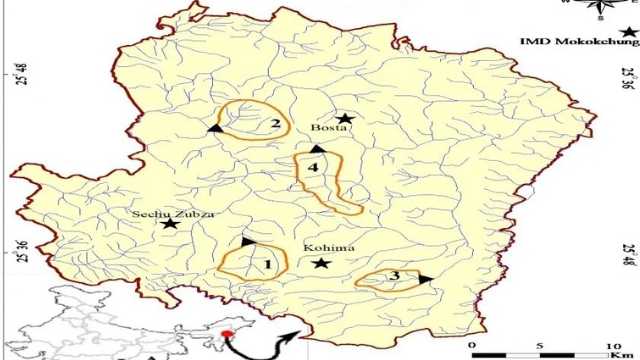
M S Rawat, Professor at Department of Geography, School of Sciences, Nagaland University, informed that the team focused on four experimentally monitored watersheds in Kohima district.
“Our research team combined advanced geospatial techniques with systematic field-based hydrological measurements, which is an approach rarely attempted in the Indian Himalayas. The study generated continuous stream discharge data across contrasting land-use systems, including dense forests, open forests, agricultural lands and urban landscapes, creating one of the first benchmark hydrological datasets for the North Eastern Himalayan region,” he said. (PTI)