
By Dipak Kurmi
The hill settlement of Litan in Manipur’s Ukhrul district has once again become a theatre of fire and recrimination, where arson, gunfire and political distrust have converged to produce a crisis that is as much about governance as it is about communal fracture. Over the past several days, violence between sections of the Tangkhul Naga and Kuki communities has left homes reduced to ashes, roads severed, and anxieties sharpened across districts already scarred by nearly two years of ethnic strife. What has unfolded since the evening of February 7 is not an isolated disturbance, but a deeply unsettling reminder of how fragile peace remains in the hill districts, and how swiftly rumour, retaliation and administrative hesitation can combine to push a volatile situation toward wider conflagration.
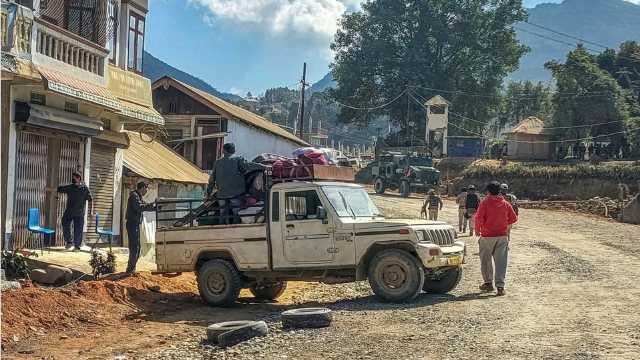
At least 23 more houses were reportedly burnt down at Litan as clashes continued for a third consecutive day, adding to a toll that has crossed 50 houses destroyed since Sunday night. Gunfights between unknown groups were reported, with reliable sources indicating that many rounds were fired using automatic assault rifles from the direction of Saireikhong village. The confrontation persisted despite the presence of strong security forces in the area, raising troubling questions about deterrence and preparedness. Although no deaths have been officially reported so far, the scale of destruction and the brazen use of firearms underscore the seriousness of the crisis. The violence reportedly began on February 7, and by February 8, 9 and 10, mobs were said to have effectively ruled the streets and roads of Litan, a small town that by its very size should not have overwhelmed the security apparatus deployed there.
The immediate trigger for the spiral remains contested. A clarification was issued stating that personnel accused by some youths of aiding arsonists in setting houses on fire were not Assam Rifles personnel, as alleged, but Army personnel. Manipur Police have also booked two individuals for allegedly raising false allegations against security personnel at Litan Saireikhong in a video clip that went viral. The State has maintained that due process is being followed and that action has been taken in accordance with law. Yet, the circulation of multiple video clips has only deepened suspicion. One clip purportedly showed individuals firing randomly from an incomplete RCC building, prompting questions about whether it was authentic or fabricated. Another reportedly depicted a young Kuki man, armed and openly challenging the Tangkhul Nagas with the term “Kacha Naga” as well as the Meiteis. The provenance of these videos, who shared them, and what action has been initiated to identify those responsible for their virality remain issues on which the public has sought clarity.
The law-and-order response has been both forceful and, in the eyes of many, reactive. Curfew was imposed in the affected areas as the Tangkhul Naga Long declared a state of emergency in Ukhrul district and urged residents to remain vigilant and exercise caution. Security forces blocked vehicular access to Litan and along the Imphal-Ukhrul road, effectively cutting off a crucial artery. Additional forces, including personnel from the Para Commandos, 8 Bihar Regiment and Rapid Action Force, were rushed in to prevent further escalation. When gunfire subsided temporarily, security personnel scanned the area using a helicopter and launched massive search operations in Litan and surrounding villages to arrest those involved and regain control. Two Naga individuals, including a minor, who had been stranded at Lamlai Chingphai Kuki village under Litan police station after their truck broke down, were rescued and identified as Chihansho Keishing, 26, and Kanambuan Golmei, 17, and brought safely to Yaingangpokpi police station.
Yet the enforcement measures extended beyond troop deployments. The State Government suspended internet and data services in Lhungtin Sub Division of Kangpokpi, Phungyar Sub Division of Kamjong and across Ukhrul district for five days, citing the volatile situation and apprehensions that anti-social elements might use social media to transmit images, posts and video messages inciting public passions and exacerbating law and order challenges. The order, issued by Commissioner-cum-Secretary N Ashok Kumar, covered mobile data, broadband, VPN and VSAT services. The shutdown initially applied only to Ukhrul district but was later extended to parts of Kangpokpi, an expansion that many described as belated. For residents already grappling with fear and displacement, the blackout further complicated access to information, communication and, potentially, relief coordination.
Civil society reactions have been sharp and polarised. Organisations including the Foothills Naga Coordination Committee, Joint Tribes Council Manipur, Liangmai Naga Council Eastern Zone, Konsakhul Village Authority and K Lungwiram Village Authority condemned the arson attacks in Litan and in K Lungwiram village of Kangpokpi district. According to a press release by the Foothills Naga Coordination Committee, the arson attacks on Naga villages in the Litan area on the night of February 8 were premeditated. It was alleged that approximately 30 Vaiphei youths from Saronphai village descended upon K Lungwiram Naga village under Sapormeina police station and set ablaze the residence of Azan Abonmai in the early hours of February 9. These organisations described the attacks as a direct challenge against the Naga people and warned that further delay or inaction would be construed as deliberate complicity.
In separate statements, village authorities of Konsakhul and K Lungwiram alleged that the attack on K Lungwiram village was orchestrated by identified Vaiphei leaders, naming individuals said to be chiefs of various villages. They further alleged that K Lungwiram village stood unlawfully seized, its inhabitants effectively held in a hostage-like situation by Vaiphei elements, plunging the settlement into a severe humanitarian crisis marked by fear, insecurity and deprivation. The organisations demanded immediate deployment of adequate neutral security forces in affected Naga areas and urgent humanitarian relief to safeguard lives, dignity and property. They warned the Government of Manipur and the Ministry of Home Affairs that failure to identify, arrest and prosecute perpetrators without bias would leave them with little option but to initiate proportionate retaliatory measures within their jurisdiction, a statement that carries ominous implications in a region already traumatised by cycles of revenge.
The Coordinating Committee on Manipur Integrity, or COCOMI, entered the discourse with a broader political indictment. Expressing grave concern over the incidents since February 8, 2026, COCOMI asserted that the violence in Litan was not isolated or accidental but part of a carefully engineered crisis imposed upon the people of Manipur through proxy politics and deliberate institutional negligence. It argued that what is being witnessed is the predictable outcome of a policy architecture reliant on proxy forces, selective silence and frameworks such as the Suspension of Operations pact, which it claimed has functioned less as an instrument of peace and more as leverage and long-term destabilisation of Manipur’s social fabric. COCOMI held both State and Central agencies accountable for what has happened and what continues to unfold, accusing security forces of remaining silent spectators while houses were set ablaze in broad daylight.
The committee warned that if the violence is not immediately and decisively contained, it could trigger a wider cycle of retaliation and communal polarisation, endangering lives, livelihoods and social harmony across the region. It reiterated resolutions adopted at a massive public rally on January 31, 2026, which condemned what it described as a proxy war being waged by the Indian State against the people of Manipur. According to COCOMI, the present turmoil reflects not merely a breakdown of law and order but the consequence of a political and security approach that has normalised conflict, enabled armed proxies and treated civilian suffering as collateral damage. It cautioned that in this turmoil nobody would emerge a winner except forces that thrive on division and fragmentation, while ordinary Manipuris continue to pay the price in blood, tears and ashes.
The strategic implications are not insignificant. Litan falls under Ukhrul district, an area widely perceived as a stronghold that has historically contributed significantly to the intellectual and organisational strength of the NSCN (IM). Observers have questioned what might transpire if armed outfits or influential groups decide to plunge more directly into the feud. The temporary cutting off of the Imphal-Ukhrul road, reminiscent of the prolonged disruptions along National Highway 2 since May 3, 2023, serves as a disturbing reminder of how quickly logistical chokepoints can paralyse mobility and commerce. The stand-off along this arterial route evokes memories of earlier blockades that deepened economic distress and hardened ethnic boundaries.
In this fraught landscape, the State Government faces a credibility test that extends beyond immediate containment. It must demonstrate not only the capacity to deploy additional forces and impose curfew, but also the willingness to undertake transparent, impartial investigations into viral videos, allegations against security personnel, and claims of organised attacks. Selective action or delayed response risks reinforcing narratives of bias and complicity from multiple sides. A calibrated response that combines credible policing, humanitarian outreach, restoration of communication channels and sustained dialogue among community leaders is imperative if the embers in Litan are not to ignite a wider blaze across Manipur’s hills and valley.
What is unfolding in Litan is therefore more than a localised clash; it is a microcosm of Manipur’s prolonged crisis, where historical grievances, armed group dynamics, contested administrative choices and digital misinformation intersect. The days since February 7 have more than testified to the dangers of reactive governance in a deeply polarised environment. If decisive, transparent and empathetic measures are not undertaken now, the destruction of over fifty homes may prove to be only a prelude to a more dangerous phase. The people of Litan, and indeed of Manipur, deserve more than a fragile ceasefire punctuated by curfews and shutdowns; they require a durable restoration of trust in institutions that are meant to protect them.
(the writer can be reached at dipakkurmiglpltd@gmail.com)