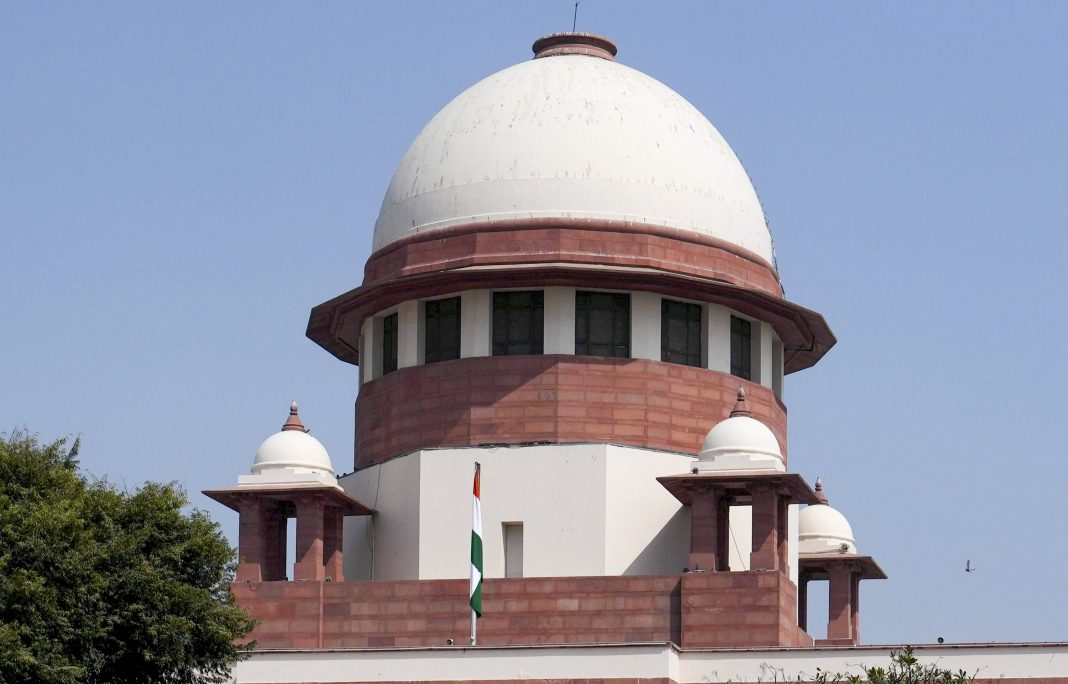

New Delhi, Feb 16: The Supreme Court on Monday said that a nine-judge bench will commence final hearing on a batch of petitions relating to discrimination against women in religions and at religious places, including Kerala’s Sabarimala Temple.
A bench comprising Chief Justice Surya Kant and Justices Joymalya Bagchi and Vipul M Pancholi said the bench, which will be constituted by the CJI, will commence the crucial hearing on the petitions on April 7.
It said that the hearing is likely to conclude on April 22.
The bench asked the parties to file their written submissions on or before March 14.
Solicitor General Tushar Mehta for the Centre said he supported the pleas for review of the Sabarimala verdict that allowed entry of women of all age groups in the sacred hill-top shrine in Kerala.
The bench-appointed lawyer Krishna Kumar Singh is the nodal counsel for parties supporting the review of the Sabarimala verdict.
It also appointed Shashwati Pari as the nodal counsel for those opposing the review of the verdict.
“We also deem it appropriate that senior advocate K Parameshwar along with Shivam Singh are appointed as the amicus. Singh shall submit the stand taken by all parties before this court,” the CJI said.
“The nine judge bench will begin hearing the Sabarimala review case on April 7, 2026 at 10:30 am. The review petitioners or the party supporting them shall be heard from April 7 to April 9. The ones opposing the review shall be heard on April 14 to April 16. The rejoinder submissions, if any will be heard on April 21, 2026 followed by the final and concluding submissions by the learned amicus.. which is expected to be over by April 22,” the order said.
The bench asked the lawyer for the parties to adhere to the time schedule.
On May 11, 2020, the top court had said that its five-judge bench had powers to refer the questions of law to a larger bench for adjudication while exercising its limited power under review jurisdiction in the Sabarimala temple entry case.
Two months prior to that, the SC had rejected the objections that a five-judge bench on November 14, 2019, was wrong in making a reference to a larger bench without deciding the review petitions challenging the 2018 Sabarimala verdict, which had allowed women of all age groups to enter the hill-top shrine in Kerala.
It had framed seven questions on the scope of religious freedom in various religions and made it clear that it was open to the addition and deletion of issues framed.
The bench had framed questions which include, “What is the scope and ambit of right to freedom of religion under Article 25 of the Constitution of India?” and “What is the inter-play between the rights of persons under Article 25 of the Constitution of India and rights of religious denomination under Article 26?”
Besides other questions, the top court said it would also examine whether a person not belonging to a religious denomination or religious group can question a practice of that “religious denomination or religious group” by filing a public interest litigation (PIL).
Besides the Sabarimala case, the verdict had also referred issues of entry of Muslim women into mosques and dargahs and of Parsi women, married to non-Parsi men, being barred from the holy fire place of an Agiary, to the larger bench. (PTI)