
By Satyabrat Borah
Prime Minister Narendra Modi’s 24 hour visit to Jerusalem was rich in symbolism, dense with agreements, and carefully choreographed for maximum political and diplomatic effect. It was also a visit that left behind as many questions as it answered, especially about India’s long standing position on Palestine and its carefully balanced engagement with the wider West Asian region. In a world already fractured by war, suspicion and shifting alliances, the visit stood out not merely for what was said and signed, but for what was left unsaid.
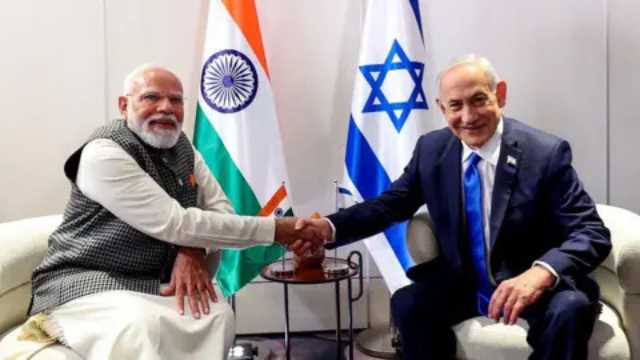
Israel’s enthusiasm in hosting Mr. Modi was evident long before the aircraft touched down. Prime Minister Benjamin Netanyahu announced the visit months in advance and personally confirmed the dates, signalling how much political value Israel attached to the moment. From the instant Mr. Modi arrived, Mr. Netanyahu’s constant presence was impossible to miss. He escorted the Indian Prime Minister through every engagement, every meeting, every ceremonial moment, projecting a message of closeness that went beyond routine diplomacy. The optics were unmistakable. Israel was not just welcoming a partner, it was embracing a friend at a time when it felt increasingly isolated on the global stage.
The outcomes of the visit, on paper, were substantial. India and Israel upgraded their relationship to a Special Strategic Partnership, a label that reflects not just existing cooperation but ambitions for the future. More than fifteen memoranda of understanding were signed across critical technologies, artificial intelligence, agriculture, education and culture. A particularly notable announcement was the plan to facilitate the employment of 50,000 Indian workers in Israel over the next five years, a move that carries economic significance for India and labour relief for Israel. These agreements reinforced a relationship that has steadily deepened since Mr. Modi’s first visit in 2017, especially in defence, technology and innovation.
Yet the warmth and intensity of this engagement also need to be read in context. This visit came at a moment when Israel is facing growing international criticism over the scale of civilian casualties in Gaza and the expansion of settlements in the West Bank. In recent weeks alone, dozens of countries, including Germany, France and the United Kingdom, traditionally cautious in their public criticism of Israel, have voiced strong opposition to Israel’s West Bank proposals. The war in Gaza has drawn unprecedented scrutiny, with humanitarian agencies warning of catastrophic civilian suffering. Against this backdrop, the presence of a major Global South leader like Mr. Modi, offering visible solidarity, carried enormous political weight for Mr. Netanyahu.
Domestically, the timing of the visit could not have been more helpful for the Israeli Prime Minister. With elections looming later this year, Mr. Netanyahu faces intense pressure over allegations of corruption, questions about accountability for security lapses in 2023, and mounting anger over the civilian toll of Israel’s military response in Gaza. An emphatic display of international support, especially from a country as significant as India, strengthens his political
narrative at home. It allows him to argue that Israel is not as isolated as critics claim, and that key partners continue to stand firmly by its side.
This is where the discomfort begins for India’s traditional West Asia policy. For decades, India has walked a careful line in the region. It has built strong ties with Israel, particularly in defence and intelligence, while simultaneously maintaining consistent support for the Palestinian cause and deep economic and human connections with the Arab world. This balancing act has served India well, allowing it to avoid entanglement in regional rivalries while safeguarding vital interests, from energy security to the welfare of millions of Indian workers in the Gulf.
Mr. Modi’s speech at the Knesset was closely watched for signs of how India intended to navigate this balance. His words were carefully chosen, but their restraint was striking. He referred only obliquely to Palestinian sovereignty, saying that the U.S. led Gaza Peace Initiative, which commits to a two state solution, holds the promise of a just and durable peace by addressing the Palestine issue. There was no direct articulation of India’s long standing support for an independent Palestinian state, nor any mention of East Jerusalem or occupation, phrases that once featured prominently in Indian statements.
Equally significant was what Mr. Modi did not say. He expressed solidarity with Israel and acknowledged the pain and grief caused by the October 2023 terror attack by Hamas. This was an important and necessary condemnation of violence against civilians. However, there was no reference to the staggering human cost of Israel’s military operations in Gaza since then, where more than 72,000 people have reportedly been killed. For many observers, this silence felt jarring, especially given India’s historical emphasis on civilian protection, proportionality and humanitarian principles in conflict zones.
The absence of a visit to Palestine during this trip further sharpened the sense of imbalance. After his 2017 visit to Israel, Mr. Modi followed up with a separate visit to Ramallah in 2018, where he reaffirmed India’s commitment to Palestinian statehood and development. That gesture had reassured many in the Arab world that India’s growing closeness to Israel did not come at the expense of Palestine. This time, no such immediate reassurance was offered. While it is still possible that Mr. Modi may visit Palestine later, the gap has already been noted and interpreted.
There is also the broader regional context to consider. Mr. Modi chose to travel at a time when tensions are rising across West Asia, including the looming threat of U.S. military action against Iran. In such an atmosphere, every diplomatic move is read through the lens of alignment. Even if India does not intend to take sides, appearances matter. A visible stance of standing firmly with Israel, without parallel engagement or strong messaging on Palestine, risks being seen as a departure from India’s historically calibrated neutrality.
This perception could have consequences. India’s relationships with key West Asian powers are built not just on transactions, but on trust. Countries in the region have long valued India as a partner that does not impose ideological conditions, does not interfere in internal affairs, and
respects regional sensitivities. Many of these countries expect India to remain consistent in its support for peace, morality and compassion in the Israel Palestine conflict. A shift, or even the perception of a shift, can complicate this trust, even if it does not lead to immediate diplomatic fallout.
At the same time, India’s strategic ambitions in the region are clearly expanding. Mr. Modi’s announcement that initiatives like I2U2, involving India, Israel, the UAE and the United States, would gain new momentum suggests that New Delhi believes regional cooperation frameworks can still function despite the polarised atmosphere. Similarly, reaffirming commitment to the India Middle East Europe Economic Corridor signals India’s belief that economic connectivity can act as a stabilising force, even when political tensions run high. These initiatives reflect India’s desire to be a central player in shaping the region’s future, not just a passive observer.
The challenge is that such initiatives depend heavily on regional buy in. They require not only technical feasibility but political goodwill across multiple capitals. If India is perceived as leaning too far towards one side in a deeply emotional and divisive conflict, that goodwill could erode. Even partners who share economic interests with India may become more cautious, recalibrating their engagement in subtle ways that are not immediately visible but matter over time.
There is also a domestic Indian dimension that cannot be ignored. India is home to a large Muslim population that has historically viewed the Palestinian cause with empathy. While foreign policy should not be hostage to domestic sentiment, sustained silence on humanitarian suffering abroad can create discomfort at home, especially when India prides itself on civilisational values of compassion and justice. Balancing national interest with moral consistency is never easy, but it has been a defining feature of India’s global identity.
None of this suggests that India should roll back its engagement with Israel. The relationship is real, valuable and mutually beneficial. Israel’s strengths in technology, innovation, agriculture and security align well with India’s development goals. Cooperation in these areas can deliver tangible benefits to ordinary Indians, from farmers to entrepreneurs. The question is not whether India should engage Israel, but how it should do so while preserving its broader regional equilibrium.
In that sense, Mr. Modi’s visit can be seen as both an assertion and a test. It asserts India’s confidence in pursuing its interests openly, without excessive caution. At the same time, it tests the resilience of India’s traditional balancing strategy in a more polarised world. The real judgment of the visit will not come from the number of agreements signed or photographs taken, but from how India follows up in the months ahead.
If Mr. Modi chooses to clarify India’s position through a clear articulation of support for a two state solution, meaningful humanitarian engagement, and possibly a visit to Palestine, it would go a long way in restoring balance. Such steps would signal that India’s closeness to Israel does not imply indifference to Palestinian suffering or abandonment of long held principles. They
would also reassure Arab partners that India remains a steady and empathetic presence in the region.
Ultimately, India’s strength in West Asia has always come from its ability to talk to everyone, listen to many, and avoid being locked into rigid camps. In an era when global politics increasingly demands binary choices, preserving this flexibility is harder but more important than ever. Mr. Modi’s Jerusalem visit has opened a new chapter in India-Israel relations. Whether it also complicates India’s ties with the wider region will depend on how carefully New Delhi navigates the difficult terrain between strategic partnership and moral responsibility, between political optics and human realities.
The visit was significant, ambitious and consequential. It showcased India’s growing global confidence, but also highlighted the costs of silence in the face of suffering. For a country that has long sought to be a voice of balance and conscience, the path ahead lies not in choosing sides, but in reaffirming principles while pursuing partnerships. That balance, once again, is India’s real test in West Asia.