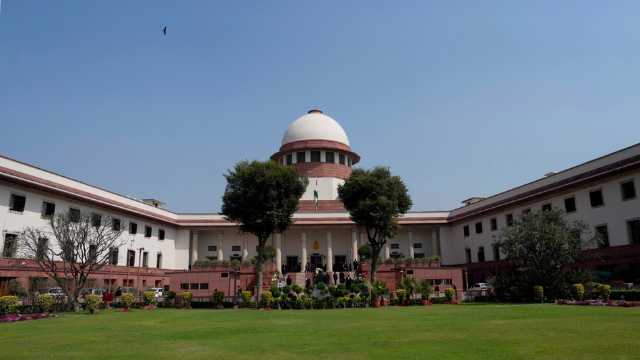

New Delhi, Mar 3 : The Supreme Court has fastened the liability to pay penalty on an employer for a delay in depositing the compensation amount under the Employees’ Compensation Act, 1923, saying the law is a “social welfare statute” for redressing employees’ grievances.
A bench of Justices Aravind Kumar and P B Varale said in a catena of judgments, the apex court has stressed the “liberal and purposive interpretation” of the Act in favour of the employees being a social-welfare legislation.
The bench delivered its verdict on an appeal filed by an insurance firm, challenging a May 2025 order of the Delhi High Court.
The high court had fastened the liability of paying the penalty imposed under section 4A(3)(b) of the Act on the insurance firm.
“The perusal of the statement of objects of the said legislation makes it crystal clear that the said legislation is a social welfare statute brought in by Parliament to redress the grievances of the employees in case of accidents that may occur in or during the course of employment by payment of adequate compensation expeditiously…,” the top court said in its February 23 verdict.
It noted that the employee, who was employed as a commercial driver, had died in February 2017 while driving the vehicle.
His legal heirs had preferred a claim petition, seeking compensation under the 1923 Act before the commissioner of the Delhi government’s labour department.
In November 2020, the commissioner held that there existed an “employer-employee” relationship and since the death had occurred during and in the course of employment, the employer was liable to pay compensation to the claimants.
The commissioner had fixed the compensation amount at Rs 7,36,680, along with interest.
Noting that there existed a valid insurance policy of the vehicle and the incident had occurred during the policy period, the commissioner granted the employer to indemnify the compensation, which he was held liable to pay by claiming it from the insurance firm.
The top court noted that the commissioner had also issued a show-cause notice as to why a penalty, not exceeding 50 per cent of the compensation amount, should not be imposed on the employer for the default in paying the compensation within a month.
As the employer neither appeared before the commissioner nor filed a reply to the show-cause notice, the latter in February 2021 imposed a 35-per cent penalty on the employer for delaying the deposit of the compensation amount within a reasonable time without any justification.
Later, the matter went to the high court, which passed the order in May last year.
The insurance firm then moved the top court, aggrieved by the limited aspect of imposition of liability for payment of penalty under the Act.
The apex court noted that the insurance company has undeniably admitted its liability to pay compensation and the interest component under section 4A(3)(b) of the Act, amounting to Rs 7,36,680 plus interest from the date of death till payment.
It said the present form of section 4A(3)(b) was the result of a substitution brought into the principal section by way of the Workmen’s Compensation (Amendment) Act, 1995, which came into force on September 15, 1995.

“Thus, when the statute itself has obligated the employer to make the payment within one month, such obligation cannot be countenanced as subservient to any contractual obligation or bypassing the statutory obligation, as the same would tantamount to disregard of the legislative intent envisaged under the said provision,” the bench said.
Allowing the appeal, it set aside the high court’s order so far as it imposed the liability of paying the penalty on the insurance company.
The top court said “liability is fastened upon the employer i.e., respondent no. 4 herein, to pay the amount of penalty of Rs 2,57,838 as ordered by the commissioner by order dated February 8, 2021, within a period of eight weeks from today”. (PTI)