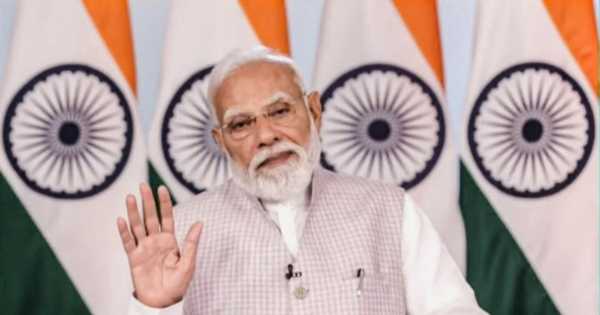

New Delhi, Mar 9 : Prime Minister Narendra Modi on Monday called for accelerating the process of linking the country’s education sector to the real world economy, while sharpening focus on subjects like artificial intelligence and automation.
Addressing a post-budget webinar, he also said that fulfilling aspirations of the people is the resolve of his government and education, skill development, health, tourism, sports and culture are some of the sectors that act as a medium to fulfil them.
“Fulfilling the aspirations of the people is not just a subject, but it is the core objective and the resolution of this government,” he said at the webinar which was attended by stakeholders from different government ministries, departments and experts from private sectors.
The prime minister said education, skill, health, tourism, sports, culture are fundamental sectors and major means of fulfilling these public aspirations.
“In the country, continuous efforts are being made to link education with employment and enterprise. The new National Education Policy (NEP) provides the foundation for a curriculum that must stay aligned with market demands and the real-world economy, specifically in fields like AI, automation and the digital economy. We will have to accelerate the process of linking our education system with the real world economy,” he said.
Discussing the nexus between education, employment, and enterprise, the prime minister highlighted the promotion of the Animation, Visual Effects, Gaming and Comics (AVGC) sector.
Asserting that India is moving towards an innovation-driven economy, he called upon academic institutions to transform their campuses into hubs of industry collaboration and research-driven learning to provide students with essential real world exposure.
“I would urge you that in this webinar, there must be a brainstorm on developing your campuses as centres of industry collaboration and research-driven learning,” he said.
Calling for a robust research ecosystem that encourages young researchers to innovate and experiment without barriers, Modi emphasised, “We have to create such a research ecosystem where young researchers get full opportunity to experiment and work on new ideas.”
The prime minister said another important sector is STEM: Science, Technology, Engineering, and Mathematics.
“It is heartening to see that the daughters of our country have a great interest in STEM. Today, when we talk about futuristic technologies, it is important that no daughter is held back due to a lack of opportunities. We must create a research ecosystem where young researchers get ample opportunities to work on new ideas,” he said.
He said the health sector has been strengthened, the Ayushman Bharat Yojana and Arogya Mandirs have led to greater penetration of health services in rural areas.
Referring to the ‘care economy’, through which trained caregivers help senior citizens, Modi said as the senior citizen population increases, the demand for caregivers will also rise.
“I request that new training models should be developed,” he said.
The prime minister said India is working on a vision of preventive and holistic health today and in the past few years, the country’s health infrastructure has been strengthened.
He said new medical colleges have opened in hundreds of districts and through the Ayushman Bharat scheme, access to health services has been extended to villages via wellness centres.
Modi also talked about the “youth power” of the country and said it becomes “national power” only when it is healthy, disciplined, and brimming with self-confidence.
“That is why, in the past few years, sports have been viewed as an important stream of national development,” he said.
The prime minister said initiatives like Khelo India have infused a new energy into the country’s sports ecosystem and sports infrastructure is being strengthened across the country.
On the potential of tourism and culture to drive employment, he noted that developing new destinations beyond traditional spots boosts a city’s branding and overall development.
“Trained guides, hospitality skills, digital connectivity, and community participation are becoming the pillars of our tourism sector. Alongside these, cleanliness and sustainable practices are essential. Your suggestions on tourism and related areas will be of immense importance as we work together to strengthen India’s position as a global destination,” he said. (PTI)