
ROOPAK GOSWAMI
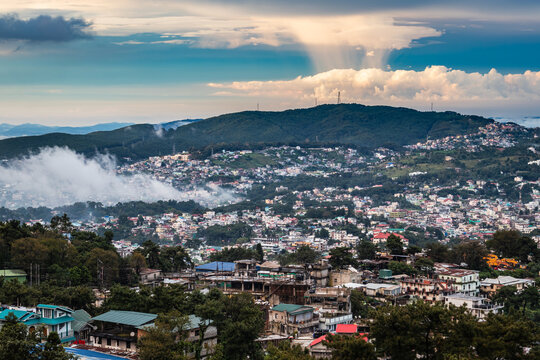
Shillong, March 17: While most cities across Northeast India are experiencing rising urban temperatures due to rapid urbanisation, Shillong has emerged as a rare exception, showing a decline in the urban heat island (UHI) effect over the past three decades, according to a new scientific study.
The research, published in Theoretical and Applied Climatology, analysed 30 years of satellite data (1994–2024) to examine how land cover changes have influenced surface temperatures in eight state capitals of Northeast India — Shillong, Guwahati, Imphal, Agartala, Gangtok, Kohima, Aizawl and Itanagar.
The study was conducted by scientists from the Department of Architecture, Planning and Design, IIT (BHU), Varanasi, and the Department of Remote Sensing and GIS, Soban Singh Jeena University, Almora.
Urban heat island refers to the phenomenon where cities become warmer than surrounding rural areas due to dense construction, reduced vegetation, and heat-absorbing surfaces such as roads and buildings.
However, unlike many other cities in the region, Shillong showed a declining trend in UHI intensity, suggesting that its ecological landscape and vegetation cover may be helping regulate local temperatures.
“Shillong exhibited a decline in UHI intensity, decreasing from 8.72°C in 1994 to 7.24°C in 2024,” the study reported.
Researchers attribute this unusual trend to an increase in vegetation cover and the city’s cooler high-altitude climate, which appear to have offset the warming effects typically associated with urban growth.
“Shillong’s distinctive pattern is likely due to its increase in vegetation cover, which appears to have mitigated the thermal impact of urbanisation,” the study noted.
The study found that Shillong recorded a significant increase in vegetation cover — about 22.25 sq km between 1994 and 2024 — partly due to the conversion of agricultural land into green spaces.
This expansion of greenery has played a crucial role in moderating temperatures, as vegetation cools urban environments through shade and evapotranspiration.
In contrast, many other cities in Northeast India showed a steady rise in surface temperatures as urban expansion replaced forests, farmland and open spaces with built infrastructure.
For instance, Guwahati recorded the largest increase in built-up area, expanding by over 93 sq km during the study period, while several cities experienced significant declines in vegetation cover.
These changes are directly linked to rising urban temperatures.
“The reduction in vegetation cover diminishes evapotranspiration, while the proliferation of built-up surfaces enhances heat storage and re-radiation, thereby amplifying surface and atmospheric temperatures,” the researchers explained.
The study also found that urban heat hotspots typically develop in densely built city centres, where concrete surfaces absorb and retain heat. As cities expand, these hotspots gradually spread outward into surrounding areas.
Shillong’s experience suggests that urban growth does not necessarily have to lead to extreme warming if ecological buffers are maintained.
The researchers emphasised that preserving green cover and integrating nature into city planning can significantly reduce the impact of urban heat.
“The contrasting case of Shillong highlights the critical role of vegetation and naturally cooler environments in mitigating UHI impacts,” the study said, noting that barren land expansion in the city was relatively limited.
Experts say the findings offer valuable lessons for cities across the Northeast.
By strengthening green infrastructure, conserving vegetation, and adopting climate-sensitive urban planning, cities can reduce heat buildup while supporting sustainable development.
The Meghalaya government has also launched an ambitious avenue plantation project aimed at transforming the upcoming New Shillong Township into one of the region’s greenest urban centres.
Under the initiative, rolled out in 2025, the state plans to plant 6,000 trees along more than 25 km of roads and 2 km of medians, with an investment of ₹2.5 crore over five years. Officials say the project is designed to ensure that rapid urban development does not come at the cost of ecology.
The plantation drive will cover key arterial routes, including the Ummir Junction–Mawkhanur corridor, where over 6,300 saplings have already been planted along a proposed 16.56 km stretch, against a target of 10,000 plants.
Unlike routine beautification efforts, the initiative is being positioned as a green infrastructure intervention. According to official documents, the plantations are expected to reduce air pollution, mitigate the urban heat island effect, control soil erosion, and improve road safety and urban aesthetics.
The study also contributes to global climate goals, particularly Sustainable Development Goals (SDG) 11 (Sustainable Cities and Communities) and 13 (Climate Action), by offering a data-driven framework to understand and address climate-related challenges in rapidly growing urban environments.