
ROOPAK GOSWAMI
Shillong, April 19: At the University of Science and Technology Meghalaya (USTM), a different kind of campus comes alive after dark.
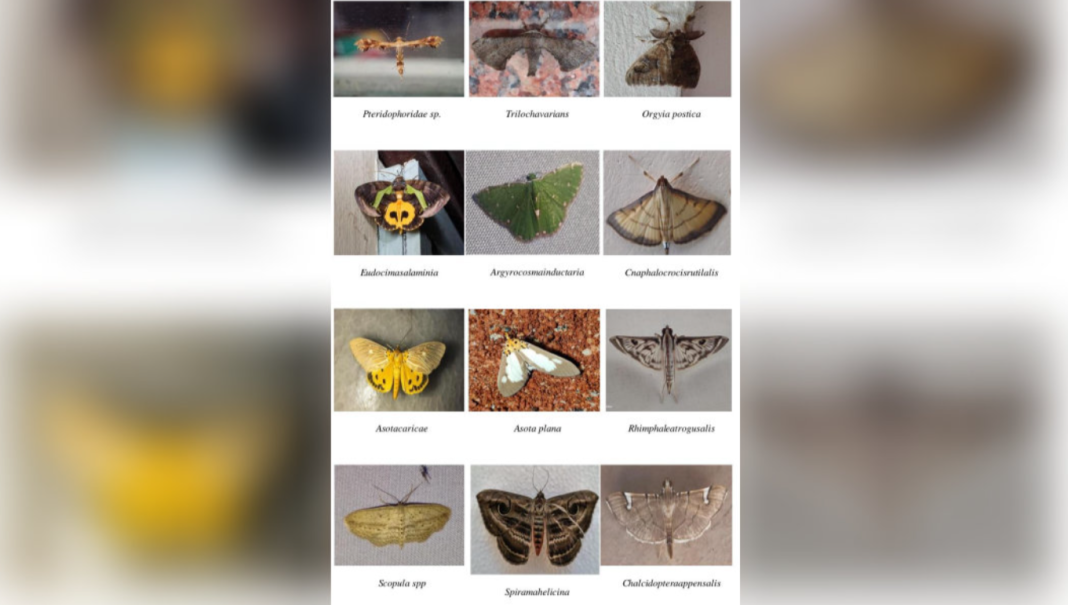
A year-long study has recorded 80 species of moths across 11 families, including 28 species not previously documented on the campus, highlighting an overlooked layer of biodiversity in the semi-urban university landscape.
The study was conducted by researchers Ahmed Golphina, Bhattacharya Anindita, Mazid Salma, Borah Alika Borphukan, and Mahanta Mridusmita over 13 months using ultraviolet light traps, night surveys, and photographic identification.
Located within a biodiversity-rich zone influenced by subtropical forests, the USTM campus provides conditions conducive to a wide range of moth species. An earlier study had documented 52 species from nine families, but the present research expands that baseline through systematic sampling across multiple seasons.
The campus itself plays a key role. A mosaic of semi-evergreen and secondary vegetation, interspersed with plantations, gardens, grasslands, and regenerating forest patches, creates a high degree of habitat diversity. Native trees, shrubs, grasses, ornamental plants, and cultivated crops together offer a variety of larval host plants and nectar sources, supporting a broader range of species.
Two families—Erebidae and Crambidae—accounted for more than three-fourths of the total observations.
While some species were recorded frequently, others appeared only once or twice during the study period, indicating differences in adaptability and habitat preference.
Reflecting on the findings, researcher Ahmed Golphina said moths often go unnoticed in biodiversity documentation. “The hidden jewels of the night reveal themselves only to those who look beyond daylight biases in biodiversity studies,” she said.
Though often overlooked, moths are considered important ecological indicators due to their sensitivity to environmental changes.
The diversity recorded in the study suggests that the USTM campus continues to support a relatively stable ecosystem despite increasing urbanisation in surrounding areas.
“Documenting moth diversity is not just a taxonomic exercise but a crucial step toward understanding ecosystem health and resilience,” said researcher Bhattacharya Anindita.
The findings underline that biodiversity is not confined to forests or protected areas.
Everyday spaces such as university campuses and mixed-use landscapes can sustain significant species diversity if habitat variation is maintained—an important insight for Meghalaya, where land-use patterns are changing rapidly.
The researchers note that continued monitoring of moth populations could help detect early signs of ecological stress.
The study adds to growing evidence that even routine spaces can host complex ecological networks—most of which remain unnoticed.