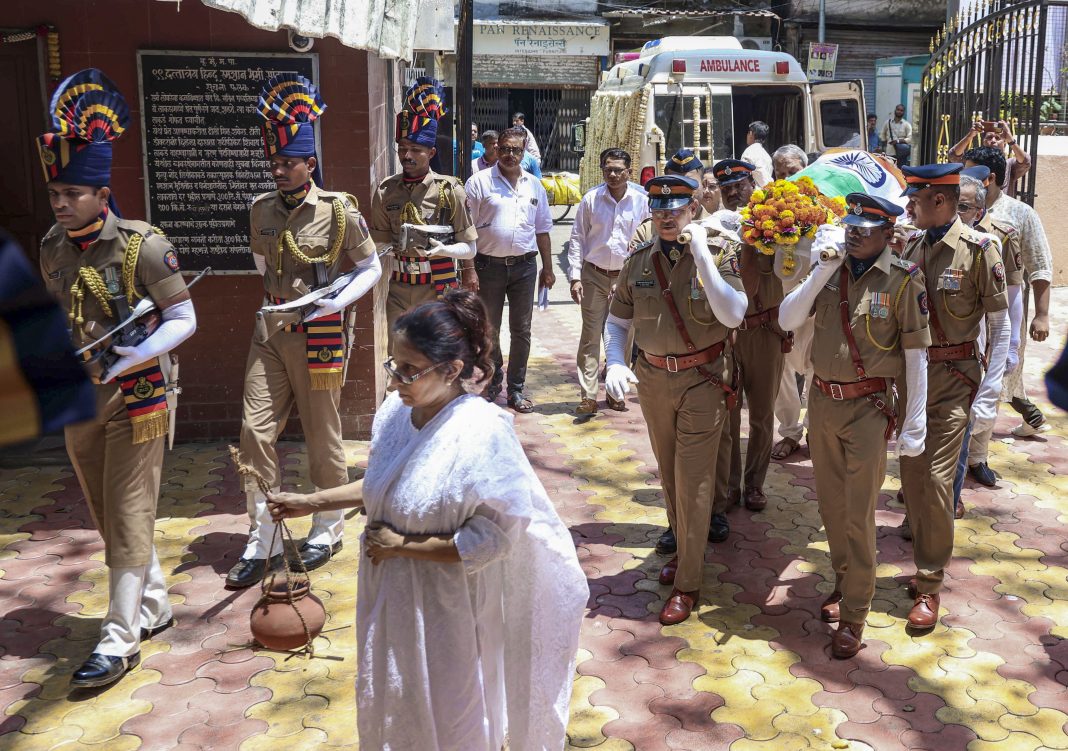

Mumbai, Jun 2: “Rahen Na Rahen Hum”… the strains of that elegiac song played in the backdrop as the last rites of Suman Kalyanpur, who should have been part of a Lata-Asha-Suman playback powerhouse but may not have got her full due, were held here on Monday with state honours.
The singer of melodies, ranging from the soulful “Na Tum Hamen Jano” to the rocking “Aaj Kal Tere Mere”, died on Sunday night following age related ailments at her home. She was 89.
Her body was draped in the tricolour and Mumbai Police personnel offered a ceremonial salute at the Santacruz crematorium where daughter Charu performed the last rites.
As the pyre was lit, many friends and family sang the evocative duet “Rahen Na Rahen Hum, Meheka Karenge” from the 1966 film “Mamta” to bid a final farewell to the singer who made her presence felt — and became the legend she was — despite the domination of the Mangeshkar sisters.
“The passing of Suman Kalyanpur, who enriched Indian music, is an irreparable loss to the world of Indian art. She enchanted people with her melodious singing in Hindi and Marathi, as well as in numerous other Indian languages,” President Droupadi Murmu said in a post on X in Hindi.
From classical melodies to popular songs, the scope of her contributions is immensely vast and influential, the president said.
Prime Minister Narendra Modi said he was anguished by her passing.
“Her melodious voice and soulful renditions enriched our cultural world. Through her songs, she created a special place among music lovers and admirers of Indian cinema. Condolences to her family and admirers. Om Shanti,” Modi wrote on X.
The singer, also known for memorable numbers such “Behna Ne Bhai Ki Kalai Mein” and “Na Na Karke Pyaar”, was perhaps the only female singer of her era to make a space for herself in the Hindi music scene dominated by Lata Mangeshkar and Asha Bhosle.
Her melodious voice was often compared to Mangeshkar, something which became both a blessing and a curse. Those who could not afford Mangeshkar would sign up Kalyanpur. Her breakout moment came when Mangeshkar and Mohammed Rafi had differences over the issues of royalties. Because of this, Kalyanpur sang over 100 duets with Rafi.
“Suman ji had a great bond with abba and they both sang some really beautiful songs. She was a down-to-earth and humble person. Suman ji was with my father when he had an issue with Lata ji… during this time, his duets were mostly with Suman ji and Asha ji,” Mohammed Rafi’s son Shahid Rafi told PTI.
Kalyanpur’s songs would often get wrongly attributed to Mangeshkar. In 2022, Kalyanpur told PTI that Mangeshkar was a close friend.
“Everyone loved her (Lata’s) songs, and she will be immortal. We recorded a duet together for the film ‘Chaand’. Everytime I met her, it felt like I met a close friend. I believe she felt the same,” she said after Mangeshkar’s death.
Anand Virji Shah, of the legendary Kalyanji-Anandji composer duo, described Kalyanpur as very talented.
They collaborated on songs such as “Na Na Karte Pyar”, “Tumhi Mere Meet Ho Tumhi Mere Preet Ho”, “Aap Se Humko Bichhade Huye”.
“We worked with her on quite a few songs. She was very easygoing; she would do rehearsals, and she would pick up the song quickly. We shared a great professional relationship,” Anandji told PTI.
Mangala Khadilkar, who wrote Kalyanpur’s biography, said Kalyanpur sang more than 3,500 songs in 13 Indian languages, most prominently in Hindi, Marathi and Bengali.
“Her personality was reflected in her singing. The softness, sweetness, and gentleness of her nature found expression in her songs. Her voice was often compared to Lata ji’s voice but while there were similarities, they were distinctly different.
“I would describe ‘bhavgeet’ music as an equilateral triangle: Lata Ji with her divine voice, Asha Ji with her colorful and versatile voice, and Suman Kalyanpur Ji with her honey-sweet voice, marked by humility, composure and grace,” Khadilkar told PTI.
Born in January 1937 in Dhaka, Kalyanpur initially pursued art and studied at the JJ School of Art but music was her true calling and she later trained under Pandit Keshav Rao Bhole, Abdul Rehman Khan and Guruji Master Navrang.
She made her playback debut in Hindi cinema with “Mangu” and sang three songs, but when composer Mohammed Shafi was replaced by O P Nayyar, only one of her tracks were included in the final movie. The song was “Koi Pukare Dheere Se Tujhe”.
Her most popular song “Na Tum Hamen Jano” was from Dev Anand-Waheeda Rehman hit “Baat Ek Raat Ki” with music by S D Burman. She also sang the title track for “Dil Ek Mandir Hai”. “Yun Hi Dil Ne Chaha” and “Chura Le Na Tumko Yeh Mausam Suhana” were hits from “Dil Hi To Hai”. The movie also had Mangeshkar and Bhosle as singers alongside Mukesh.
In many albums from the era, Kalyanpur got the duet but Mangeshkar the solos.
In “Jahan Ara”, she sang the duet “Baad Muddat Ke Yeh Ghadi Aayi” with Rafi. Mangeshkar was credited for the other four songs in the movie. Similarly, in “Sanjh Aur Savera”, “Ajhun Na Aye Balamwa” was sung by Kalyanpur and Rafi while Mangeshkar was credited for solo numbers. Bhosle also sang a duet in the film with Rafi.
In 2023, Kalyanpur was awarded with the Padma Bhushan. (PTI)