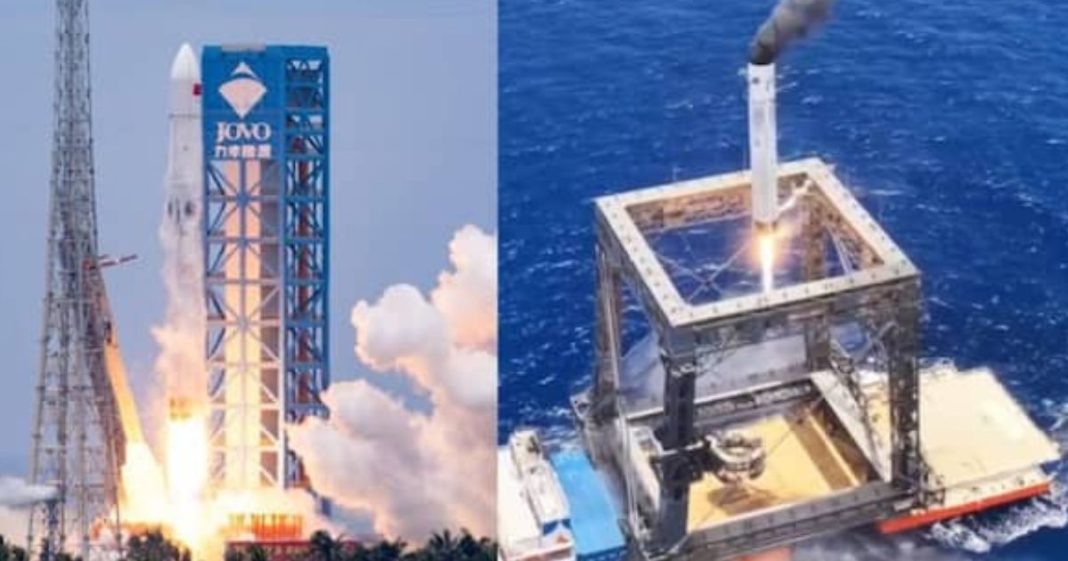

Beijing, Jul 10: China on Friday achieved its first controlled recovery of an orbital-class reusable rocket booster after the maiden launch of its Long March-10B carrier rocket, marking a major milestone in the country’s reusable space technology.
The achievement comes over a decade after US-based SpaceX, founded by Elon Musk, became the first company to successfully recover an orbital-class rocket booster in December 2015.
Friday’s mission marked China’s first successful controlled recovery of a carrier rocket’s first stage and represented a major breakthrough in the country’s reusable rocket technology, state-run Xinhua news agency reported.
A controlled recovery of a carrier rocket’s first stage involves safely returning a rocket booster back to Earth for reuse after it delivers its payload.
Last December, two other Chinese reusable rockets attempted SpaceX-style vertical landings using grid fins and landing legs, but both attempts ended in failure, the Hong Kong-based South China Morning Post reported.
The Long March-10B carrier rocket was launched from south China’s Hainan Province and successfully placed its payload into the designated orbit, Xinhua reported.
After the separation of the rocket’s first and second stages, the first-stage booster returned and was successfully captured on a sea-based platform using a net-capture system.
Both the launch and the recovery of the first-stage booster were completed successfully, the report said.
The SpaceX breakthrough of 2015 demonstrated the feasibility of reusable rockets, significantly reducing launch costs.
Unlike SpaceX, whose boosters typically land on ground-based or drone-ship landing pads, the Long March-10B’s first-stage booster was recovered at its launch site on a sea-based platform.
Videos circulating on social media showed crowds cheering as the booster descended steadily onto the recovery platform.
The Long March-10B is a reusable liquid-fuelled commercial launch vehicle measuring about 63 metres in height and five metres in diameter.
It has a lift-off thrust of about 890 tonnes and a lift-off mass of around 760 tonnes.
In its reusable configuration, the rocket is capable of carrying a payload of 16 tonnes to low-Earth orbit, according to the Xinhua report. (AP)