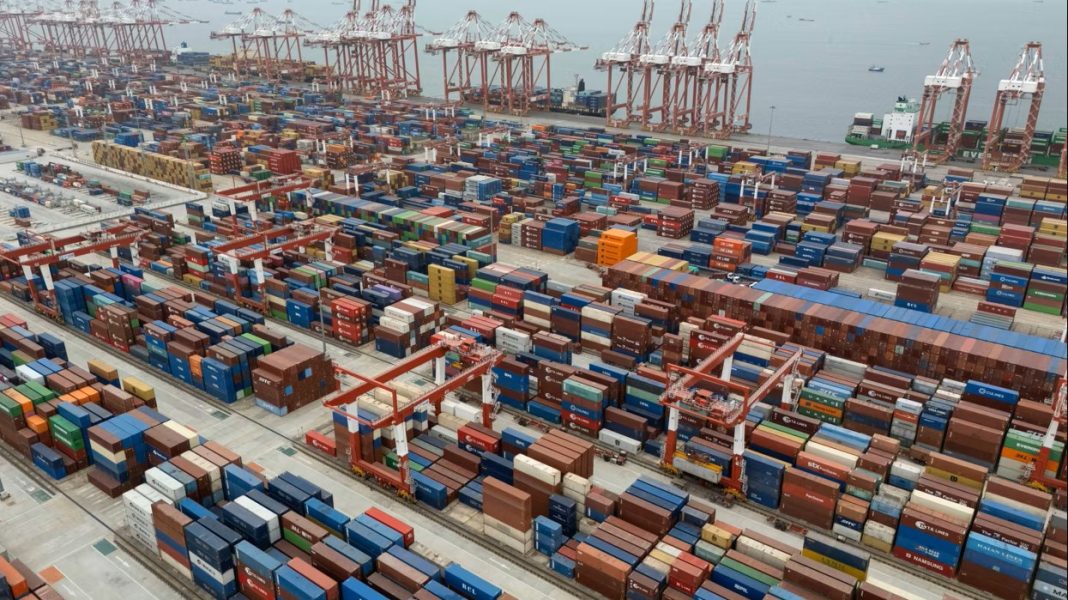

Washington, Jul 16: The US Treasury last year swelled with revenue from President Donald Trump’s double-digit taxes on imports from almost every country on earth.
But the money dried up after the Supreme Court struck down the biggest and boldest of Trump’s tariffs in February.
The question now is: Can the president’s trade team make good on its promise to replace the lost revenue?
A deadline is approaching rapidly.
After the Supreme Court setback, the president turned first to Section 122 of the Trade Act of 1974 to impose 10 per cent tariffs globally. But Section 122 only authorises tariffs for 150 days. Trump’s expire on July 24. Congress would have to extend those tariffs — something lawmakers are unlikely to do as the November 3 midterm elections approach amid voter discontent over the high cost of living.
But the administration has more durable options: Section 301 of the same 1974 trade law permits the president to impose tariffs and other sanctions against countries found to engage in “unjustifiable,” “unreasonable” or “discriminatory” trade practices.
Trump used Section 301 to impose big tariffs on China in his first term and is rolling them out again — as recently as late Wednesday when he announced 25 per cent tariffs on some Brazilian imports, charging the world’s 11th-biggest economy with a host of unfair trade practices.
Trade attorneys and analysts are confident the tariff-happy Trump administration will manage to beat the clock and swap out Section 122 tariffs with bigger Section 301 tariffs by the July 24 deadline.
“They’re going to raise the tariff wall again,” said trade lawyer Ryan Majerus, a partner at King & Spalding and a trade official in Trump’s first administration and in President Joe Biden’s.
Trump last year tested – and exceeded – the limits of his authority to impose import taxes, a power the US Constitution gives Congress. He invoked the 1977 International Emergency Economic Powers Act (IEEPA) to slap big tariffs on most of the world’s countries.
He justified the levies, which marked a stunning reversal of decades of US policy in favour of lower tariffs and freer trade, by labelling America’s longstanding trade deficits a national emergency.
The Supreme Court didn’t buy it, ruling in February that the president couldn’t use the emergency powers law to impose tariffs at all. The legal defeat meant the administration had to send refunds to importers that had paid the levies.
As a result, tariffs have at least temporarily gone from a windfall to a drain on the Treasury.
Revenue from import taxes peaked at more than USD 31.4 billion last October. Then, after the Supreme Court ruling, it started dwindling – to USD 22 billion in both March and April.
As refund checks went out faster than revenue from the Section 122 and other tariffs came in, the number turned negative: A small (USD 42 million) shortfall in May was followed by a whopping USD 25.6 billion loss in June.
Trump and Treasury Secretary Scott Bessent have vowed to use other legal authorities to recoup the lost income.
Enter Section 301, which gives the president power to impose – and adjust – tariffs in response to other countries’ trade practices. But the administration must first check procedural boxes – collecting comments and holding hearings. There are no limits on Section 301 tariffs. They expire after four years but can be renewed.
So the president has flexibility in how he uses the Section 301 tariffs. Trump can still change them — after clearing procedural hurdles — but he can’t impose or move them up or down on a whim as he often did with the IEEPA tariffs.
Uncertainty over Trump’s tariff policy has vexed businesses, leaving them hesitant to make investments and decisions because they don’t know what the trade rules are going to be.
A switch to rule-bound 301 tariffs would mean “there’s less uncertainty but not no uncertainty,” said Sarah Bianchi, a former US trade official who is now chief strategist of international political affairs at the investment research firm Evercore ISI.
The Trump administration has turned to two big Section 301 investigations in its campaign to replace lost tariff revenue.
One accuses 60 countries, accounting for 99 per cent of US imports, of failing to do enough to crack down on imports created by forced labour. The other is investigating whether 16 US trading partners — including China, the European Union and Japan — are overproducing goods, driving down worldwide prices and putting American manufacturers at a disadvantage.
The administration has already decided what it wants to do about the forced labour issue. Invoking Section 301 last month, US Trade Representative Jamieson Greer proposed tariffs — 10 per cent on 16 countries and 12.5 per cent on 44 — that are the same or slightly higher than the 10 per cent Section 122 levies they would replace. But Greer’s office is still receiving public comments on the proposed tariffs and has not imposed them yet.
Nathaniel Halvorson, a partner at the Baker McKenzie law firm and a former US trade official, expects Greer’s office will manage to get the forced-labour levies in place in time so that there won’t be much, if any, “daylight” between them and the expiring Section 122 tariffs. “Really, they’re operating about as fast as legally possible,” he said.
The administration has not yet completed the other Section 301 investigation into alleged overproduction by 16 countries.
Trade attorney Majerus expects the administration to propose more big tariffs in that case, likely in a month or two. He suspects they will be timed to take effect only after the midterm elections “for obvious reasons.”
Trump, who has proudly called himself “Tariff Man,” has made it clear that he is seeking to bring back the big, worldwide import taxes he’d imposed in 2025. So the new 301 investigations look like a pretext to do that and might be vulnerable in court, Bianchi said.
“Section 301s have been pretty legally durable,” she said. “But no one has tried to use it to basically put in place universal tariffs. I think there will be legal challenges.” (AP)