
By Dipak Kurmi
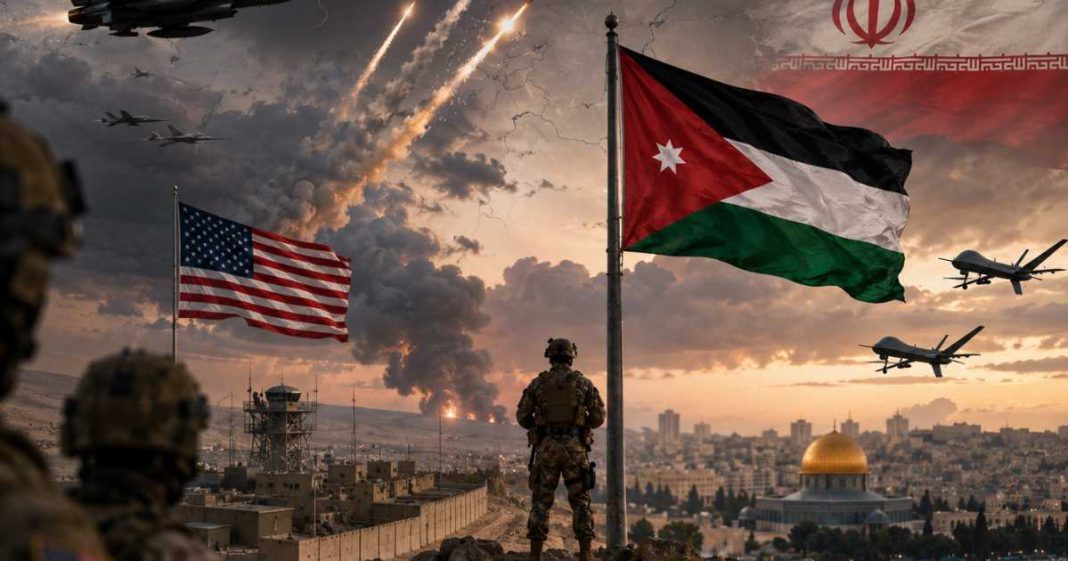
The recent escalation between the Islamic Republic of Iran and the United States has once again placed the Hashemite Kingdom of Jordan in an exceedingly precarious geopolitical position. An attack by Iran’s Islamic Revolutionary Guard Corps (IRGC) targeting an American military facility inside Jordanian territory—resulting in the deaths of at least two United States service members—ignited a dangerous cycle of direct strikes and retaliation between Washington and Tehran. In the aftermath, American forces targeted Iranian military sites, while the Royal Jordanian Air Force intercepted additional Iranian missiles and unmanned aerial vehicles entering the country’s airspace. Although Amman has consistently sought to insulate its territory and population from regional conflict, these developments underscore how inexorably Jordan is being drawn into the wider strategic contest. Positioned along the fault lines of Middle Eastern politics, the kingdom finds its security environment increasingly compromised by the confrontation between Western powers and Tehran’s regional influence.
This involvement in the military crossfire is not an isolated incident, but the continuation of a pattern established in recent years. In April 2024, during Iran’s first direct large-scale attack on Israel, the Jordanian Air Force intercepted and destroyed Iranian drones and missiles traversing its airspace toward Israeli targets. From Tehran’s perspective, Amman’s action was viewed not as a neutral defense of sovereign airspace, but as direct assistance to Israel, reinforcing deep-seated suspicions regarding Jordan’s strategic alignment. This operational intervention highlighted the kingdom’s structural integration into Western security arrangements, convincing Iranian military planners that Jordan serves as a key component of the regional coalition containing Iran. Consequently, Jordan’s attempt to balance strict territorial neutrality with its defense commitments has become increasingly difficult to maintain as regional hostilities intensify.
Despite sharp rhetoric, Iran’s hostility toward Jordan is fundamentally strategic rather than ideological or sectarian. The Islamic Republic targets Jordan less because of its domestic political structure and more because of its geography, formal alliances, and central role in the regional security architecture. Situated squarely between Iran’s sphere of influence in Iraq and Syria and the state of Israel, Jordan serves as a crucial geographical buffer. Furthermore, as a close partner of the United States and a hub for Western military coordination, the kingdom occupies a highly sensitive position in the Middle Eastern balance of power. Any Iranian initiative to project influence westward or challenge Western regional dominance inevitably confronts the territorial and strategic barrier presented by the Hashemite monarchy.
This strategic alignment is particularly notable given Jordan’s complex internal demographics. An estimated fifty to sixty percent of the population is of Palestinian origin, including prominent figures such as Queen Rania, wife of King Abdullah II, whose family roots trace to the West Bank. Despite widespread public sympathy for the Palestinian cause and strong popular pressure during regional crises, the Jordanian state has consistently prioritized its strategic partnership with Washington and maintained a cautious security relationship with Israel under their 1994 peace treaty. Navigating these intense domestic political currents alongside rigid national security imperatives requires a delicate balancing act. The government seeks to maintain essential Western economic and military support while managing popular disaffection regarding regional foreign policy.
The evolution of Jordan-Iran relations reveals a dramatic shift from historic cooperation to systemic mistrust. Prior to the watershed 1979 Iranian Revolution, bilateral ties between Amman and Tehran were remarkably cordial. Both the Hashemite Kingdom of Jordan and the Pahlavi monarchy of Iran operated as pro-Western dynastic states navigating the ideological pressures of Cold War geopolitics. Both governments maintained close strategic partnerships with Washington, engaged in quiet security cooperation with Israel, and shared deep anxieties regarding revolutionary movements and regional radicalism. In particular, the rising influence of Arab nationalist movements inspired by Egyptian President Gamal Abdel Nasser posed a common threat to monarchical stability. During this era, Jordan and Iran regarded one another as natural allies in preserving the conservative regional order against revolutionary secular forces.
The 1979 Revolution fundamentally altered these geopolitical dynamics. The establishment of the Islamic Republic transformed Iran from a pro-Western monarchy into an ideological state dedicated to opposing Western influence, undermining US-aligned governments, and expanding its regional sway through support for militant groups. This ideological transformation deeply alarmed moderate Arab monarchies, including Jordan. Tensions deteriorated further during the Iran-Iraq War from 1980 to 1988, when Jordan decisively backed Saddam Hussein’s Iraq with vital political and economic assistance. For Tehran, Jordan’s active support for Baghdad cemented the perception that Amman was firmly aligned with an opposing regional camp, establishing a profound foundation of institutional mistrust that persisted long after the conflict ended.
Relations remained constrained in subsequent decades, but strategic rivalry intensified following the 2003 United States invasion of Iraq. The overthrow of Saddam Hussein removed a major regional counterweight, enabling Iran to expand its political and military influence among Iraq’s Shia parties and armed factions. Fearing that Iranian influence was extending through Iraq into Syria and Lebanon, King Abdullah II issued a famous warning in 2004 regarding a potential “Shia crescent.” While critics suggested the concept oversimplified regional nuances, it accurately captured Jordanian fears of an unbroken arc of Iranian-backed power reaching its eastern border. The collapse of Iraqi state neutrality transformed Jordan’s eastern perimeter into a potential conduit for Iranian power projection.
The Syrian civil war after 2011 further sharpened these security concerns. Iran emerged as a principal backer of Bashar al-Assad’s government, deploying military commanders, Hezbollah forces, and affiliated militias across Syria. Sharing a direct border with Syria, Jordan faced immediate risks from instability, Iranian-aligned armed groups near its territory, and illicit cross-border smuggling networks, particularly drug trafficking. These escalating threats reinforced Jordan’s reliance on security cooperation with Western and regional Arab partners, leading to expanded joint defense exercises and intelligence sharing. However, this deeper security integration with the West further convinced Tehran that Jordan served as an operational platform aimed at curbing Iranian regional influence.
Despite persistent tensions, Jordan and Iran have deliberately avoided a total diplomatic rupture. Both nations recognize the hazards of direct military conflict and maintain active diplomatic channels to manage crisis situations. Today, Jordan views Iran not as an immediate conventional military invader, but as a primary source of asymmetrical instability through its proxy networks and regional expansionism. Conversely, Iran views Jordan as an integral component of an American-led regional security matrix that includes a formal peace treaty with Israel. Ultimately, the trajectory of Jordan-Iran ties illustrates a broader dynamic in Middle Eastern politics, where competing visions of regional order drive strategic rivalry. Jordan’s involvement in the ongoing Iran-United States confrontation is thus not an accidental occurrence, but the latest iteration of a complex, long-standing geopolitical struggle.
(the writer can be reached at dipakkurmiglpltd@gmail.com)