
By Dr. Bijoy A. Sangma
Recurring flooding at Jorabat demands accountability. Lasting solutions, however, require evidence before attribution.
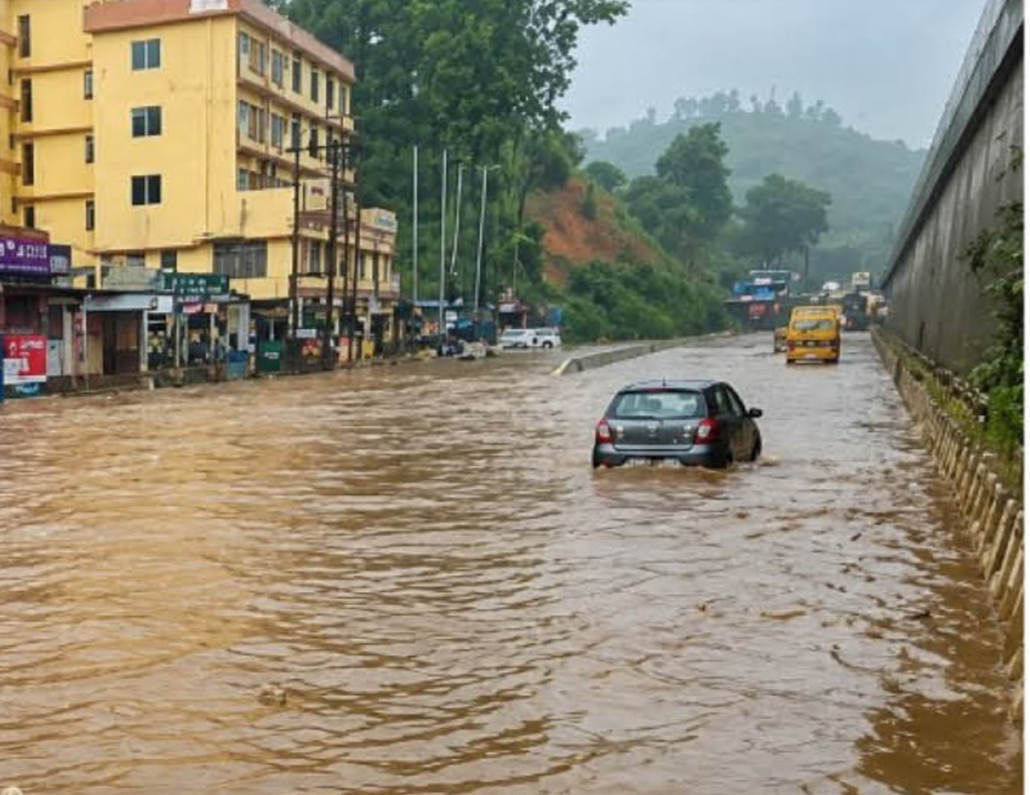
Each monsoon, Jorabat becomes more than a traffic junction. It becomes a reminder of the North East’s continuing struggle with urban flood management. Thousands of commuters are stranded for hours. Ambulances move slowly through long queues of vehicles. Schoolchildren miss classes. Trucks carrying essential goods stretch for kilometres along the highway. What begins as a local traffic disruption soon affects commerce and connectivity across Assam, Meghalaya and the wider Northeast. Public frustration is entirely understandable. So is the demand for accountability.
The concern is not simply about inconvenience. Jorabat is one of the busiest gateways into Guwahati and an important link between Assam, Meghalaya and other states. When this corridor slows to a crawl, businesses absorb delays, transport costs increase, emergency services are affected and valuable working hours are lost. The disruption extends well beyond the immediate area, affecting people and economic activity across the region.
Recognising the seriousness of the problem, the Assam Government has recently announced that ₹150 crore has been earmarked within the proposed Guwahati Ring Road project for flood mitigation measures around Jorabat. The announcement is significant not simply because of the amount involved, but because it acknowledges that the problem cannot be ignored any longer. Whether that investment succeeds will depend not only on engineering but also on sustained maintenance and sound environmental planning.
Public concern is therefore justified. Citizens have every right to ask why a problem that has persisted for years continues to return with such regularity. Governments must answer those questions, and wherever environmental laws have been violated or public infrastructure has been compromised, those responsible should be held accountable.
The more difficult question is how that responsibility should be determined.
In recent years, the discussion around Jorabat has increasingly moved beyond flooding itself. Before technical assessments are completed, explanations begin to harden into conclusions. Political statements are interpreted as established findings. Public debate often fills the gaps left by incomplete information. By the time engineers and hydrologists begin examining the causes, much of the conversation has already settled on where responsibility lies.
The present controversy has become a test not only of environmental compliance but also of how public institutions establish responsibility. Allegations have been made that activities in the upstream hills have contributed to flooding. Such concerns deserve careful and impartial investigation. If any institution, public authority or private developer has altered natural drainage, violated environmental regulations or increased flood risk, the law should take its course without hesitation.
But investigation must come before judgment. That principle is not about protecting any institution. It is about protecting the credibility of environmental governance. Scientific evidence, not public opinion, should determine responsibility. Otherwise, accountability itself becomes vulnerable to perception rather than proof.
The landscape around Jorabat has changed significantly over the past two decades. Urban expansion has accelerated. Residential colonies and commercial establishments have grown on both sides of the Assam-Meghalaya border. Wetlands have diminished, natural drainage channels have been altered in many places and transport infrastructure has expanded to meet rising demand. At the same time, episodes of intense rainfall have placed increasing pressure on drainage systems that were often designed for different conditions. Climate alone does not explain flooding, nor does it excuse poor planning or environmental violations. It does, however, make existing weaknesses more visible.
The recurring floods at Jorabat are therefore more than a seasonal disruption. They remind us that environmental decisions should be guided by evidence rather than assumption. That principle is essential not only for achieving justice but also for preventing the next flood.
Evidence Before Conclusions
The current debate has largely centred on one question: have activities in the upstream hills contributed to the flooding at Jorabat and Guwahati? It is an important question because environmental responsibility cannot be ignored wherever there is credible evidence of harm. At the same time, it is not the only question that deserves attention.
Floods are rarely the result of a single event or a single decision. They are usually the outcome of many factors acting together over time. Rainfall, topography, natural drainage, wetlands, urban expansion, road construction and changes in land use all influence how water moves across a landscape. In a rapidly growing urban corridor such as Jorabat, those factors interact in ways that cannot be understood through observation alone. They require careful technical assessment.
Assam Government-commissioned technical assessments over the years present a remarkably consistent picture. They do not explain Guwahati’s floods through a single cause. Instead, they identify a combination of rapid urbanisation, shrinking wetlands, encroachment on natural drainage channels, siltation and inadequate stormwater infrastructure acting together across an interconnected watershed. The same understanding informs the Government’s flood mitigation strategy, which combines measures to manage runoff from the surrounding hills with major investments in drainage, pumping systems and wetland restoration within the city. This broader assessment is reflected in the Assam State Disaster Management Authority’s review of earlier flood studies and in the Government’s Mission Flood-Free Guwahati strategy. Together, they suggest that reducing flood risk requires action across the entire watershed rather than focusing on one location or one institution alone.
Seen in this context, the ongoing investigation should not be viewed as an obstacle to accountability but as the means of achieving it. If scientific evidence establishes that any institution, government agency or private developer has contributed to flooding through unlawful hill cutting, obstruction of natural drainage or other environmentally harmful activities, corrective action should follow without delay. Environmental law means little if proven violations are ignored.
The same principle applies with equal force in the opposite direction. Allegation should not become a substitute for evidence. Public confidence in environmental regulation depends not only on firm enforcement but also on fair enforcement. Conclusions that cannot withstand scientific scrutiny rarely stand the test of time.
For that reason, the decision of the Governments of Assam and Meghalaya to seek an independent scientific assessment through the North Eastern Space Applications Centre (NESAC), with technical support from IIT Roorkee, is a welcome step. Rather than allowing competing narratives to shape public understanding, both governments have accepted that hydrological questions are best answered through hydrological investigation. Whatever the findings, they will provide a far stronger basis for policy than assumptions formed in the midst of public debate.
Equally important is what happens after the study is completed. Its findings should be placed in the public domain. Transparency strengthens public trust, allows independent scrutiny and ensures that future decisions are informed by evidence rather than speculation. Where shortcomings are identified, they should be addressed promptly, whether they relate to environmental compliance, drainage infrastructure or broader patterns of urban development. Floods rarely have a single author. Our conclusions should not have one either.
Beyond This Monsoon
The recurring flooding at Jorabat and Guwahati area presents an opportunity to look beyond the immediate controversy. Water does not recognise state boundaries. Rain falling over the Meghalaya hills eventually reaches the Assam plains, and once there, its movement depends upon the condition of drains, wetlands, culverts and rivers across the entire watershed. Managing one part of the system while neglecting another is unlikely to produce lasting results.
This calls for closer cooperation between Assam and Meghalaya. Regular sharing of hydrological data, coordinated land-use planning, protection of wetlands, timely maintenance of drainage systems and consistent enforcement of environmental laws would contribute far more to long-term flood resilience than recurring exchanges of accusation and denial. Environmental challenges that cross state boundaries require solutions that do the same.
What matters now is straightforward. Complete the ongoing flood mitigation works. Preserve what remains of the region’s natural drainage network. Prevent further encroachment on wetlands and water channels. Publish the findings of scientific investigations. Most importantly, act upon those findings without fear or favour. Accountability should neither stop at allegations nor hesitate when evidence is established.
For the people who travel through Jorabat every day, these are not abstract policy questions. They simply want roads that remain open during heavy rain, drainage systems that function as they should and public authorities that solve recurring problems instead of debating them each monsoon. Those expectations are reasonable. They should also be achievable.
When the next monsoon arrives, the people waiting at Jorabat will not be interested in who won this debate. They will simply want to know whether the road remains open. That is the standard by which governments, institutions and public policy will ultimately be judged.
If that question can finally be answered in the affirmative, the evidence will have spoken more clearly than any accusation ever could.
(The views expressed are the author’s own and are based on publicly available information. The article does not attribute legal liability, which remains subject to due process.)