
By Satyabrat Borah
The story of August fifteenth, nineteen forty seven, is often pictured through a glowing, nostalgic lens. Standard history books showcase a jubilant moment of national liberation, defined by brilliant tricolor flags, historic speeches, and crowds celebrating the fall of British colonial rule. The full truth of that day was far more complex, emotional, and fraught with profound human heartbreak. As the nation approaches eighty years of freedom, looking back at its very first day of independence reveals a raw, deeply human reality. That hot August Friday in New Delhi and across the vast subcontinent was not merely a grand party; it was a dizzying blend of euphoric hope and devastating tragedy, extraordinary courage and chaotic uncertainty.
The road leading up to the final midnight was marked by an exhausting race against time. Lord Mountbatten, the final British viceroy, had unexpectedly moved the transfer of power forward by nearly a year. Suddenly, a complex, centuries old empire was forced to dismantle itself in just a few chaotic weeks. When August fourteenth began to slip into August fifteenth, the atmosphere inside the Constituent Assembly in New Delhi was charged with electric tension and solemn reverence. Members gathered under heavy ceiling fans, their white khadi garments glowing under the warm lights. Just before the stroke of midnight, Jawaharlal Nehru rose to deliver his iconic Tryst with Destiny address. His voice echoed through the hall, speaking of a long suppressed soul finding utterance as the world slept. Outside, midnight crowds waited patiently in the muggy night air, roaring with joy as the clock struck twelve. The conch shells sounded, freedom had finally arrived, and the birth of a sovereign nation was officially proclaimed.
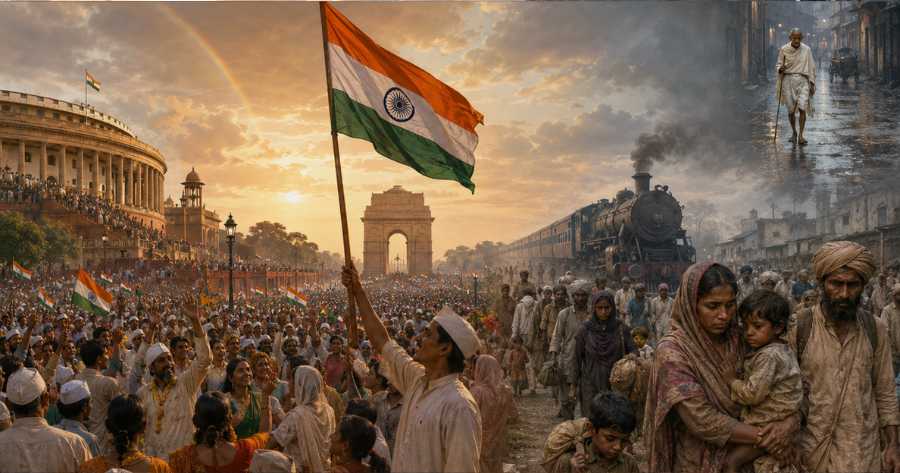
Morning brought an astonishing surge of human emotion to the streets of the new capital. Hundreds of thousands of people flooded the open lawns around the India Gate complex, eager to catch a glimpse of their new leaders and the symbol of their free nation. The sheer volume of the crowd shattered all official protocols and security arrangements. Royal carriages carrying foreign dignitaries were completely engulfed by cheering citizens. Mountbatten and his family found themselves surrounded by a sea of smiling faces, with Nehru himself eventually climbing onto the roof of a vehicle to help clear a path. When the moment came to raise the first official national flag, a sudden summer rain shower broke out over the capital, accompanied by a bright rainbow stretching across the sky. The crowd viewed the rain as a divine blessing, a refreshing cleansing of two hundred years of foreign subjugation.
A detail that often surprises people today is that the famous Red Fort flag hoisting tradition had not actually begun on that first morning. Millions now associate Independence Day with the Prime Minister addressing the nation from the historic ramparts of the Old Delhi fort, but on August fifteenth, nineteen forty seven, that ceremony did not take place. The formal unfurling of the national flag at the Red Fort occurred the following day, on August sixteenth. On the actual day of independence, the main public events were centered around the Constituent Assembly, Parliament House, and the open grounds near India Gate, making the day feel spontaneous, evolving, and completely unprecedented.
Distance yourself from the political center in New Delhi, and the scene transformed into something far more quiet and solemn. The man most responsible for inspiring the non violent struggle for freedom was entirely absent from the grand stage in the capital. Mahatma Gandhi spent August fifteenth, nineteen forty seven, in Kolkata, living in a dilapidated, rain soaked house in a neighborhood scarred by recent communal violence. He refused to wear new clothes, rejected invitations to attend official celebrations, and spent the entire day in prayer, fasting, and silence. For Gandhi, freedom achieved through the painful division of his country was a heartbreaking compromise. He walked barefoot through muddy lanes, urging Hindu and Muslim neighbors to put down their weapons and protect one another. His quiet presence in Bengal achieved what thousands of armed troops could not, keeping a fragile peace intact while other regions tore themselves apart.
Further north, across the green fields of Punjab, August fifteenth looked like an absolute nightmare. The tragedy of partition was unfolding with unprecedented horror. Millions of families woke up on their very first day of independence without knowing which country they actually belonged to. Cyril Radcliffe, a British lawyer who had never set foot in India before, had drawn the border lines dividing Punjab and Bengal in just thirty six days. The official boundary maps were deliberately kept secret until August seventeenth to prevent early panic, leaving entire towns in agony. In border cities like Lahore, Amritsar, and Gurdaspur, people raised different flags on their rooftops, guessing wildly which side of the line their homes would fall on.
The reality on the ground in the north was defined by dust, blood, and unimaginable human displacement. Endless foot columns of refugees, stretching for miles along sun baked roads, carried small bundles of possessions on their heads. Parents held their children tight as they walked toward an uncertain future, leaving behind ancestral properties, fertile lands, and generations of rich family history. Trains carrying terrified families across the newly invented borders were frequently attacked, arriving at stations as silent carriages of sorrow. Neighbor turned against neighbor in a sudden fit of madness, and millions of lives were shattered in a matter of weeks. For these displaced millions, August fifteenth was not marked by speeches or fireworks, but by the desperate struggle to keep their loved ones alive.
Away from the refugee roads, the new government faced an administrative crisis of staggering proportions. The country was not just geographically divided; its entire operational infrastructure had to be split down the middle. Civil servants spent the days leading up to independence dividing everything from railway tracks, military regiments, and police uniforms down to library books, typewriters, office chairs, and central treasury reserves. Even instruments in police brass bands were painstakingly inventoried and split between the two new nations. On top of this logistical nightmare, more than five hundred semi autonomous princely states were scattered across the map. Sardar Vallabhbhai Patel and his team worked around the clock, using a delicate mix of persuasion, political strategy, and sheer willpower to integrate these diverse territories into a single, cohesive republic.
Economic conditions on that first day were equally daunting. Two centuries of economic extraction had left the country severely impoverished, with a life expectancy barely reaching thirty two years. Widespread illiteracy, recurring famines, and a lack of modern industrial infrastructure meant the young democracy was stepping into the world with immense vulnerabilities. Foreign commentators and geopolitical analysts openly predicted that the nation would collapse within a few short years under the weight of its internal contradictions, poverty, and vast cultural diversity.
Understanding what August fifteenth, nineteen forty seven, really looked like requires holding two contrasting truths together in your mind. It was a triumph of human spirit, non violent resistance, and political courage that inspired anti colonial movements across the globe. It was also a profoundly painful human catastrophe that left deep, permanent scars on millions of hearts. The people who celebrated on that historic Friday did so with full knowledge of both realities. They cheered for the flag because it represented their dignity and self determination, even as they wept for the loved ones they had lost along the way.
That complicated, chaotic, beautiful, and heartbreaking day laid the ultimate foundation for the nation we see today. The democratic institutions built in the shadows of partition proved far more resilient than the skeptics ever imagined. The sheer determination of ordinary citizens turned a shattered post colonial territory into a thriving, vibrant power. As the nation marks nearly eight decades of freedom, remembering the true human face of August fifteenth, nineteen forty seven, serves as a powerful reminder. Liberty was never a simple gift; it was a deeply complex, dearly bought inheritance that continues to shape the soul of the country.