
Nagpur, Aug 15: Describing youth as a demographic dividend, RSS chief Mohan Bhagwat on Saturday said if their potential is harnessed properly, the nation will become a Vishwaguru; otherwise, it will become a heavy burden as this generation will become old after 30 years.
He also stressed that opposition and movements are an essential part of democracy when issues of public benefit are being raised. “Dialogue and debate must continue without harming the Constitution or the laws of the country,” he added.
Addressing youngsters at an event organised by the Lokmat Media Group at Kasturchand Park, Bhagwat said the youth will age after 30 years, and advised them not to think only of themselves but also to be sensitive to the needs of future generations.
He urged the youth to be courageous and face the future with confidence, saying they must work to shape their own destiny as well as that of the nation.
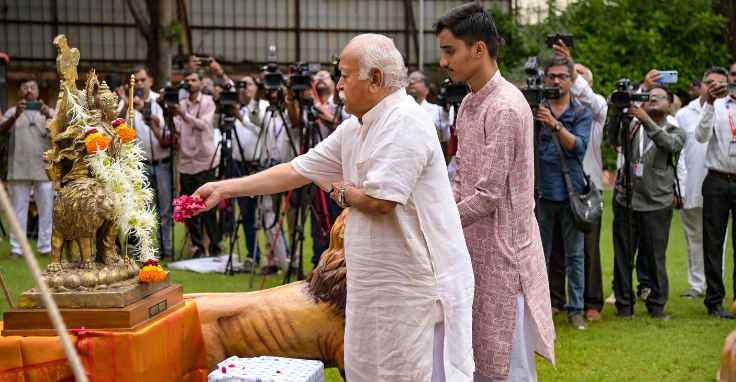
Bhagwat hoisted a 200-foot-high national flag erected by the Lokmat Media Group at Kasturchand Park in collaboration with the municipal corporation.
“The youth are a demographic dividend. We will benefit greatly if they are handled properly. If we make proper use of it, then country will become a ‘Vishwaguru’. If we fail to do so, it will become a heavy burden later because this young generation will become the older generation after 30 years,” he said.
The youth are going to be earning people. Employment is not only jobs, but also those who do labour work, and it needs to be treated with respect, he said.
He said India is entering the 80th year of its Independence, which was made possible by the sacrifices of those who fought to free the country. The younger generation, he said, must now think about the nation’s future.
Bhagwat noted that India is a vast country with immense diversity, including differences of language, region, caste and thought.
Referring to the Dharma Chakra on the national flag, Bhagwat asked the youth to reflect on its meaning. He said its spokes point in different directions and, if left exposed, could cause harm. Yet all the spokes originate from the same centre.
“The spokes go off in different directions with varying force, yet they originate from a single centre, and in doing so they must not cause harm,” he said.
Giving the example of the Dharma Chakra, Bhagwat said, “The laws and the Constitution of the country must not be harmed. Our ancient and sacred culture must not be harmed. Our good virtues and upbringing must not be harmed. Our moral strength must not be harmed.”
He said the circle surrounding the spokes represents restraint and ensures that differences remain within certain boundaries.
“That is why it is the Dharma Chakra. Dharma does not mean rituals and worship; dharma means the rules that shape a society’s conduct, and we must do everything living within those rules,” he said.
Bhagwat said there would always be different ideas and different ways of expressing them.
“This is a democracy, so there is dialogue, there are debates, and there are supporting and opposing sides. There will be mutually opposing viewpoints as well,” he said.
He stressed that opposition and movements are an essential part of democracy when issues of public benefit are being raised.
“Opposition will have to happen. When beneficial issues are raised, they must be raised strongly. Work must be done on them; one must apply effort. Movements happen, all of that happens,” he said.
However, he said such differences must not undermine the Constitution or the unity. Referring to Dr B.R. Ambedkar’s speeches on the Constitution, Bhagwat said the principles laid down by its framers should continue to guide the country.
He urged people to work together to build the nation despite their differences.
“We must move forward together. We must never split. There must be no internal dispute,” the RSS chief said.
Referring to the colours of the national flag, Bhagwat said the saffron, white and green represented important values that citizens should reflect in their lives. The message of the Dharma Chakra, he said, was that despite India’s diversity, people must continue to move forward together.
“If we go together, the great dignity of our large country will be able to flutter freely in the high winds; it will be able to shine its light on the whole world. That is what we must do, and in that future lies my and my family’s future. For that future I will work, so that both the country and my family will be all right,” he said.
Drawing a parallel with the efforts required to hoist the giant tricolour at the event, Bhagwat said people should reflect on what the national flag represents. He also urged the youth not to compare India with other countries.
“We are not America, China, Australia or New Zealand. We are India,” he said, adding that the country’s development model must be shaped according to India’s own needs, dignity and strengths.
Bhagwat said the rest of the world often focuses primarily on material advancement, whereas India has traditionally taken a broader view of progress.
“The world is stumbling today because it thinks otherwise, because of a partial vision. It becomes India’s duty, from our perspective, to steady that faltering world and show it the way forward,” he said.
He also stressed the need to promote entrepreneurship, saying young people would have to face hurdles with courage and work towards success.
Bhagwat said India’s large population and comparatively smaller geographical area meant the country could not simply adopt the approaches followed by nations such as Canada, the United States and China.
“It is sufficient for countries to think only about employment which have less population, or huge geography, or countries having huge resources.
“But a country like Bharat, with a huge population, has less geography than Canada, the US and China, and because of this, we need a completely separate thought process for our issues. For that, we must look at things from our own perspective,” he said.
Bhagwat also urged young people to keep their courage alive and not allow concerns about their personal or family future to diminish it.
He said the same courage which others might regard as recklessness could help young people in their work, family responsibilities and service to the country.
“With that courage we must face the future ahead of us. We must meet it head-on. We will make our own destiny, and we will make our country’s destiny,” Bhagwat said.
He added that the destiny of an individual or a family cannot be separated from that of society and the nation.
“Nor does a single family’s fate. If we want security and respect in the world, we will not get them until our country and society are secure and respected,” he said.
Bhagwat said the rest of the world largely thinks in materialistic terms, while Bharat’s outlook is not limited to making money.
“In Bharat, we do not only think about making money. People say even a chicken would not eat money. This is how we are,” he said.
Speaking on the occasion, Lokmat Media Group editorial board chairman and former Rajya Sabha member Vijay Darda praised Bhagwat for his efforts to bring people with balanced views to his side. (PTI)