

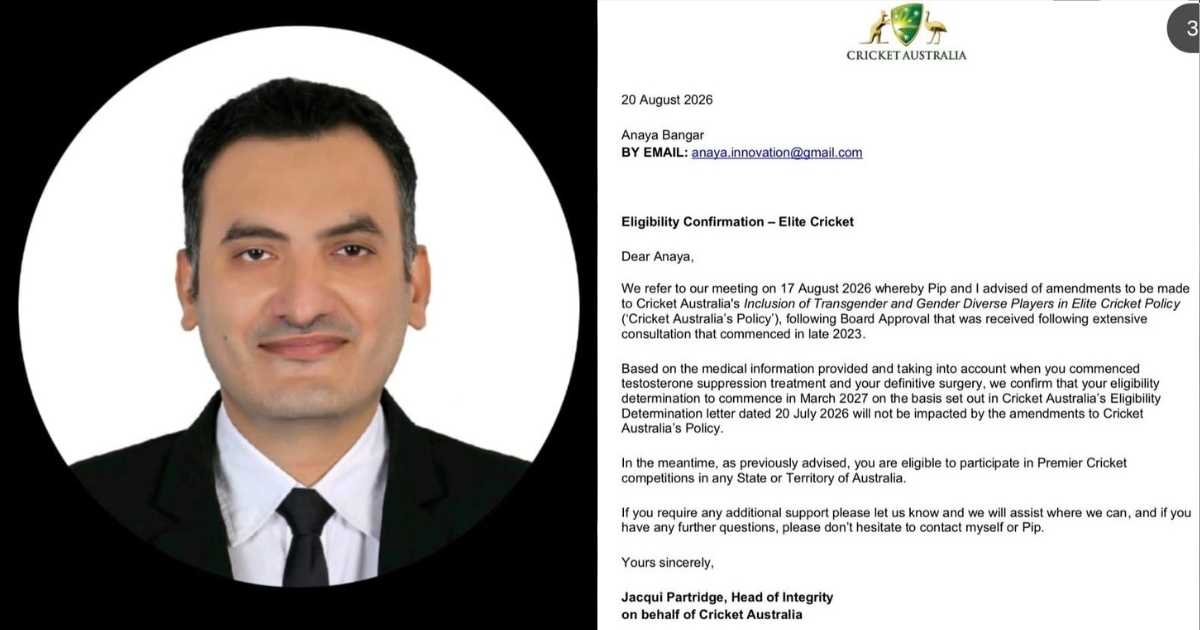
GUWAHATI, Aug 31: Anaya Bangar’s journey towards elite women’s cricket in Australia has thrown an uncomfortable question at Indian cricket’s doorstep: where does the BCCI stand when a transgender athlete seeks a clear and transparent pathway into the women’s game?
As Cricket Australia opens a pathway for Bangar under its transgender and gender-diverse player policy, the absence of a clearly defined domestic framework from the Board of Control for Cricket in India has come sharply into focus.
In an exclusive conversation with The Meghalaya Express, Supreme Court Senior Advocate Saurabh Mishra said the issue cannot be approached by putting equality and sporting fairness on opposite sides of the argument.
“The constitutional objective should not be framed as a choice between equality and fairness. A properly designed regulatory framework should seek to advance both,” Mishra said.
His intervention adds a significant legal dimension to a debate that has largely been played out through sporting policies and competing views on eligibility.
Mishra pointed first to the Supreme Court’s landmark judgment in NALSA v. Union of India, which recognised constitutional protections for transgender persons.
“Transgender persons are entitled to equality, dignity and protection against discrimination,” he said, adding that Articles 14, 15, 16, 19 and 21 protect transgender persons and recognise gender identity as an important aspect of personal autonomy and dignity.
But, he stressed, constitutional protection does not automatically create an unrestricted right to compete in every sex-segregated sporting category.
“Competitive sport can legitimately prescribe eligibility criteria where there is a rational and evidence-based basis for doing so, particularly in a women’s category where the objective of preserving competitive fairness is itself legitimate,” Mishra said.
That, he believes, is where the real legal test begins.
Any restriction, he said, must be founded on objective criteria, serve a legitimate sporting purpose, be proportionate and non-arbitrary, and give the athlete a fair opportunity to have her eligibility considered.
That distinction could be crucial for the BCCI.
The Anaya Bangar episode, Mishra said, makes a strong case for Indian cricket’s governing body to finally spell out how such cases would be dealt with.
“The ICC already has a defined framework for international women’s cricket, while domestic eligibility is left to the respective member boards. Cricket Australia, too, has a published transgender and gender-diverse player policy,” he said.
“In that background, an athlete should not be left in a situation of uncertainty as to whether and how her eligibility will be assessed.”
The issue is therefore bigger than Bangar herself.
It is about whether Indian cricket has a framework capable of dealing with an increasingly complex area of modern sport — one that protects an athlete from arbitrary exclusion while also addressing the legitimate competitive concerns surrounding women’s sport.
Mishra believes the BCCI should consider a policy that leaves little room for ambiguity.
Such a framework, he said, should clearly establish the eligibility criteria, the scientific and sporting parameters to be considered, the procedure for individual assessment, confidentiality safeguards and an independent mechanism for review or appeal.
That would ensure that decisions are not made on an ad hoc basis and that an athlete knows precisely what is expected before seeking entry into a particular competition.
For Bangar, Australia has provided a pathway. For Indian cricket, her case has exposed a policy question that cannot easily be pushed aside.
The BCCI now faces a choice: continue dealing with such questions only when individual cases arise, or establish a transparent framework before the next case lands on its table.
And there is another important principle at stake.
“The constitutional objective should not be framed as a choice between equality and fairness,” Mishra reiterated.
For Indian cricket, that may be the hardest balance to strike — but increasingly, it is a balance the sport will have to confront.
For Anaya Bangar, the road to Australian cricket is about an individual sporting ambition. For the BCCI, her journey could become the moment when the question of transgender participation in Indian cricket can no longer remain undefined.