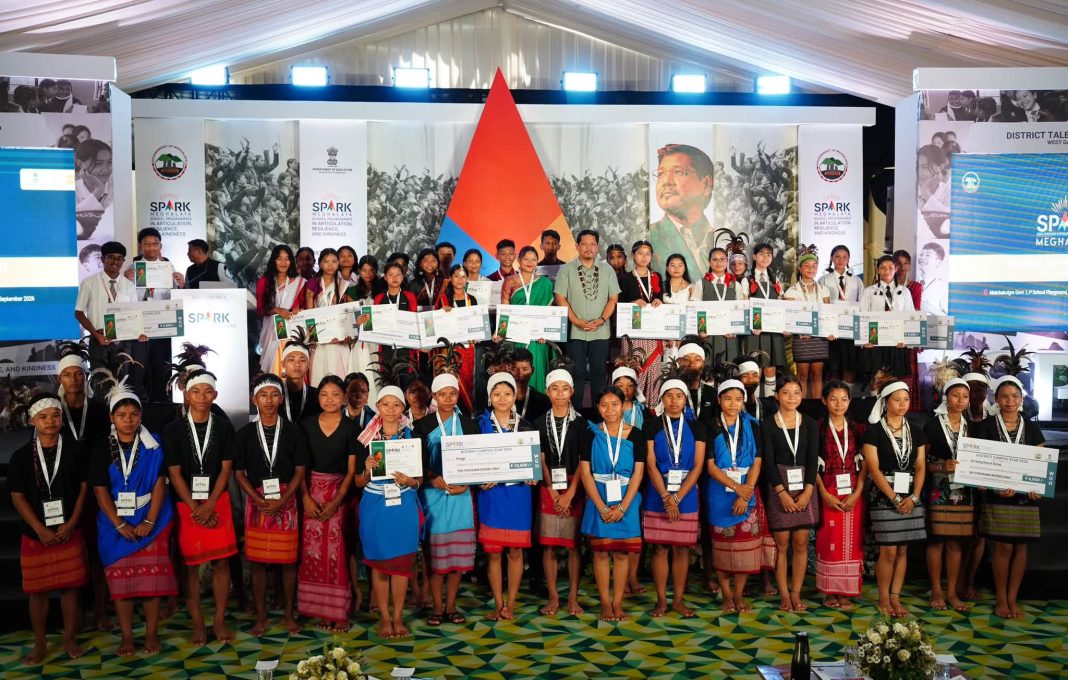

Tura, Sept 2: Chief Minister Conrad K. Sangma said Tuesday that Meghalaya’s flagship soft-skills programme, SPARK, has now reached more than 20,000 students since its 2024 launch, as he addressed the District Talent Event 2026 in Tura.
SPARK — School Programmes in Articulation, Resilience and Kindness — is a state initiative aimed at building skills like communication, teamwork and resilience that the chief minister said don’t show up on report cards but shape how far a student goes in life.
“A student may know an answer perfectly well and still struggle to ask a question, explain an idea, work within a group, face an interview or recover from a failure,” Sangma told students, teachers and parents at the event, organized with the group Avenues.
The Chief Minister said the state has invested heavily in schools and infrastructure, but that SPARK reflects a different kind of investment — in the human capabilities needed to make use of that infrastructure. He recalled his own struggles with public speaking as a student, noting he lacked access to programmes like SPARK growing up.
SPARK started in 2024 as a pilot reaching 5,143 students across 25 government schools in all 12 districts, with girls making up 73 percent of participants.
It later expanded to 28 campuses and over 8,000 students with support from the Ministry of Education’s Samagra Shiksha Abhiyan funding, and was recognized by the Ministry as a Best NEP (National Education Policy) Practice.
The state has since scaled the effort into SPARK Meghalaya, a multi-year, state-funded programme covering soft skills, STEM awareness and talent development for students in Classes 6 through 10.
As of August 31, 2026, the programme has directly reached 12,078 students — 6,592 girls and 5,486 boys — across 53 benchmark campuses in all 12 districts.
Sangma highlighted SPARK for Teachers as central to the initiative, noting that 526 teachers from 287 schools have completed a 30-hour semi-residential training at district headquarters. He said participating teachers have reported reconnecting with their sense of purpose and rediscovering the role of communication in their classrooms.
The chief minister argued that as technology automates routine tasks, skills like responsibility, problem-solving and purpose-driven work will remain in demand. “Problem solving is at the crux of every organisation and will be required forever,” he said, adding that education systems are slow to show results — decisions made today may not pay off for a decade — making early investment in adaptability critical.
He clarified that SPARK is not a substitute for the government’s investment in higher education, skilling and employment, but is meant to strengthen the foundational capabilities that let young people take fuller advantage of those opportunities.
Sangma also pointed to the STAR sports programme as evidence that talent is widely distributed across the state. Working with an Australian firm using global athletic benchmarks, the programme has screened 24,000 children over five years and identified 10 as being in the top 1 percent of athletes worldwide — several without prior training or proper footwear, including one rural student who ran 100 metres in 10.8 seconds.
“This proves raw talent is distributed across every corner of the state,” Sangma said, adding that ensuring opportunity reaches children regardless of location is a government responsibility.
He closed by reiterating that the state’s small population should not limit its ambitions. “It is not quantity, but quality that will determine productivity, growth and where we take Meghalaya,” he said, pledging continued state support for SPARK as a long-term initiative.