
By Prarthana Hazarika | The MeghalayanExpress
Guwahati, Sept 30: India’s compound archers delivered a powerful statement at the Aichi-Nagoya Asian Games, with both the women’s and men’s teams clinching gold medals, and Olympian archer Jayanta Talukdar believes the double triumph is the result of years of planning, preparation and collective effort.
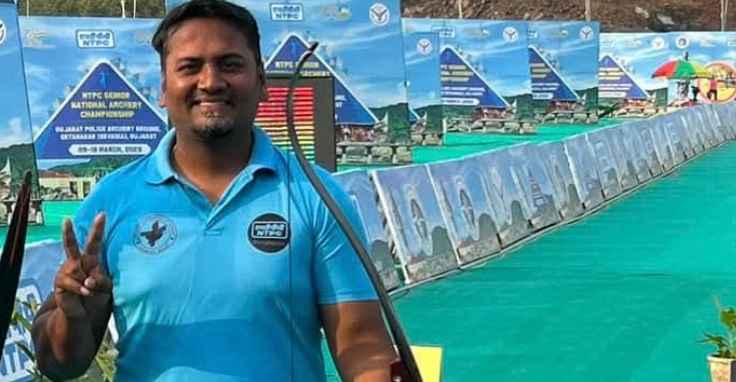
Speaking exclusively to The Meghalayan Express, Talukdar described the achievement as an important starting point for Indian archery at the Games, while expressing hope that the medal haul will grow further in the individual events.
“I think it’s a really good starting point in archery. We all know that compound is already doing very well. They have been performing consistently. The men won the gold, the women also won gold. The start was good,” Talukdar said.
The back-to-back victories assume greater significance given the strength of the Chinese challenge. India had to maintain its composure against a highly competitive Chinese side, particularly when the pressure of a gold-medal contest intensified.
For Talukdar, however, the result was not the product of one individual performance. He credited the archers, coaches, the Archery Federation of India, the government and private-sector support for creating an ecosystem that has enabled Indian archers to compete successfully on the biggest stages.
“I think it’s the hard work and the planning done by the coaches, and obviously the federation has also supported a lot and the government as well,” he said.
Reflecting on his own journey in the sport, Talukdar pointed to the transformation in the facilities and support available to Indian archers compared to the time when he began competing.
“When I started in archery, back then and now, our facilities have improved a lot. Lots of private companies are also helping. So I think it’s an overall achievement from everyone,” he said.
According to Talukdar, the responsibility was shared across the system — from the athletes putting in the work on the range to coaches preparing them for high-pressure situations and administrators ensuring the necessary support.
“Archers have done their part, the coaches have done their part, as well as the federation and the government. So it’s a team effort, and they have really performed well,” he added.
The former archer also believes the success of the compound teams can create momentum for the rest of India’s archery campaign. With individual compound events to follow, expectations remain high.
“We expected this result from compound, and we are also hoping that the recurve will do the same,” Talukdar said.
Pressure separates champions
For an archer, winning at an Asian Games is not merely about technical ability. The atmosphere, the magnitude of the occasion and the pressure of representing a country can all influence performance.
Talukdar, who has experienced the demands of elite international competition himself, admitted that he could learn from the composure displayed by the current generation of Indian archers.
“The way our archers kept their mind so cool and calm, I think for me, I have to learn many things from them. It’s like learning from juniors,” he said.
That composure was particularly evident during the tense final against China. According to Talukdar, the Indian archers showed remarkable control while their opponents struggled to deal with the pressure.
“The way they control their pressure and their temperament, it’s really next level,” he said.
He pointed to one crucial moment in the final, when a Chinese archer shot an eight in the final round.
“As you can see, in the last round, the Chinese archer shot one arrow in eight, and that is not going to help you win a medal in the gold-medal match,” Talukdar observed.
For him, that moment illustrated the fine margins that decide major finals. At the highest level, one lapse under pressure can alter the entire contest.
“The pressure was there. They couldn’t handle it, but our archers really did well. We are really proud of them,” he said.
A platform for what lies ahead
India’s double gold in compound team events has given the country’s archery campaign a strong beginning at Aichi-Nagoya. But Talukdar believes the story does not end with the team events.
With the individual compound competitions ahead, Indian archers will have another opportunity to add to the medal tally. Beyond the medals themselves, Talukdar sees the performance as evidence of the growing strength of India’s archery ecosystem.
The combination of athlete development, coaching, improved facilities, institutional backing and private support has helped create a generation capable of handling the pressure of major international competition.
For the moment, though, Talukdar’s message is simple: India’s compound archers have done their part — and done it exceptionally well.
Two gold medals have already arrived.
The individual battles are next.