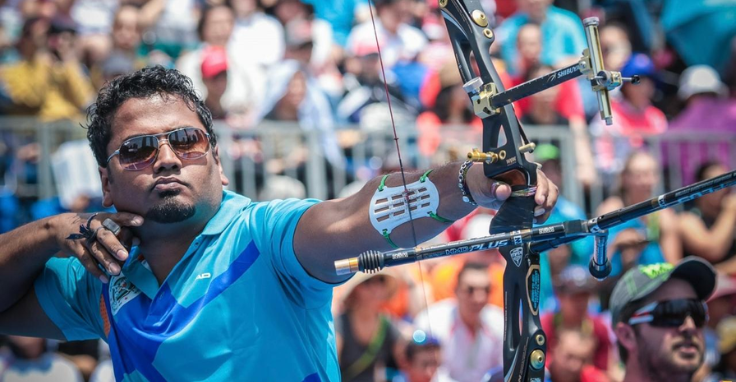

Olympian Jayanta Talukdar on India’s golden transformation, all-weather preparation and the growing belief to beat traditional powerhouses
By Prarthana Hazarika | The Meghalayan Express
India’s growing dominance in international archery is no longer just about individual talent. It is increasingly the product of a more structured performance system, intense domestic competition, scientific preparation and, perhaps most importantly, the belief that Indian archers can consistently beat the world’s best.
As India celebrates a remarkable medal-winning campaign at the Aichi-Nagoya 2026 Asian Games, Olympian archer Jayanta Talukdar believes the transformation has been years in the making. From preparing for unpredictable weather to simulating the pressure of an international final, Indian archery has evolved into a system designed to deliver when the margins are at their smallest.
In an exclusive interaction with The Meghalayan Express, Talukdar explains why adaptability, preparation and a fundamental shift in mindset are helping Indian archers convert their potential into gold medals.
‘When gold is decided by one point, preparation makes the difference’
Archery is a sport in which the smallest variables can have a decisive impact. A sudden change in wind direction, temperature or humidity can affect an archer’s rhythm, equipment and ability to execute a technically sound shot.
Talukdar believes all-weather and condition-specific training has become an important component of India’s preparation for major international competitions.
“The objective of all-weather training is not to predict exactly what conditions will occur on competition day, but to make athletes adaptable,” he says.
Indian archers reportedly trained in cold, rain, heat and strong winds, alongside an acclimatisation camp in Japan ahead of the Asian Games. According to Talukdar, such preparation goes beyond physical and technical conditioning. It allows athletes to understand how their equipment responds to different environments, regulate their timing and maintain concentration when conditions are less than ideal.
“At the Asian Games level, the margins are extremely small. A final can sometimes be decided by just one or two points, so being comfortable and confident in unfamiliar conditions can make a significant difference,” he explains.
For Talukdar, the ultimate objective is to develop a repeatable shot process that remains stable regardless of the environment. When an archer steps onto the shooting line, the weather should not become another source of uncertainty.
The importance of preparation was also evident in India’s compound mixed-team final against Korea, where the teams finished level at 157-157 before India prevailed 20-19 in the shoot-off.
At that level, preparation and the ability to execute under pressure can prove decisive.
From raw talent to a performance-driven system
Talukdar identifies a fundamental shift in Indian archery over the past decade: the transition from a largely talent-driven sport to a more structured, competitive and performance-oriented system.
“We always had talented archers in India, but today the depth is much greater,” he says.
According to the Olympian, the growing pool of high-performing archers has made domestic selection increasingly competitive. This internal pressure raises standards, pushes athletes to improve and ensures that international representation is earned in a demanding environment.
India’s six-gold-medal performance at the 2025 Asian Archery Championships, he notes, reflected the growing depth and confidence within the system.
Preparation methods have also evolved. Training is no longer simply about shooting a large number of arrows. Competition simulation, physical preparation, mental conditioning, equipment management and attention to technical details have become increasingly important.
The preparation at SAI Sonepat for the 2026 Asian Games exemplified this approach. Indian compound archers recreated elements of the competition environment in Japan, including targets, screens, music, podium arrangements, flags and colour schemes, repeatedly practising under pressure.
Such simulations help athletes become familiar with the competitive setting before the stakes are highest.
The psychological shift: India now believes it can win
For Talukdar, one of the most significant changes is psychological.
Indian archers are increasingly approaching competitions against established powerhouses such as Korea with the confidence to compete for victory, rather than merely hoping to challenge them.
“That psychological shift is extremely important,” he says.
India’s compound mixed-team shoot-off victory illustrated that belief. After the final ended 157-157, both Indian archers produced 10s when the contest came down to a single decisive moment.
Talukdar also points to progress across both compound and recurve archery. While India’s compound programme has developed considerable depth, the women’s recurve team’s historic Asian Games gold against Korea in 2026 demonstrated that the progress extends beyond a single discipline.
He attributes the improvement not to one athlete, coach or technique, but to years of investment, greater international exposure, stronger training methods and the deliberate creation of pressure situations in practice.
“The biggest transformation is that Indian archery is increasingly producing athletes who are not only technically capable of winning medals, but are also prepared to perform when the medal is decided by the smallest of margins,” Talukdar says.
For Indian archery, the challenge now is to sustain that progress. Asian Games gold medals offer evidence of what the system can achieve, but maintaining that standard will require continued investment, competitive depth and consistent preparation.
The message from the Olympian is clear: talent may open the door, but adaptability, preparation and the confidence to deliver under pressure are what turn that talent into international success.