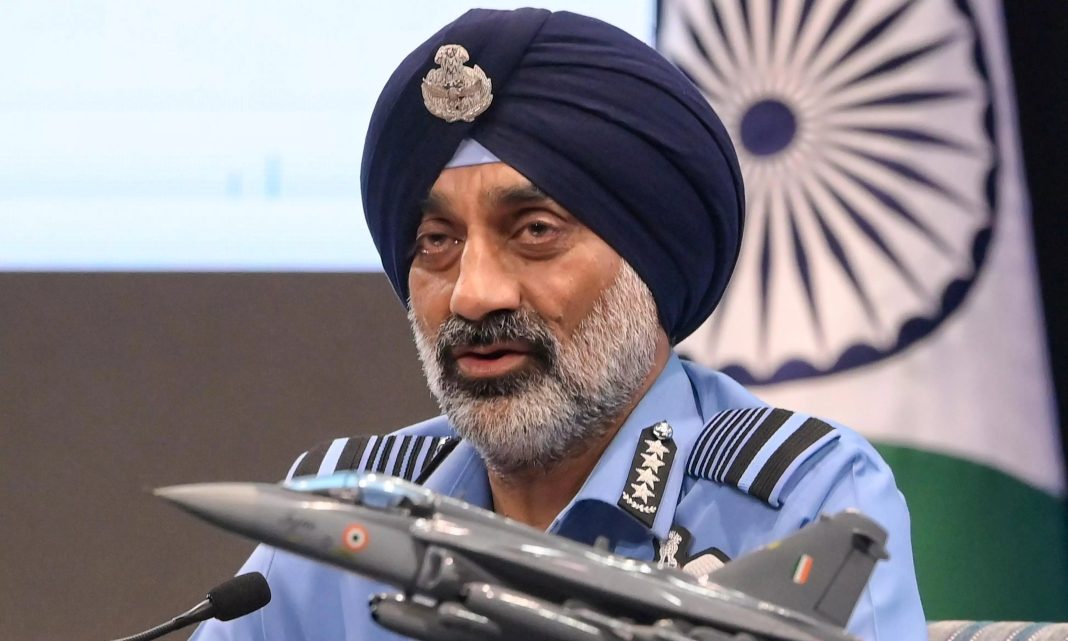

New Delhi, Oct 3: The inordinate delays in inducting new combat jets, including the Tejas aircraft, are hurting the Indian Air Force (IAF) in view of the depleting strength of its fighter squadrons at a time when air power is increasingly becoming crucial to deal with security challenges, Chief of Air Staff Air Chief Marshal AP Singh said on Saturday.
Addressing a press conference ahead of the 94th Air Force Day, the IAF chief also said that the force requires induction of at least 36-40 fighter jets annually for the next few years to plug the gaps and hoped that the situation will improve with the induction of indigenously-built Tejas Mark-1A aircraft as well as Rafale combat jets to be procured under the multi-role fighter aircraft (MRFA) programme.
Air Chief Marshal Singh also flagged concerns over Pakistan collaborating with China on a fifth-generation fighter jet.
“It is a cause for worry,” he said, adding: “We do have capabilities. It is not that one platform matters so much.”
Elaborating on measures to enhance the IAF’s combat prowess, he said the government is looking at finalising the MRFA deal by this financial year, provided things go as per plan.
In its largest-ever defence acquisition push, India in February cleared a long-pending proposal to procure 114 Rafale fighter jets under a government-to-government framework with France, nearly two decades after the plan was originally rolled out to boost the Indian Air Force’s combat prowess.
The price negotiations and other critical issues relating to the project are currently being finalised.
“I think if things go well, we should be able to sign it (MRFA deal) in this financial year. That’s what my hope is. But it is a two-way process,” he said while referring to negotiations between the Indian and the French sides.
The IAF chief also voiced concerns over delays in supply of Tejas Mark-1A jets to his force “There is some extra delay, and there is no doubt that it is going to hurt us,” he said.
“We need to induct two fighter squadrons every year. That means anything between 36 and 40 aircraft should be produced and inducted into the IAF for us to stop going down from the current 30 fighter squadrons and start improving towards the target of 42 squadrons. Actually, we need even more than that,” he added.
In February 2021, the defence ministry sealed a Rs 48,000 crore deal with HAL for the procurement of 83 Tejas Mk-1A jets for the IAF. The first set of aircraft was to be delivered in March, 2024. However, not a single jet has been supplied to the IAF till now.
The IAF wants to induct the warplanes as the number of its fighter squadrons has gone down significantly from the officially sanctioned strength of 42.
The defence ministry in September last year sealed another deal worth Rs 62,370 crore with HAL to procure 97 Tejas MK-1A light combat aircraft for the IAF.
The Chief of Air Staff said the IAF is looking forward to getting the Tejas Mark-1A jets, aircraft under the MRFA programme, Tejas Mark 2s and the combat planes under the Advanced Medium Combat Aircraft (AMCA) programme.
At the same time, he said the IAF may have to look at procurement of another platform if the AMCA programme faces delays. Russia has offered Su-57 jets, but no decision has been made on it, he said.(PTI)
“If there are delays in the AMCA fifth-generation fighter programme, we may have to look at other options. Russia has offered the Su-57, but no decision has been taken yet,” he said.
Responding to a question on the proposed theaterisation plan, Air Chief Marshal Singh indicated that the proposed structure is being looked at with a fresh perspective following Operation Sindoor.
“I have made it clear that the Indian Air Force is not against theatre commands. We have been working towards it, and we have been a part of discussions throughout,” he said.
The Chief of Air Staff said following Operation Sindoor, the discussions on the theatreisation plan have taken a “slightly different direction”.
It is because we gained some first-hand experience during Operation Sindoor, he said.
The government had announced the theaterisation plan in 2019 to ensure greater synergy among the three services. However, no visible forward movement has been made towards it.
Under the theaterisation model, the government seeks to integrate the capabilities of the army, air force and navy and optimally utilise their resources for wars and operations.
The IAF chief said the government will take decisions on what kind of organisation for theaterisation will have to be created, in what sequence should it be made, whether it should be in one go or whether it should be incremental.
“Those decisions, I am sure, government will take when we project it to them that these are the options that we have,” he said without elaborating further.
As per the theaterisation plan, each of the theatre commands will have units of the Army, the Navy and the Air Force and all of them will work as a single entity looking after security challenges in a specified geographical territory.
At present, the Army, Navy and the Air Force have separate commands.
Air Chief Marshal Singh also emphasised the growing importance of air power in the current geopolitical context, asserting that India needs to further ramp up its air power.
On modernisation of the IAF, he said the force has to be augmented through artificial intelligence, but added that humans will continue to take critical decisions.
“We have to have an AI-augmented force,” he said.
The Chief of Air Staff also underlined the need for India to produce a fighter jet engine in the country.
To a question on whether the IAF is considering creating a separate “drone force”, he said no such move is being contemplated.
“Drones are not revolutionary to the Indian Air Force, but evolutionary. We are growing the number of drones and loitering munitions. Whether we need a separate drone force, I don’t think so. They should be a part of the same setup, and we have to be operating together,” he said.
“These have to be together along with other weapons so that they bring in that effect. We cannot be operating one type of weapon separately somewhere and another type of weapon separately. So we have not thought of having a separate drone force.”