
Exclusive | The Meghalayan Express | By Prarthana Hazarika
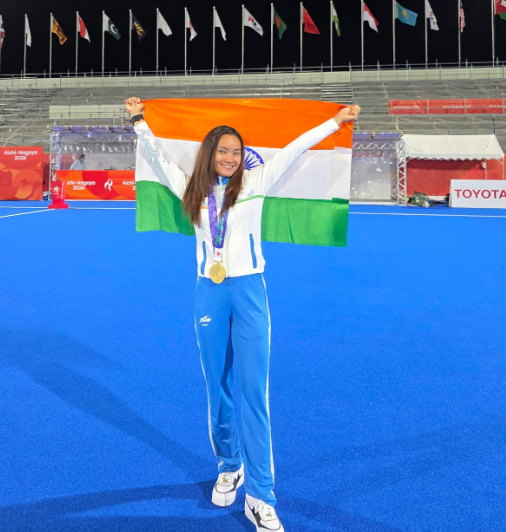
When Lalremsiami decided to pursue hockey as a career, she did not have a pair of shoes to play in. A hockey stick was beyond her means, money was scarce, and the road ahead offered no guarantees. The young girl from Mizoram had little in terms of material resources, but she possessed two things that would prove invaluable: her family’s support and an unshakeable belief in her dream.
Yet, the financial struggle was only the beginning.
When Lalremsiami entered the national hockey setup, she faced another challenge that had little to do with the ball, the stick or the opposition. She did not know Hindi or English. In an environment where players came from different states, spoke different languages and had to learn to function as a team, communication itself became an obstacle.
For a young player arriving from Mizoram, adapting to the national camp meant learning much more than the demands of elite hockey. She had to overcome the language barrier, understand an unfamiliar environment and find her feet among players from across the country.
She learnt Hindi and English to communicate and fit into the national camp.
It was another test of her determination — one that unfolded away from the spotlight, without the applause that accompanies a goal or the recognition that follows a medal.
Lalremsiami’s journey was not simply about learning to play at the highest level. It was about learning to belong.
The courage to start with almost nothing
For many aspiring athletes, the first hurdle is getting access to equipment, coaching and competition. For Lalremsiami, even the basics were a challenge. She did not have the shoes or the hockey stick that a budding player would ordinarily need to begin a sporting journey.
What she had was a passion for hockey and a family that stood behind her.
Choosing the sport meant accepting that there would be challenges and that she would have to face them herself. The decision demanded conviction, particularly when the outcome was uncertain.
Her family’s support gave her the foundation to pursue that ambition. But it was Lalremsiami who had to navigate the unfamiliar territory that followed — from the early struggle to access equipment to the demands of adapting to a national sporting environment.
The language barrier added another dimension to that transition. Learning Hindi and English was not merely an academic exercise. It was part of her effort to communicate, adjust and become comfortable in a setting where players had to understand one another on and off the field.
For an athlete whose first language and cultural roots were in Mizoram, that adjustment required patience and persistence.
Beyond the hockey field, another battle
Elite sport demands physical conditioning, technical ability, tactical awareness and mental resilience. But for athletes who move away from home and enter national camps, there are other challenges that rarely feature in match reports.
Language is one of them.
Athletes from the Northeast can find themselves entering environments where the dominant languages are different from those they speak at home. They must adapt to new routines, new teammates and new expectations while continuing to compete for selection.
Lalremsiami’s experience brings that often-overlooked aspect of an athlete’s journey into focus.
Her effort to learn Hindi and English reflects the determination required to navigate a new environment. It also raises an important question about how sporting institutions support young athletes as they make the transition from their home states to national-level programmes.
Adaptation is part of elite sport, but young athletes should not have to navigate every difficulty alone. Inclusive team environments, effective communication and support systems can help players concentrate on what they have come to do: represent the country.
Lalremsiami worked to overcome the barrier. Her story should also encourage Indian sport to recognise the challenges that athletes from different linguistic and cultural backgrounds face.

A story Mizoram can call its own
Lalremsiami’s rise has given young hockey players in Mizoram a figure to look up to. But the significance of her journey extends beyond the medals and the India jersey.
It is a story about a young woman who began without the equipment many take for granted, entered an unfamiliar environment without knowing two widely used languages and set about overcoming each obstacle in front of her.
Her journey required more than sporting talent. It required the willingness to learn, adapt and keep moving forward when the surroundings were unfamiliar.
For the Northeast, where sporting talent continues to emerge from communities with varying levels of access to resources, her experience carries a wider message. Talent may be the starting point, but opportunity, family support and the ability to navigate unfamiliar systems can be just as important in determining how far an athlete goes.
Lalremsiami’s story began with a dream that seemed bigger than the resources available to her. She had no shoes, no hockey stick of her own and no command of Hindi or English when she entered the wider world of Indian hockey.
But she was willing to learn what she did not know and confront what stood in her way.
That is what makes her journey compelling. Before she became an established Indian hockey player, she was a young girl from Mizoram determined to find her place in a world that was new to her.
She did not begin with everything she needed. She began with the determination to acquire it — one challenge at a time.