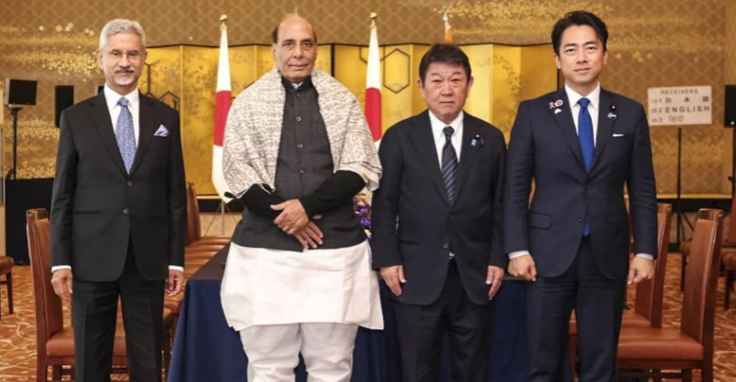

Tokyo, Nov 19: External Affairs Minister S Jaishankar on Thursday flagged the growing “weaponisation” of connectivity, resources and supply chains, and called for stronger India-Japan cooperation amid global uncertainty and a complex Indo-Pacific strategic landscape.
Jaishankar and Defence Minister Rajnath Singh are in Tokyo for the fourth India-Japan Foreign and Defence Ministers’ Dialogue, known as the 2+2 meeting, held on Thursday.
Addressing the media after the 2+2 meeting, Jaishankar said the global order was facing multiple shocks, including two major ongoing conflicts, economic volatility and the after-effects of the COVID-19 pandemic.
“There are two major ongoing conflicts whose impact have been felt even in distant regions,” he said, adding that these developments had heightened concerns over energy, trade, food and health security.
“As we seek to secure ourselves on these fronts, trusted and substantive partnerships like ours become more valuable,” the minister said.
The Russia-Ukraine war and the conflict in West Asia have had repercussions far beyond their respective regions, affecting global energy markets, maritime shipping and food security.
Jaishankar said New Delhi and Tokyo were committed to keeping the Indo-Pacific free and open, and were joined in that endeavour by other Quad partners.
The remarks came two days after Prime Minister Narendra Modi, US President Donald Trump, Japanese Prime Minister Sanae Takaichi and Australian Prime Minister Anthony Albanese met in Manila for a Quad leaders’ summit.
“The reality is that old assumptions may no longer hold true and each one of us will have to make a greater contribution to global good,” Jaishankar said, adding that such contributions could come through initiatives and activities at the national and bilateral levels or with like-minded partners.
“We also spoke about a growing tendency to weaponise connectivity, resources, services, supply chains and market shares,” said the minister, adding that many of these had direct implications for national security.
“Strengthening resilience and exploring new options must be seen in that context,” he said.
Jaishankar also referred to growing concerns over connectivity and chokepoints in the light of experiences in the Gulf, stressing the importance of ensuring the smooth functioning of maritime trade.
“Ensuring that maritime trade, which is at the heart of international commerce, functions smoothly is imperative. Our maritime cooperation can help make a difference,” he said, adding that discussions on the subject were particularly timely.
The two sides also agreed on the importance of adhering to international law in this context, he said.
The 2+2 meeting also took into account the changing nature of warfare, with Jaishankar pointing to the effective application of smart weapons and innovative solutions.
“Our cooperation here feeds into a larger engagement on innovation and startups,” the minister said.
Jaishankar said the broader objective of India-Japan cooperation was to support a multipolar Asia and a multipolar world, adding that the two countries had been strong proponents of reformed multilateralism.
“We are two significant nations of the Indo-Pacific with a long and continuous history of friendship and goodwill,” he said, adding that a stronger India-Japan relationship could play a more important role as countries entered an era in which each had to step up its contributions to the global order.
“Our 2+2 discussions today and the understandings we reached were a very good step in that direction,” he said.
The 2+2 format brings together the foreign and defence ministers of both countries to review their strategic relationship and discuss regional and global security challenges.
On Wednesday, Jaishankar addressed the Raisina Tokyo Dialogue, where he identified five defining features of the changing global landscape, including repeated shocks to the international system, the weaponisation of economic activity, greater risk-taking, de-risking and diversification, and the growing importance of trusted partnerships. (PTI)