
By Dipak Kurmi
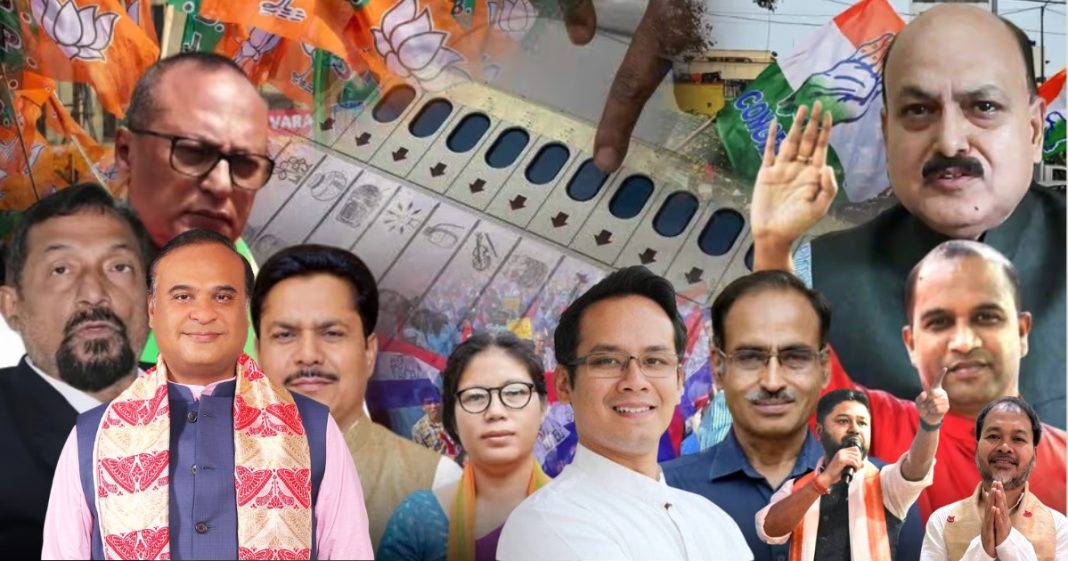
The political atmosphere in Assam is currently witnessing a profound transformation as the state approaches the 2026 Assembly elections. What was once a battlefield of distinct ideologies—ranging from staunch regionalism and ethnic identity to national integration—has increasingly morphed into a theatre of opportunistic shifts and power-centric maneuvers. The traditional sanctity of party loyalty is rapidly dissolving, replaced by a culture where political leaders switch allegiances with startling frequency, often leaving the electorate in a state of deep confusion. This phenomenon is not merely about individual ambition but reflects a systemic change where the pursuit of power has superseded the commitment to public service or foundational principles. As the NDA government concludes its current term, the scramble for tickets and the fluctuating alliances between major players like the BJP, Congress, and the AGP suggest that the upcoming electoral battle will be defined more by tactical calculations than by visionary governance.
The electorate today observes a disheartening spectacle where leaders who once championed specific regional causes are now seen embracing the very national platforms they previously criticized. This shift is particularly evident in the way regionalism is being redefined within the state. The Asom Gana Parishad (AGP), which once stood as the singular voice of Assamese nationalism, now finds itself navigating a complex partnership with the BJP, a move that has sparked internal friction and external skepticism. Many veteran leaders, fearing the loss of their influence or being denied a ticket, are jumping ship to whichever side promises a surer path to the legislative assembly. This “musical chairs” of politics has led to a situation where the common citizen is left questioning whether the leader they voted for yesterday will still represent the same values tomorrow. The disillusionment is palpable, as the public sees their trust being treated as a tradable commodity in the high-stakes game of political survival.
Economic factors and the allure of developmental funds have also played a significant role in this ideological dilution. There is a growing perception that being on the side of the ruling power, particularly at the center, is a prerequisite for securing the “developmental storm” necessary for a constituency’s growth. Leaders often justify their defections by citing the need for resources to serve their people, yet the underlying motivation frequently appears to be the preservation of their own political relevance. This has created a cycle where local issues are overshadowed by the grand narratives of national parties. The influence of “money power” and the sheer scale of assets declared by candidates during their nominations have further widened the gap between the representatives and the represented. When a candidate’s wealth increases exponentially within a single term, it raises serious ethical questions about the nature of their service and the true purpose of their political engagement.
In Upper and Lower Assam, the internal dynamics of the Congress and the BJP are creating new friction points. The Jorhat constituency, for instance, has become a microcosm of this broader struggle. The tension between established veterans and newcomers is reaching a boiling point, with the distribution of tickets becoming a source of intense resentment. In some cases, the denial of a ticket to a loyalist in favor of a “turncoat” from another party has led to open rebellion and the splintering of local cadres. The Congress, while attempting to forge a united front against the ruling dispensation, faces its own uphill battle with internal discipline. The “Miya” factor, tribal land rights, and the ST status of six ethnic groups remain volatile issues that every party tries to manipulate, yet none seem to offer a definitive or sustainable solution. These issues are often used as emotional levers during the campaign, only to be shelved once the ballots are counted.
The role of regional parties like the Raijor Dal and Assam Jatiya Parishad adds another layer of complexity to the 2026 outlook. While they strive to present themselves as the “pure” alternative to the national giants, they are frequently caught in the crossfire of strategic voting. The electorate is torn between the desire for authentic regional representation and the pragmatic need for a stable government that can interface effectively with the central administration. Meanwhile, in the BTR areas, the contest for dominance between the Hagrama Mohilary-led BPF and the UPPL continues to redefine the ethnic political landscape. The shift in power dynamics here often dictates the broader trends of the state, as the support of these blocks is crucial for any coalition seeking to form a government in Dispur. The fragmentation of the opposition further complicates the scenario, making it difficult for a singular, cohesive narrative to emerge against the incumbent power.
As the election date draws near, the focus is shifting toward the “identity” of the candidate rather than the “identity” of the party. Voters are now analyzing the personal credibility and the past performance of individuals, recognizing that party banners have become increasingly fluid. The media’s role in highlighting these shifts is crucial, as it documents the changing stances of leaders who were once poles apart. The rhetoric of “Assamese pride” or “Nationalism” is frequently invoked, but the repetitive nature of these slogans has begun to wear thin on a public that is increasingly concerned with rising prices, unemployment, and the preservation of their cultural heritage. The upcoming election will be a litmus test for the maturity of the Assamese voter—whether they will continue to be swayed by the grand spectacles of political rallies or if they will demand a return to principled politics that prioritizes the state’s long-term interests over short-term electoral gains.
The current political climate in Assam suggests a transition toward a more homogenized, power-driven system where the distinctions between various factions are becoming blurred. The old guard is struggling to maintain its relevance against a new wave of transactional politics. The challenge for any future leadership will be to restore the lost faith of the masses and to prove that politics can still be a medium for genuine social change rather than just a vehicle for personal advancement. Whether the 2026 results bring about a renewal of ideological clarity or further entrench the current trend of opportunism remains to be seen. However, one thing is certain: the people of Assam are watching closely, and their verdict will determine not just the next government, but the very soul of the state’s political future.
(the writer can be reached at dipakkurmiglpltd@gmail.com)