
By Dipak Kurmi
In the lush alluvial plains of Assam, where the Brahmaputra’s cultural currents have long shaped the spiritual imagination of the region, the sacred complex of Batadrava Than stands as one of the most evocative centres of Neo-Vaishnavite faith. Located about sixteen kilometres west of Nagaon town, this hallowed site—also widely known as Bardowa—transforms each spring into a theatre of colour, music, and devotion during the Doul Utsav, Assam’s distinctive interpretation of Holi. The festival here is not merely an exuberant celebration of colour but a layered cultural performance rooted in theology, memory, and community identity. First introduced to the Brahmaputra Valley by the saint-reformer Srimanta Sankardev, the observance represents one of the most enduring bridges between classical bhakti philosophy and lived Assamese folk culture. What unfolds at Batadrava Than each year is therefore both spectacle and scripture in motion, a ritual continuum that has survived political upheavals, doctrinal debates, and the passage of centuries.
To grasp the full resonance of Doul Utsav at Bardowa, one must situate the shrine within the region’s pre-Ahom political landscape. Before imperial consolidation under the Ahoms, the Brahmaputra Valley was a mosaic of competing polities—Kachari, Chutia, Koch, and Moran—while large tracts of riverine territory were controlled by the influential Bara Bhuyan confederacy. These “twelve landowners,” led by a Shiromoni Bhuyan, exercised semi-autonomous authority and played a decisive role in shaping early Assamese socio-political structures. Their origins remain debated among historians, with some tracing their migration to Chotanagpur and others to the Bay of Bengal littoral, yet their composite social character is widely acknowledged: predominantly Kayastha but inclusive of Brahmins, Doibogyas, and even Muslims. Over time, the Bhuyans evolved from subordinate feudatories under the kings of Kamrup or Kamata into independent regional power brokers whose authority stretched from present-day Goalpara to the Subansiri and southward toward the Kapili basin. It was within this historically fluid frontier that the lineage connected to Bardowa emerged, beginning with Chandibor, who received the Shiromoni Bhuyan title from the Kamata monarch Durlov Narayana. Through successive generations of migration and settlement, his descendants transformed the flood-prone Bardowa lowlands into a habitable landscape of ponds and raised roads known as Alipukhuri—setting the stage for one of Assam’s most consequential spiritual births.
That birth, of course, was the arrival of Sankara—later revered as Srimanta Sankardev—son of Kusumbar and Satyasandhya. His life would decisively redirect Assamese religious history. Emerging in an era marked by inter-polity conflict, particularly between the Bhuyans and the Kacharis, Sankardev articulated a radical devotional humanism grounded in non-violence and monotheistic surrender. When retaliatory violence by the Bhuyans culminated in massacre, the young reformer openly condemned the bloodshed and chose exile over complicity. His subsequent itinerant years carried him through settlements such as Rowta, Gangmow, Komorakat, and Maluwalor-ati before he established an extended eighteen-year residence at Buwahat near Ahatguri in Majuli. There he built Belaguri Than and systematised the doctrine of Ek Saran Nam Dharma, emphasising absolute devotion to a single divine reality through congregational singing and remembrance. It was also during this fertile intellectual phase that he encountered his most brilliant disciple, Madhavdeva, whose literary and organisational genius would later consolidate the movement. Yet despite his long absence, Bardowa never faded from the devotional imagination of his followers.
For nearly one hundred and forty years after Sankardev’s departure, the Bardowa site lay largely abandoned until the determined efforts of Aai Kanakalata, his granddaughter-in-law, revived it. Assisted by Damodar Ata and the Ahom noble Tangshu Phukan during the reign of Jaydhwaj Singha, she identified the scattered remnants of the saint’s early establishment—Doul, Manikut, Santijan, Charihati, and the venerable Silikha tree—thus firmly reasserting Bardowa as the birthplace of the Neo-Vaishnavite movement. The subsequent founding of Bardowa Satra transformed the location into an institutional centre of Purush Samhati lineage. Parallel developments such as the establishment of Narowa Satra in North Lakhimpur expanded the movement’s geographic footprint. Yet, as often happens in religious institutions with hereditary claims, succession disputes soon emerged. After Damodar Ata’s death, tensions between his son Ramakanta and Anantaraya, Kanakalata’s grandson, intensified and were further complicated by the disruptive Mughal invasion led by Mir Jumla in 1662. Both claimants fled eastward, later founding influential Satras such as Kowamara and Salaguri under Ahom patronage. Bardowa itself underwent administrative division into Borhisha and Chatuhissa segments, a structural compromise that continues to shape the shrine’s ritual management even today.
Within this layered institutional history lies the origin of Doul Utsav at Batadrava Than. A “Than” in Assamese Vaishnavite vocabulary signifies a sacred repository of relics associated with a saint, and Bardowa preserves revered objects such as the pada-sila (foot impressions) and paduka attributed to Sankardev and his apostolic circle. Tradition credits the saint with introducing Doul Utsav to Assam, and many accounts assert that he personally celebrated it only once in his lifetime, at Bardowa itself. His own Kirtan literature vividly evokes the playful Krishnaite imagery of Holi: the forest-garlanded Lord joyfully scattering coloured powder. Yet the precise circumstances of that inaugural celebration remain the subject of scholarly debate. Ramcharan Thakur’s Guru Charit narrates that a four-armed idol discovered during excavation for the Kirtanghar inspired the festival’s institution, along with rituals such as meshadaha and yajna. Critics, however, point out that such practices appear to contradict Sankardev’s strict opposition to idol worship within Ek Saran Nam Dharma. Some historians reconcile the tension by suggesting the episode belongs to his early formative phase, when doctrinal boundaries were still evolving under Brahmanical influence. Other textual traditions—from the Bhagawat’s Dritiya Skandha to later Guru Charits—offer variant explanations involving artisan-crafted idols or requests from relatives who wished to recreate pilgrimage experiences. The multiplicity of narratives itself reveals how living traditions absorb and reinterpret memory over time.
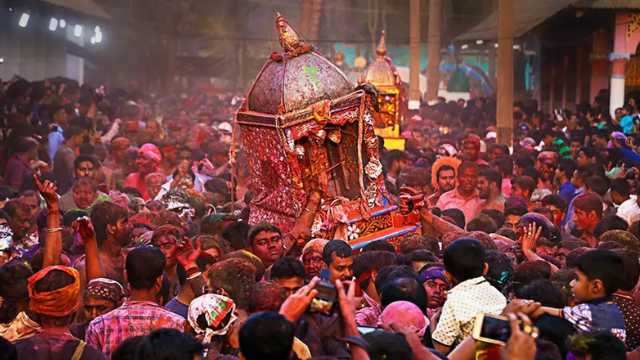
In its contemporary form, the Doul Utsav at Batadrava Than unfolds through a meticulously choreographed five-day sequence jointly sustained by Sri Narowa Satra and Sri Salaguri Satra, which alternate annual responsibility. The festival begins with the Gandha ritual, when the movable idol of Lord Govinda is ceremonially escorted from the Kirtanghar to a decorated robhatoli amid the resonant rhythms of Gayan Bayan ensembles. The two Satras maintain subtle procedural differences: Salaguri constructs a temporary Gandhaghar on the Akasiganga bank and performs the symbolic burning associated with the once-literal meshadaha, now replaced by a rice-flour effigy, while Narowa omits this element and conducts the ablution near the main stage. The Purnima afternoon witnesses an intensification of devotional soundscape—khol drums, tal cymbals, nagara kettledrums, and conch blasts—while clouds of phaku colour are ritually offered to Lord Govinda. The following protipod day brings the chariot procession toward the Doul Mandir, accompanied by Biyanam marriage songs and exuberant colour play among devotees. Particularly striking is the Duwardhra Anusthan performed by Salaguri Satra, a dramatic door-obstruction ritual recalling the mythic quarrel between Krishna and Rukmini, possibly a later incorporation influenced by Jagannath traditions. The sequence culminates with the idol’s return to the Kirtanghar amid continuous Nam Kirtan.
Equally central to the festival’s endurance is its formidable musical heritage. Sankardev’s theological vision rejected world-renouncing asceticism in favour of accessible devotion through collective singing and remembrance of the divine name. To democratise spirituality, he and Madhavdeva translated sacred texts into the vernacular and composed Bargeets, Kirtans, and lyrical dramas set to classical ragas yet infused with regional sensibility. Over centuries, these musical forms became inseparable from Satra liturgy. During Doul Utsav, standard Kirtan sequences are expanded with special Phakuwa compositions unique to Bardowa’s oral tradition. Women’s devotional groups perform morning and afternoon Prasanga, while Gayan-Bayan troupes sustain the nocturnal vigils. Many of these songs remain anonymously transmitted through generations; modern scholars such as Gajen Rajkhowa have attempted preservation through compilations like Bardowat Basartu aru Aai sokolor Diha Naam. The result is a rare example of a living musical archive embedded within a seasonal festival.
Beyond its ritual choreography, Doul Utsav at Batadrava Than functions as a powerful instrument of social cohesion. Like Holi elsewhere in India, it temporarily dissolves everyday hierarchies, yet it does so within the distinctive theological grammar of Assamese Neo-Vaishnavism. The festival’s continued vitality illustrates how inherited traditions adapt without surrendering core identity. Practices once literal—such as meshadaha—have been symbolically reinterpreted to align with evolving ethical sensibilities, while the foundational emphasis on congregational devotion remains intact. Each spring, when clouds of coloured powder rise above Bardowa’s prayer halls and the air vibrates with centuries-old melodies, participants are not merely celebrating a festival. They are entering a living historical continuum shaped profoundly by Sankardev’s reformist vision nearly five hundred years ago. In that sense, Batadrava Than’s Doul Utsav remains one of Assam’s most eloquent cultural texts: a chromatic liturgy of memory, faith, and collective belonging that continues to renew itself with every returning full moon of Phalguna.
(the writer can be reached at dipakkurmiglpltd@gmail.com)