
By Satyabrat Borah
The story of our future is currently being written by the sheer weight of our numbers and the finite boundaries of the world we inhabit. When we look at the figure of 8.3 billion people and the projected leap to 12.4 billion by the 2070s, we are not just looking at a spreadsheet of census data. We are looking at the biological breaking point of a living system. For centuries, humanity has operated under the quiet assumption that the world is an infinite well of bounty. We took for granted that the soil would always regenerate, the rains would always fall in their season, and the oceans would indefinitely absorb the consequences of our expansion. That era of blissful ignorance has closed. We are now living in a period where our collective footprint is heavier than the ground beneath us can support.
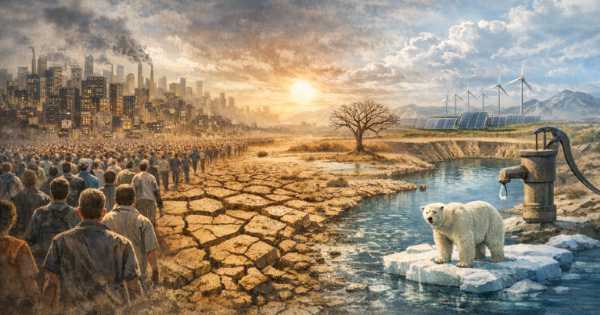
To understand why the current population is described as surpassing the sustainable limit, we must look at the mechanics of the natural world. Every forest, river, and field has a specific pace at which it functions. Trees take decades to reach maturity. Aquifers take thousands of years to fill with filtered rainwater. The atmosphere has a limited capacity to recycle carbon. When we exceed these limits, we are essentially running a global deficit. We are spending natural capital rather than living off the interest. This is the reality of a world with 8.3 billion people trying to achieve a standard of living that requires the resources of multiple Earths. The strain is visible in the cracking of parched earth in regions that used to be breadbaskets and in the rising acidity of the seas.
The jump to 12.4 billion within the next few decades feels like a mathematical impossibility when placed alongside our dwindling resources. Imagine the logistics of a world with four billion more mouths to feed, four billion more bodies to clothe, and four billion more minds seeking opportunity. The pressure on the agricultural sector will be immense. To keep up with such a demand, we would need to revolutionize the way we interact with the land. Current industrial farming often strips the earth of its vitality, relying on chemicals that eventually find their way into our bloodstreams and ecosystems. A massive population spike forces a choice between total ecological collapse or a radical move toward restorative systems that give back to the earth as much as they take.
Water is perhaps the most immediate concern. While the planet is covered in blue, the portion we can actually drink is a tiny fraction. In a world of 12.4 billion, pany of the historical causes of conflict will pale in comparison to the struggle for access to clean wells and flowing rivers. We see the beginnings of this tension today in shared river basins where upstream usage threatens downstream survival. When the population reaches that projected peak, the concept of water as a basic human right will be tested to its absolute limit. It will require a level of global cooperation that humanity has rarely demonstrated. We will have to move away from the idea of ownership and toward a philosophy of stewardship.
Space is another factor that is often overlooked. It is not just about having enough room to stand. It is about the loss of the wild. As human settlements expand to accommodate billions more, the habitats of other species shrink into oblivion. This is not just a tragedy for the animals; it is a threat to our own survival. We rely on a complex web of life for everything from pollination to medical breakthroughs. Every time a forest is cleared for a new housing development or a wetland is drained for a factory, a thread in that web is cut. A world with 12.4 billion humans could be a very lonely and sterile place if we do not find a way to densify our living spaces while leaving the rest of nature to breathe.
The energy required to sustain such a massive population is another mountain to climb. The traditional path of burning old sunlight in the form of coal and oil is no longer an option. The carbon cost is too high. The transition to sun, wind, and tide is the only logical way forward, but the infrastructure needed to provide power to 12.4 billion people is staggering. It involves reimagining every city, every transport system, and every household. It means moving away from a centralized model of power toward a world where every roof is a generator and every community is self-sufficient. This shift is about more than just technology; it is about a change in the human psyche.
We must also consider the social fabric of a crowded planet. When resources are tight and space is at a premium, the potential for friction increases. Maintaining peace and equity in a world of 12.4 billion will require a fundamental reassessment of how we distribute wealth and opportunity. The current model of extreme concentration of resources in the hands of a few will be unsustainable in a world where billions are struggling for the basics. A high-population future necessitates a high-empathy future. We will have to find ways to ensure that every person has a seat at the table, not just because it is moral, but because the stability of the entire system depends on it.
This path toward the 2070s is not a guaranteed disaster, but it is a wake-up call of the highest order. It invites us to be the most creative, resourceful, and compassionate version of ourselves. We are being asked to solve puzzles that no previous generation ever had to face. We have the tools, the communication networks, and the scientific understanding to navigate this transition. What is needed now is the collective will to prioritize the health of the planet over short-term gain. We have to start seeing ourselves as part of the Earth, not as masters of it.
As we move forward, the focus should be on quality of life rather than the quantity of things. A sustainable world for 12.4 billion people is possible if we embrace circular economies where nothing is wasted and everything has a second life. It is possible if we treat every drop of water and every inch of soil as the precious assets they are. It is possible if we realize that our individual well-being is tied to the well-being of a stranger on the other side of the globe. The warning from researchers is a roadmap. It tells us where the cliffs are so we can choose a different path.
The story of the next fifty years will be the story of how we answered this challenge. It will be the tale of how we learned to live within the means of our beautiful, blue, and finite world. We are the architects of the 2070s. Every decision made today regarding energy, food, and family ripples forward to that future. We have the chance to prove that humanity is capable of self-regulation and wisdom. The Earth is giving us a clear signal. Our success depends on our ability to listen, to adapt, and to cherish the delicate balance that allows life to flourish. The limit is not a wall; it is a boundary that defines our responsibility to the future.