
By Satyabrat Borah
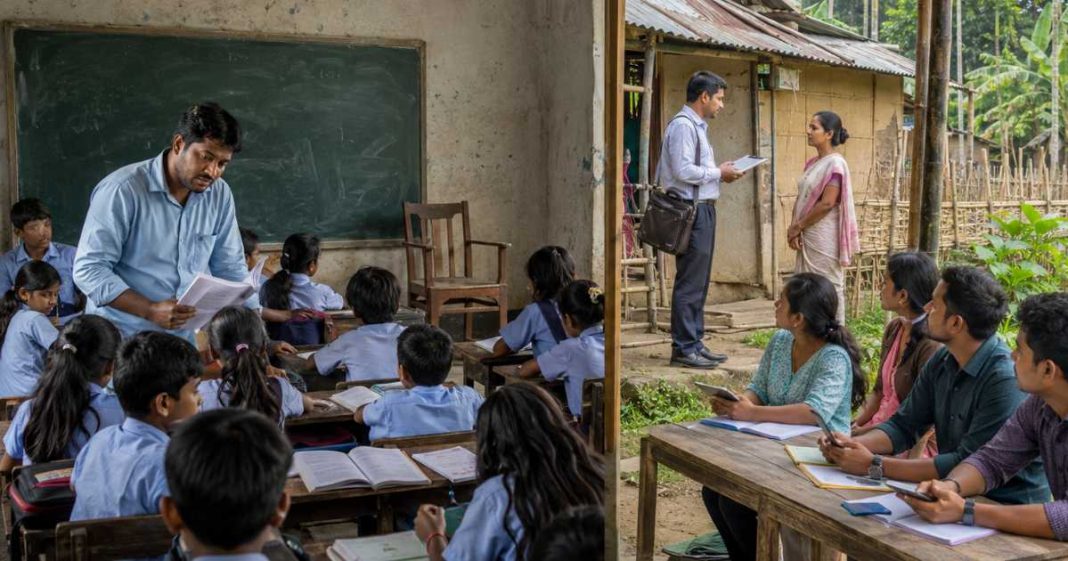
Every morning across the towns and villages of Assam, thousands of young boys and girls put on their school uniforms, sling their bags across their shoulders, and set off toward their local government schools. They walk into classrooms expecting to hear the familiar voice of their teacher explaining a complex math problem, reading aloud a piece of classic literature, or guiding them through scientific concepts. For months at a time, many of these classrooms sit strangely quiet, or they are crammed to capacity as one remaining staff member tries desperately to supervise several grades simultaneously. The missing teachers are not sick, nor are they taking unauthorized leave.
They are out in the field, clipboard or tablet in hand, going door to door to count households, record family details, and register socioeconomic data.
This scene plays out with painful regularity whenever a national census or major administrative counting drive begins. The government relies heavily on public school teachers as the backbone of its administrative machinery. They are educated, organized, embedded within local communities, and already on the state payroll, which makes them the default choice for massive field operations. This practice comes at a crushing cost to the very children who rely on the public education system for their future.
The disruption is felt most acutely in government schools, which serve families from lower-income backgrounds. Wealthier families send their children to private schools, where staff members are never pulled away for state census work. Private institutions run uninterrupted, completing syllabi on time and preparing students thoroughly for competitive examinations. Public school students are left behind, watching their academic calendar slip away while their teachers serve as data collectors.
The math of the classroom reveals a stark reality. In many rural parts of Assam, primary and middle schools operate with a minimal staff, sometimes just three to five teachers for an entire school. When two or three of those educators are drafted into full-time census operations for weeks or months, the remaining staff simply cannot cope. A single teacher might be tasked with managing five different grades all morning. That is not teaching; it is babysitting. Educational goals are tossed aside just to keep order in the hallway.
Children lose more than just daily instructional hours. They lose the vital momentum of learning. Education depends on continuity, daily engagement, practice, and regular feedback. When a teacher disappears for a month, returning briefly before being called away for another phase of field verification, the thread of instruction breaks. Students forget previous lessons, foundational literacy and numeracy slip, and the motivation to attend school wanes. When examinations arrive, the missing syllabus is often rushed through in a matter of days, leaving children confused, stressed, and ill-prepared.
The teachers themselves are caught in an unfair tug of war. Most educators enter the profession because they care about teaching and want to shape young minds. Pushing them into arduous field work creates immense professional frustration and physical exhaustion. They are forced to trek long distances, deal with reluctant householders, handle tedious paperwork, and face public annoyance, all while knowing their students are missing out on vital instruction. When census duties end, teachers face the overwhelming pressure of catching up on lost academic time. The emotional toll on educators is severe, leading to burnout and diminishing the joy of teaching.
This situation is frustrating because an obvious, mutually beneficial solution exists right outside the school gates. Assam, like many states, has thousands of educated, energetic, and capable young people who are actively seeking employment. College graduates, diploma holders, and young professionals are constantly looking for opportunities to earn a living, gain work experience, and contribute to society.
Instead of pulling teachers away from classrooms, the government could recruit and train unemployed youth for census operations. This single policy shift would solve two major problems at once. It would protect the sanctity of the classroom, ensuring that public school students receive uninterrupted education. Simultaneously, it would offer short-term employment, valuable field experience, and a stipend to thousands of young people who desperately need work.
Deploying unemployed youth for data collection makes sense on every level. Young people are digital natives, comfortable with smartphones, data collection apps, and GPS tagging, which speeds up modern census operations. They have the energy for extensive door-to-door surveying and are motivated to perform well to build their resumes and earn money. A structured training program lasting a week could easily prepare them to handle demographic surveys with precision.
Financially, the state already allocates a budget for census operations, including allowances and logistics. Redirecting those funds toward paying a fair temporary wage to unemployed youth would inject money directly into local communities, stimulating the rural and semi-urban economy. It would give young job seekers a sense of dignity, civic purpose, and institutional connection.
Continuing the habit of treating teachers as cheap, multi-purpose administrative labor reflects a flawed set of priorities. It signals that gathering data is more important than educating the next generation. While counting every citizen is necessary for policy planning and resource allocation, doing so at the expense of public education is self-defeating. A country cannot plan for its future by undermining the education of its children today.
The long-term consequences of this policy are damaging. When public schools fail to deliver quality education due to constant teacher absences, trust in the state educational system collapses. Parents who can barely afford it take out loans to send their children to private institutions. Those who cannot afford private schooling are trapped in an underfunded, frequently disrupted public system. This deepens the social and economic divide, punishing poorer children for structural administrative inefficiency.
Protecting classroom instruction must become a non-negotiable priority. Schools should be treated as sanctuaries of learning, not as labor pools for every government survey that comes along. The law guarantees children the right to education, but that right becomes hollow when teachers are routinely taken away from their desks.
The path forward requires political will and administrative imagination. Authorities must establish dedicated field-survey cadres or partner with local youth groups, university students, and job seekers for large-scale enumeration projects. Teachers should be left to do what they were trained to do: teach, mentor, and inspire.
By shifting census responsibilities to the unemployed youth of Assam, the state can protect its children’s academic futures while empowering its young workforce. It is a simple, sensible solution that honors the dignity of teachers, satisfies the needs of job-seeking youth, and ensures that no child in a government school is left staring at an empty blackboard ever again.