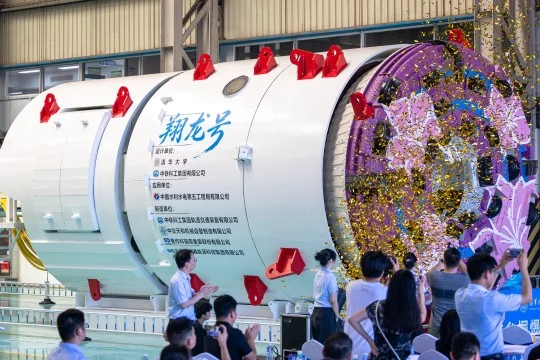

Beijing, Aug 4: China has developed the world’s first tunnel boring-and-blasting machine, a new class of equipment designed to meet the challenges of tunnelling through complex geologies.
The 4.5-metre-diameter machine, named “Xianglong”, was jointly developed by Tsinghua University and a unit of state-owned China Railway Group. It rolled off the production line in Wuhan, capital of central Hubei province, according to a statement issued by the provincial government.
Smaller than conventional tunnel boring machines, the hybrid equipment integrates excavation with built-in drilling and blasting that boosts hard-rock digging efficiency by 30 per cent, the Hong Kong-based South China Morning Post reported on Tuesday, quoting the statement.
Currently, engineers use two separate systems, Traditional Tunnel Boring Machines (TBMs) and the drill-and-blast method, when facing extreme geology. Switching back and forth between a TBM and conventional drill-and-blast meant disassembling or backing out equipment, resulting in major project delays and high safety risks.
According to the statement, standard tunnel boring machines start to slow down while cutting through extremely hard or fractured mountain rock, often delaying major infrastructure projects.
The new technology, built entirely with a domestic supply chain, was designed to address this problem, it said.
The hybrid rig will undergo its first field trial at a pumped-storage power plant under construction in Henan province by a subsidiary of state-owned Power Construction Corporation of China.
Once heavily reliant on foreign-imported large-diameter machines, China has transformed itself into the world’s leading boring machine manufacturer, according to a March report by state broadcaster CCTV.
Machines produced in Zhengzhou, a major tunnel boring machine manufacturing hub, have been exported to 36 countries.
Official sources have also said China has restricted exports of heavy boring and drilling machines to India, particularly for use in border areas.
Last week, Chinese engineers used a large-diameter shield tunnelling machine to drill an underwater tunnel traversing the Yangtze River.
The breakthrough will allow high-speed trains to run beneath the Yangtze River at speeds of up to 350 km per hour without slowing down for the first time, marking a landmark progress in China’s river-crossing railway tunnelling technology, according to the state-run Xinhua news agency. (PTI)