
Sanand, March 31: Prime Minister Narendra Modi on Tuesday said the 21st Century has brought several challenges and global supply chains have been affected due to conflicts, emphasising that the government is laying a strong foundation for technology and energy security in the coming decades.
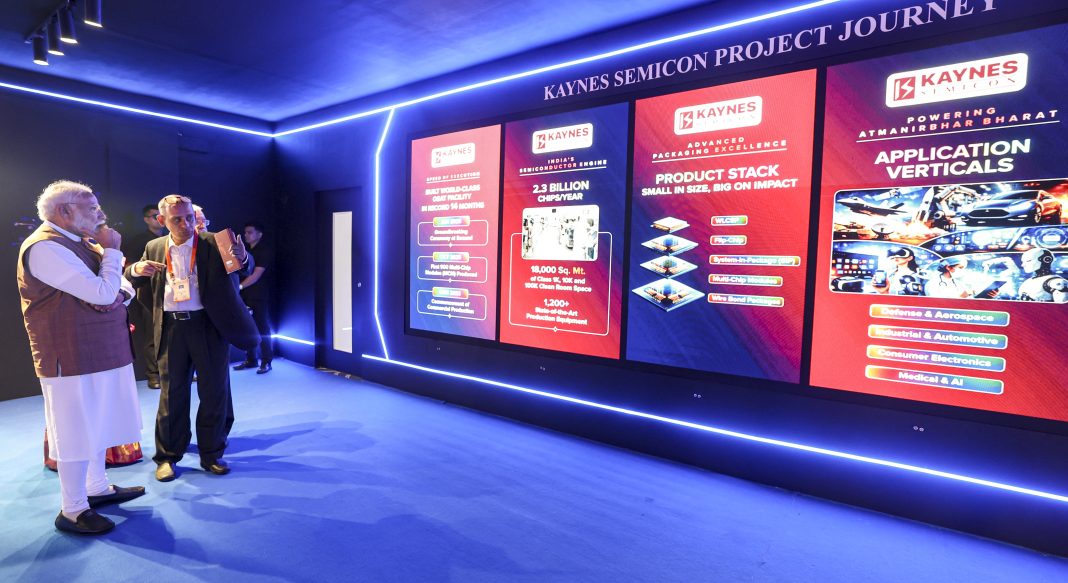
Modi inaugurated Kaynes Semicon’s outsourced semiconductor plant in Sanand, marking the commencement of production, and said India is strengthening its role as a reliable semiconductor supplier in the global market.
In a sense, a new bridge has emerged today between Sanand and Silicon Valley, he said.
Addressing a gathering on the occasion, Modi said India is actively building a robust semiconductor ecosystem and simultaneously making significant efforts to establish a resilient supply chain for raw materials.
Modi noted that when the Coronavirus pandemic disrupted supply chains, India had decided to become a hub of semiconductor manufacturing.
“India is actively building a robust semiconductor ecosystem and simultaneously making significant efforts to establish a resilient supply chain for raw materials. India’s participation in Pax Silica is a testament to this very endeavour. Working in tandem with our global partners, we aim to ensure a secure supply chain,” Modi added.
India recently joined Pax Silica, a US-led strategic coalition launched in December 2025 to secure critical technology supply chains, with a special focus on semiconductors, AI, and rare earth elements.
“Furthermore, to achieve self-reliance in critical minerals, India has launched the National Critical Minerals Mission,” Modi said, adding that this mission emphasises mining and production of critical minerals.
Additionally, a scheme of Rs 1,500 crore has been launched to promote the recycling of minerals, he said.
Modi referred to the announcement of a ‘rare earth corridor’ in this year’s Budget, encompassing coastal states such as Odisha, Andhra Pradesh, Tamil Nadu, and Kerala.
“This corridor will serve as an integrated network, forging a robust value chain spanning mining, refining, and manufacturing. Our objective is to establish a national reserve of critical minerals within the country.
“It would have been ideal had this initiative commenced 30 or 40 years ago; nevertheless, India is now pursuing this objective in a dedicated ‘mission mode,” he said.
India believes that the 21st Century is not just an era of economic competition, but also a pivotal moment to shape the technological landscape of the future, Modi said.
“For this very reason, I refer to this decade as India’s ‘Techade.’ The technology-related initiatives that India is undertaking in this decade will strengthen India’s leadership in the times to come,” he added.
Observing that India is leading the world in terms of AI adoption, Modi stated that Indians explore technology, and that the success of Digital India and the excellent work being done in Fintech shows Indians’ trust in technology.
“India’s AI ecosystem stands to benefit significantly from the emergence of our semiconductor ecosystem. The India of the 21st century is moving forward not merely as a witness to change, but with a firm resolve to lead that change. Our policies and decisions are laying a strong foundation for the technology and energy security of the coming decades,” he said.
He said India is today making unprecedented investments and undertaking reforms across every critical technology sector.
Calling the inauguration of the second semiconductor plant at Sanand a “moment of pride” as an Indian company has joined the global semiconductor supply chain, the Prime Minister said India is strengthening its role as a reliable semiconductor supplier in the global market.
“In a sense, a new bridge has emerged today between Sanand and Silicon Valley; the plant in Sanand is now supplying Intelligent Power Modules to a company based in California,” he said.
Modi said the 21st Century has brought several challenges, and global supply chains have suffered a lot, whether it is chips, rare earth minerals, or energy; they have been badly affected by conflicts.
“These initiatives are intrinsically linked to the accelerated progress of humanity. Any disruption in supply chains or their flow impacts the development of the entire human race. Therefore, it is extremely important that for the development of the entire world, a democratic nation like India advances in this direction,” he said. (PTI)