
By Satyabrat Borah
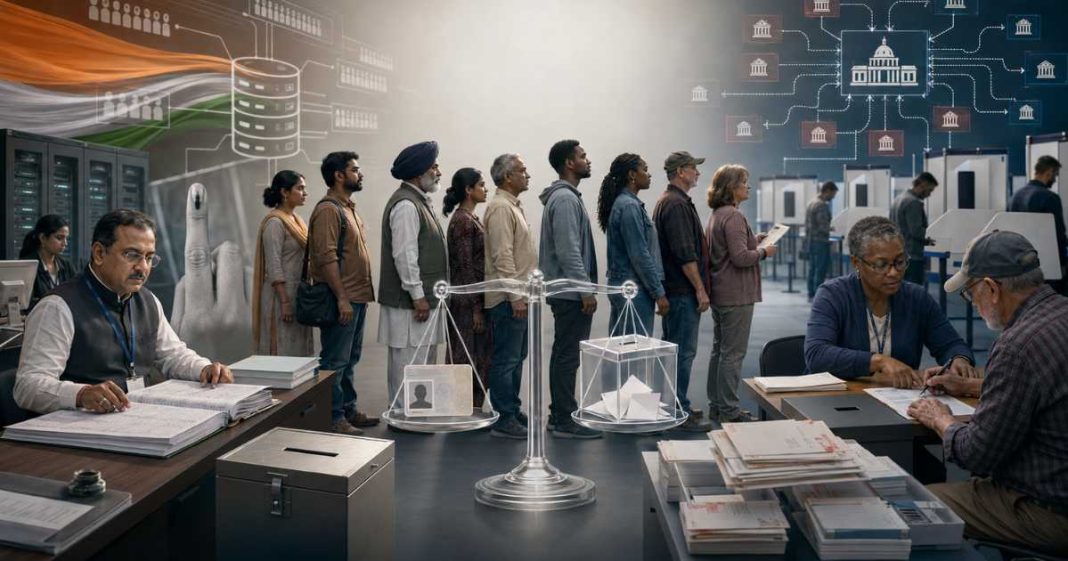
When political leaders look across international borders to evaluate each other’s democratic mechanics, the resulting observations often illuminate deeper domestic tensions. President Donald Trump’s recent public appreciation of India’s election administration has cast a bright light on the ongoing, highly contentious debate over voter eligibility, identification, and list maintenance in both democratic giants. In his public statements, Trump pointed to remarks attributed to India’s Chief Election Commissioner, Gyanesh Kumar, who allegedly questioned how a country as prominent as the United States could conduct major elections without enforcing a universal, mandatory voter photo identity standard. Trump’s enthusiasm for adopting a comprehensive voter cleanup and identification initiative similar to India’s Special Intensive Revision exercise highlights a shared fixation on election purity. The fundamental structures of the two nations present vastly different landscapes for such reforms.
The drive to ensure that electoral rolls contain only living, eligible citizens is universally accepted as a prerequisite for a fair democratic process. Every voter, politician, and civic group agrees that elections ought to be transparent and immune to double voting or illegal registration. Consensus breaks down completely when it comes to deciding who gets to define those standards and how those rules are applied on the ground. Partisan polarization has turned administrative list maintenance into a primary political battlefield. Candidates who lose elections increasingly attribute their defeat to structural flaws or illegal voters, chipping away at public trust in the system. Progressive and conservative factions offer diametrically opposed visions of reform. Conservatives emphasize strict verification, document checks, and purging outdated entries to prevent fraudulent votes.
Progressives prioritize maximum voter inclusion, warning that aggressive verification routines selectively disenfranchise low-income citizens, rural populations, and minority communities.
The structural difference between the two countries stems directly from their founding documents. India operates under a centralized election administrative authority. Article 324 of the Indian Constitution establishes the Election Commission of India as an independent, autonomous body tasked with preparing electoral rolls and overseeing elections across all states and union territories. This centralized apparatus allows for nationwide uniformity. Every eligible voter in India receives an Electoral Photo Identity Card under a single set of standardized federal parameters. While this centralized model has historically earned widespread praise for conducting massive, peaceful exercises involving hundreds of millions of citizens, it is currently navigating its own severe crisis of institutional trust.
The United States utilizes an intensely federalized and fragmented election model. Under the American Constitution, individual states hold primary authority over how elections are run, leaving individual state legislatures to craft their own voter registration rules, mail-in ballot procedures, and polling place identification requirements. While Congress holds the constitutional power to alter these state regulations by passing federal laws, state-level politics resist top-down federal mandates. This patchwork approach creates fifty different systems operating side by side. A voter in one state might be required to show a government-issued photo ID and prove citizenship, while a voter in a neighboring state might register automatically through the motor vehicle bureau and vote by mail without ever showing a physical ID.
This fragmented framework creates administrative loopholes and inconsistencies that invite persistent political suspicion. Proposals to introduce national standards in the United States face significant legislative and constitutional hurdles. Legislation like the expanded Safeguard American Voter Eligibility Act passed the House of Representatives but faced immediate resistance in the Senate, where state sovereignty and partisan divisions stall sweeping national overhauls. The proposed law seeks to require proof of citizenship during voter registration and mandate government photo identification for federal voting nationwide, mirroring practices that are standard in India. Opponents view the measure as a politically motivated attempt to create paperwork obstacles for millions of legitimate American citizens who lack easy access to passport records or original birth certificates.
Statutory law in both India and the United States already clearly dictates that only citizens are legally permitted to register and vote in national elections. The controversy lies not in what the law states, but in the specific mechanisms used to enforce it. In India, the Election Commission’s deployment of the Special Intensive Revision has drawn sharp criticism from opposition parties and civil rights organizations. Intended as a comprehensive, once-in-two-decades door-to-door verification drive to purge duplicate or deceased entries, the initiative has raised concerns regarding a lack of adequate public consultation, aggressive timelines, and opaque operational metrics. Critics argue that the exercise risks quietly disenfranchising vulnerable social groups, internal migrant workers, and poor households who cannot produce decades-old family documentation on short notice.
The core dilemma facing both nations is the weaponization of voter roll maintenance for partisan gain. Ruling parties routinely frame strict list maintenance as an urgent security necessity, claiming that existing rules are overly permissive and allow non-citizens or illegal residents to obtain voting rights. Opposition parties view these arguments with deep skepticism, seeing them as calculated strategies designed to alter the electorate by removing demographic groups that traditionally vote against the incumbent government. When administrative bodies are perceived as acting at the behest of political rulers, the legitimacy of the entire democratic framework is placed in jeopardy.
Clean voter rolls and secure photo identification are fundamental components of any well-functioning democracy. They provide voters with confidence that their individual ballots will not be diluted by administrative errors or unlawful entries.
Maintaining accurate lists requires meticulous administrative diligence, generous timeframes, clear notification procedures, and easy avenues for appeal. The state must never utilize these administrative tools as a selective filter to target opposition strongholds or exclude marginalized populations.
If India and the United States hope to present a unified model of democratic excellence to the rest of the world, they must first restore internal confidence in their own election systems. That restoration begins with removing partisan posturing from the basic mechanics of voting. A clean electoral roll is only as valuable as the trust it inspires across the entire political spectrum. Protecting the integrity of the voting list and guaranteeing that every eligible citizen retains their right to vote are not competing interests; they are twin pillars that support the entire structure of self-governance. Both nations must ensure that administrative procedures serve to empower the entire electorate rather than serve as a political tool for those currently holding power.