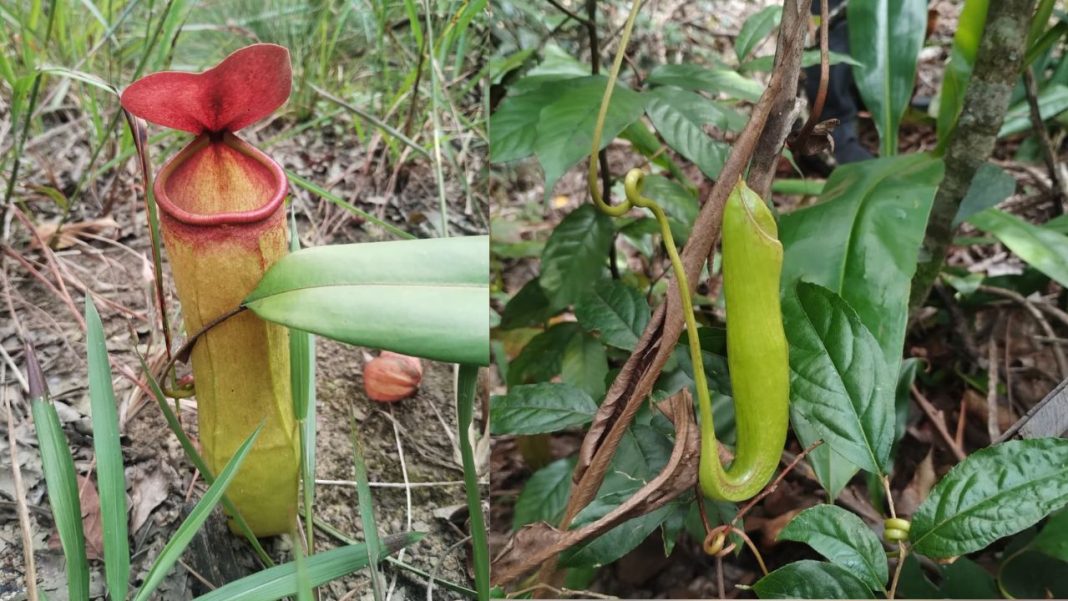

The researchers examined four developmental stages, beginning with a young, closed pitcher containing digestive fluid, followed by an opening stage, a mature pitcher containing trapped insects and an ageing stage marked by a hardened structure and reduced digestive fluid.
ROOPAK GOSWAMI
Shillong, Nov 22: Meghalaya’s rare carnivorous pitcher plant, Nepenthes khasiana, undergoes significant changes in its chemical composition as it grows, with different compounds playing potential roles in attracting, trapping and digesting insects, according to a new scientific study.
The research, conducted by Debaraty Chakravarty, Neeharika Gogoi, Santa Ram Joshi and Saroj Kanta Barik of North-Eastern Hill University (NEHU), Shillong, provides a detailed account of how the plant’s biochemical composition changes through four stages of pitcher development.
Published in Plant Biosystems, the study examined pitcher samples collected from Jarain in West Jaintia Hills district, using advanced analytical techniques to understand the relationship between the plant’s physical development and its chemical properties.
The findings reveal that the pitcher plant employs a changing combination of chemical compounds and specialised physical structures to sustain its unusual insect-trapping mechanism. The researchers identified a diverse range of metabolites, including sugars, fatty acids, alkaloids and naphthoquinone derivatives, with their relative abundance varying considerably as the pitchers mature.
The study is significant because Nepenthes khasiana is the only representative of the genus Nepenthes found in India and is endemic to Meghalaya. The species is classified as endangered on the International Union for Conservation of Nature (IUCN) Red List and is included in Appendix I of the Convention on International Trade in Endangered Species of Wild Fauna and Flora (CITES).
Unlike ordinary plants that depend primarily on soil nutrients, the pitcher plant has evolved modified leaves that function as traps, enabling it to supplement its nutritional requirements by capturing insects and other small arthropods.
The researchers examined four developmental stages, beginning with a young, closed pitcher containing digestive fluid, followed by an opening stage, a mature pitcher containing trapped insects and an ageing stage marked by a hardened structure and reduced digestive fluid.
The pitchers measured around 4 cm in the initial stage, increased to approximately 8 cm after opening and reached about 12 cm at maturity.
One of the key findings was that the chemical composition did not remain constant throughout this development. Certain compounds were concentrated during early growth, while others became more prominent as the pitcher matured.
For instance, a derivative of 5-hydroxy-2-methyl-1,4-naphthoquinone accounted for 23.39 per cent of the relative abundance of identified metabolites in the first developmental stage but was no longer detected in the oldest pitchers.
Similarly, canavanine, a nitrogen-rich compound, showed its highest relative abundance in the fourth stage. Other compounds, including oleic acid and certain derivatives, were detected only in ageing pitchers.
The digestive fluid also showed marked changes. Xylose accounted for 43.18 per cent of the identified metabolites in newly opened pitchers. In mature pitchers, however, succinic acid and phosphoric acid emerged as prominent constituents, accounting for 20.97 per cent and 19.05 per cent respectively.
The researchers suggested that the changing composition could reflect different metabolic requirements during the life cycle of the pitcher, including the breakdown of captured prey and the subsequent utilisation of nutrients.
The study also offers insights into the physical mechanisms that make the plant an effective insect trap.
The rim of the pitcher, known as the peristome, contains specialised nectar-secreting structures. The nectar makes the surface slippery, causing insects searching for food to lose their grip and fall into the digestive chamber.
Using scanning electron microscopy, the researchers identified specialised glands on the underside of the pitcher lid. These glands were considerably larger in mature pitchers than in younger ones, indicating structural changes accompanying the development of the trapping mechanism.
The chemical analysis also identified several sugars and carbohydrate derivatives in the lid and rim secretions, including sucrose, glucose and fructose derivatives. These compounds are believed to contribute to prey attraction.
An examination of captured prey revealed insects belonging mainly to three orders: Diptera (flies), Hymenoptera (ants and wasps) and Coleoptera (beetles). The diversity of captured insects suggests that the plant is not dependent on a single category of prey.
Beyond its unusual carnivorous behaviour, the plant’s chemical composition has also attracted scientific interest.
The researchers detected several classes of compounds, including naphthoquinones, alkaloids, phytosterols and fatty acids. Some of these compounds have been associated in earlier scientific studies with antioxidant, antimicrobial and other biological activities.
The paper particularly discusses naphthoquinones, including plumbagin and related derivatives, which have attracted attention in pharmacological research. However, the identification of such compounds in the pitcher plant does not establish their therapeutic effectiveness, and further targeted investigations are needed to determine their biological functions and potential applications.
The researchers describe their work as an initial mapping of the chemical diversity of Nepenthes khasiana pitchers across different developmental stages. They point out that the absolute concentrations of individual metabolites remain to be established and that further quantitative studies under different ecological conditions would help validate the findings.
The study adds to the scientific understanding of one of Meghalaya’s distinctive botanical species, showing how its physical structures and chemical composition work together to support its survival in nutrient-deficient habitats.