
ROOPAK GOSWAMI
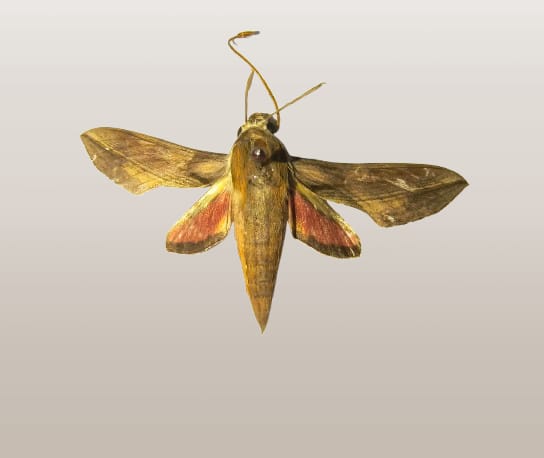
Shillong, Feb 20: In a significant addition to Meghalaya’s biodiversity records, researchers have documented the first-ever state record of the pale striated hawk moth (Hippotion boerhaviae) from Ri-Bhoi district.
The study, published in Annals of Entomology (2026), was authored by Golphina Ahmed and Salma Mazid from the Department of Zoology, Girijananda Chowdhury University, Assam; Jalil Ahmad from the Lepidoptera Section, Zoological Survey of India (ZSI), Kolkata; and Prabal Sarkar from the Department of Zoology, University of Science and Technology, Meghalaya (USTM).
The specimen was collected from 9th Mile, Bara Killing Village in Ri-Bhoi district at an elevation of around 330 metres. The area lies at the fringes of the Nongkhyllem Wildlife Sanctuary and reserve forest, part of the Indo-Burma biodiversity hotspot. The region experiences a tropical monsoon climate, characterised by hot, wet summers and cool, dry winters.
Researchers highlighted that the region’s tropical moist deciduous and semi-evergreen forests provide suitable habitat for hawk moth species.
Until now, Hippotion boerhaviae had been recorded in Northeast India from Assam and Arunachal Pradesh, but not from Meghalaya.
The new state record extends the known distribution of the species, strengthens Meghalaya’s documented lepidopteran diversity, and highlights Ri-Bhoi as an underexplored region for nocturnal insect surveys. The moth was collected using a vertical sheet light trap and identified through detailed morphological examination.
The species is characterised by a slender body and elongate forewings, a distinct dark antemedial line, rosy-pink hindwings bordered with thick black, and tapering antennae — features that distinguish it from its close relative Hippotion rosetta.
“The distribution record of H. boerhaviae in Meghalaya suggests that its actual range in northeastern India may be greater than previously believed. In addition to a favourable climate — high humidity, moderate elevation, and an abundance of floral resources — sphingid moths flourish in the region’s tropical moist deciduous and semi-evergreen forests. The collecting site’s proximity to the Nongkhyllem Wildlife Sanctuary and reserve forest likely supports the persistence of this species by providing continuous forest cover and diverse nectar sources,” the authors said.
The authors noted that the new record contributes to growing evidence that the Ri-Bhoi region, within the Indo-Burma biodiversity hotspot, harbours rich but under-documented sphingid fauna, warranting further systematic surveys and ecological investigations.