
By Prarthana Hazarika
Mangaldai, Oct 23: Before the India jersey, before the national spotlight and before her name began travelling beyond Assam, there was a young girl in Mangaldai who wanted to play cricket.
But there was a problem. There were hardly any girls to play alongside her.
For a young girl trying to find her place in a sport still searching for wider participation among women, that could have been reason enough to give up. Cricket required practice, competition and the opportunity to test herself against others. Yet the numbers were not in her favour.
Jintimani Kalita found another way.
She practised with the boys.
There were no special concessions in those sessions. The boys bowled faster, played harder and demanded more in the field. If Jintimani wanted to keep pace, she had to raise her own standards.
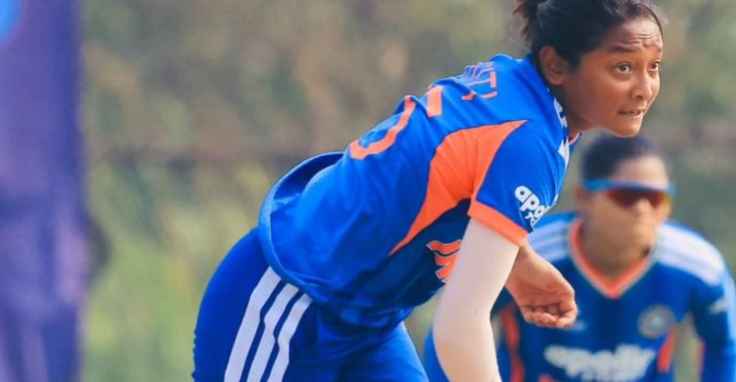
Years later, as the Mangaldai cricketer earns an opportunity in India’s squad for the ODI series against Zimbabwe, those early days have acquired a special significance.
Her journey is not simply about a player making it to Team India. It is about a girl who continued to pursue her ambition when the sporting environment around her offered few girls to share it.
And it is about what her journey could mean for those who follow.
When the girls were few, she found a way
Recalling Jintimani’s formative years, Nabajit Deka, Cricket Secretary of Mangaldoi Sports Association, spoke of a time when girls were scarcely represented in the local cricket set-up.
Jintimani trained alongside boys, an experience Deka believes played an important role in her development.
The intensity of those sessions pushed her to improve. Facing faster deliveries, responding to more demanding play and working to maintain the required standard helped her develop the ability to compete at a higher level.
Deka believes that without practising with boys, her improvement might not have been the same.
There is a larger story in that observation.
Jintimani did not wait for ideal circumstances to begin building her cricketing future. She made the most of the opportunities available to her, even when those opportunities meant stepping into an environment where girls were few.
But her experience also raises an important question: should a girl have to depend on the absence of other girls to find the competition she needs?
Her determination is worth celebrating. So, too, is the need to create better pathways for the next generation—more girls’ teams, regular matches, access to coaching and training environments where young female cricketers can develop together.
Jintimani found a way forward. The girls who follow her deserve an easier starting point.
A girl from Mangaldai, a dream for many
In a town where local cricket has helped nurture sporting ambitions, Jintimani’s rise has become a source of pride.
For young girls watching her journey, the significance of her selection may go beyond the achievement itself. It is one thing to admire an international cricketer from a distance; it is another to see someone from your own town reach that stage.
The distance between the local ground and the Indian dressing room suddenly feels less impossible.
A girl who once struggled to find enough female peers to practise with is now part of the national set-up. That journey offers something statistics cannot fully capture: the power of seeing a possibility embodied by someone who comes from a familiar place.
Deka believes Jintimani’s achievement has encouraged more girls to take an interest in cricket in Mangaldai.
That is perhaps the most meaningful measure of her influence at home.
A young player may not immediately dream of playing an international series. She may begin by asking for a bat, joining a practice session or convincing her family to let her spend more time on the field.
But sporting dreams often begin with these small acts of courage. They grow when a girl sees someone else take the same first steps and go further than she imagined.
For Mangaldai, Jintimani could become that example.
The people behind the journey
No sporting journey is built on talent alone. Behind the player who reaches the national stage are the people who help keep the ambition alive—the local cricket fraternity, those who offer encouragement and those who provide assistance when resources are limited.
Deka recalled support from members of Mangaldai’s cricket community, whom he credited with helping Jintimani.
Such contributions may not appear on a scorecard, but they form part of the support system that allows young athletes to continue pursuing their sport.
For girls in smaller towns, that support can be especially important. Training, equipment, travel and access to competition all require commitment, often from families and communities that must find ways to sustain a young athlete’s ambition.
Jintimani’s story is therefore also a reminder that identifying talent is only the beginning. The challenge is to ensure that girls receive the opportunities and support required to develop it.
Assam and the Northeast have no shortage of sporting ambition. The task is to build pathways that allow more of that potential to reach its destination.
From one girl’s ambition to a region’s aspiration
India’s 1983 Cricket World Cup triumph under Kapil Dev showed how a sporting achievement could inspire generations. Jintimani’s journey is different in scale, but its significance in Mangaldai lies in the same powerful idea: seeing someone succeed can change what others believe is possible.
For the girls of Assam and the wider Northeast, her story carries a message that extends beyond cricket.
You do not have to begin in a major city. You do not have to be surrounded by a large group of girls who share your ambition. And you do not have to let the limitations of your starting point decide the limits of your dream.
But ambition must be met with opportunity. More girls need access to coaching, equipment, safe training spaces and regular competition. Their progress should not depend on exceptional circumstances or individual sacrifice alone.
Jintimani has taken an important step in her cricketing journey. Her selection for India is a personal milestone and a moment of pride for the community that watched her grow.
What happens next in Mangaldai may be just as important.
Perhaps another girl will walk onto the local cricket ground, pick up a bat and imagine herself wearing India’s colours. Perhaps she will find more girls beside her, a coach ready to guide her and a pathway that makes the dream easier to pursue.
For now, Mangaldai has Jintimani Kalita—a young woman whose journey from practising with boys to representing India has made a national ambition feel closer to home.
The India jersey tells the story of how far she has come. The girls watching her may one day tell the story of how far she helped them go.