
By Satyabrat Borah
The night air over Ahmedabad carried a strange mixture of tension and hope. The massive Narendra Modi Stadium, one of the largest cricket arenas in the world, had witnessed many dramatic evenings. Yet this night felt different. It felt like a moment waiting to be written into memory long before the first ball was bowled. For more than a lakh spectators packed into the stands, and for millions watching across India, this was not just another cricket final. It was a chance for redemption, a chance for healing, and a chance for history.
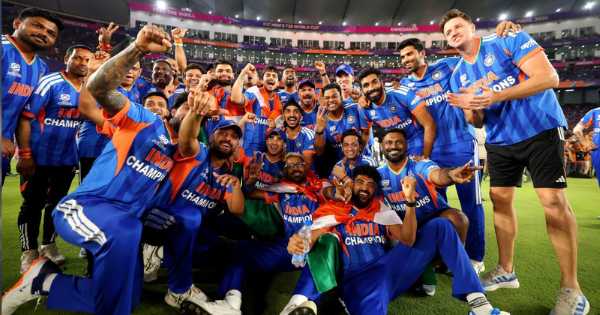
When Tilak Varma settled under the high ball at long on, time seemed to slow. Jacob Duffy had struck the ball high into the night sky, perhaps hoping for a miracle, perhaps knowing it was only a matter of seconds before the inevitable would happen. The stadium fell into a brief hush as Varma tracked the ball. Then it landed safely in his hands. As he tried to fling the ball into the sky in celebration he slipped on the grass, but the moment had already exploded into joy. His teammates rushed towards him. Blue jerseys flooded the outfield. The stadium erupted in a thunder of sound that seemed powerful enough to shake the steel and concrete of Motera.
India had defended their T20 World Cup title.For a few seconds the players themselves appeared unsure how to react. Some laughed. Some shouted. Some simply stood still, letting the emotion sink in. After months of preparation, weeks of matches and years of expectation, the dream had turned real once again.
The victory carried a deeper emotional meaning for the stadium itself. This was the same arena that had hosted the heartbreaking finale of the 2023 ODI World Cup. That day India had arrived at the final in unstoppable form. Every match had gone their way. The team had looked destined to lift the trophy in front of their home crowd. Yet cricket has its own script. Australia produced a performance of ruthless efficiency and the Indian dream dissolved into silence.
That memory had lingered in the stands of the Narendra Modi Stadium like an unfinished story. Fans had carried the wound quietly. Every time the team returned to the ground, echoes of that disappointment seemed to float in the air.
This night changed that story.As fireworks burst over the stadium and blue confetti drifted down from the sky, the crowd found the closure it had waited for. The roar was not only for a cricket victory. It was the sound of a collective release. The pain of 2023 had finally been washed away.
Players gathered in small circles, hugging each other, laughing and shaking their heads in disbelief. Cameras chased them across the ground. Words did not come easily. Tilak Varma spoke with a smile that seemed almost shy.
The next couple of days will be a big party with the boys.Arshdeep Singh sounded equally overwhelmed. He called the team a group full of match winners and said the trophy felt like a cherry on the cake. Sanju Samson, who had been named player of the tournament, simply said it felt like a dream.
For Jasprit Bumrah the moment carried a personal emotion. He had once played a World Cup final at his home venue and walked away empty handed. This time he stood with the medal around his neck and a quiet sense of satisfaction in his eyes.
Around them the celebrations unfolded like a festival.Hardik Pandya turned to the stands and blew kisses to the fans who had supported them through every moment of the tournament. Suryakumar Yadav walked towards coach Gautam Gambhir and embraced him tightly. It was a brief but powerful moment. Gambhir, known for his intense focus, allowed himself a rare smile. Surya then moved from teammate to teammate, hugging each one. His eyes appeared moist as he thanked the support staff who had worked tirelessly behind the scenes.
Children ran onto the field. Varun Chakaravarthy lifted his son and held him close. Suryakumar crouched down to play with Axar Patel’s toddler. In those simple moments the scene felt less like a sporting event and more like a family celebration.
On the other side of the field the New Zealand players gathered quietly. They had fought hard throughout the tournament. Yet they knew that on this particular night they had been outplayed by a team operating at a different level.
India’s dominance had become clear long before the final wicket fell.Once the scoreboard showed 255 runs for India the task ahead of New Zealand looked almost impossible. T20 cricket often produces surprises, yet chasing such a towering target in a World Cup final requires something extraordinary.
The pressure began to work almost immediately. The New Zealand openers tried to attack early. Tim Seifert and Finn Allen struck a few clean blows and briefly threatened to lift the mood in their camp. For a moment the crowd fell quiet, remembering how quickly fortunes can change in this format.
Then the Indian bowlers took control.
Axar Patel produced a clever delivery that ended Allen’s promising innings. Soon the scoreboard read 47 for 3. A few overs later it became 72 for 5. The chase had begun to collapse.
Jasprit Bumrah delivered the decisive blows. The fast bowler, known for his calm demeanor, suddenly broke into a playful dance after dismissing two batters in quick succession. The crowd loved it. It felt like the final act of a story that had already been written.
New Zealand were eventually bowled out for 159. The margin of victory was 96 runs. It reflected the scale of India’s superiority that night.
Every great sporting triumph carries a deeper narrative. This one carried many.
For years India had been regarded as a powerhouse in T20 cricket. The country hosts the richest cricket league in the world. The Indian Premier League has become a breeding ground for fearless young players. Stadiums across the country echo with cheers every season as new talents announce themselves.
Yet international trophies had not always matched the strength of that system.
India had won the first T20 World Cup in 2007 under the leadership of a young team. After that triumph, years passed without another title. Fans waited patiently. New generations of players emerged. Still the crown remained out of reach.
The drought lasted seventeen years.
Then came the breakthrough in 2024 when India finally reclaimed the T20 World Cup. That victory had felt like the closing of a long chapter. Two years later the team achieved something even more impressive. They defended the title.
Winning a single tournament can sometimes be the result of favourable circumstances. A team may find momentum at the right moment. A few close matches may go their way. Success may arrive through a combination of skill and luck.
Winning consecutive titles requires something deeper. It requires consistency, adaptability and mental strength. T20 cricket is famous for its unpredictability. A single over can transform the direction of a match. A single mistake can undo weeks of effort.
India managed to navigate all of those challenges.Throughout the tournament the players carried a heavy burden of expectations. Every opponent saw them as the team to beat. Every crowd expected victory. Every mistake was analysed and debated by millions of fans.
Yet the squad handled the pressure with remarkable calm.The batting unit displayed a blend of elegance and aggression. The bowlers operated with sharp coordination. Fielding remained energetic and disciplined. When one player had a quiet day another stepped forward.
Watching this team felt like listening to a well rehearsed orchestra. Each instrument played its part while contributing to the harmony of the whole.
The final itself demonstrated that harmony perfectly.India began their innings with a sense of purpose that was clear from the first few overs. There was no hesitation. The batters attacked from the start, sending the ball racing to the boundary again and again.
Abhishek Sharma led the charge with an explosive burst of strokes. His innings reminded fans of the fearless style that has become a hallmark of modern Indian T20 cricket. Even after his departure the momentum continued.
Ishan Kishan walked in and started striking boundaries almost immediately. He did not wait to settle in. One of his early fours was a remarkable stroke that drew gasps from the crowd. By the time he completed his innings he had smashed 54 runs from only 24 balls.
Among the new generation of Indian batters Kishan perhaps represents the most aggressive spirit. His approach reflects the changing philosophy of the format. Modern T20 cricket encourages creativity and freedom. Players are willing to attempt audacious shots that once seemed risky.
The top three batters together produced 195 runs from just 92 balls. It was a display of raw power combined with remarkable skill.
Seventeen sixes soared into the stands. Nineteen fours raced across the grass. Yet the numbers alone do not capture the feeling of the innings. The strokes were not merely attempts to accumulate runs. They were expressions of confidence.
The pitch helped as well. The mixed soil surface offered consistent bounce and pace. It invited batters to swing through the line. The ground dimensions were manageable, encouraging players to aim for the ropes.
Still the brilliance of the batting came from execution. Timing was precise. Footwork was sharp. Every player seemed to understand the rhythm of the match.
For spectators the experience felt almost unreal. The scoring rate climbed rapidly, as if someone had pressed a fast forward button on a video game.
The crowd responded with waves of noise that rolled across the stadium like thunder. Thousands of fans wearing blue jerseys jumped and danced in the stands. Drums beat. Flags waved. Cameras captured faces shining with excitement.
At times the sound became so loud that commentators struggled to hear themselves.Only two brief moments of quiet interrupted the celebration. One arrived when India lost a few wickets late in the innings while chasing the dream of reaching 300 runs. The other came when Seifert and Allen began their attacking start during the chase.
Apart from those moments the stadium felt alive with constant energy.When the final wicket fell and the victory became official, the arena seemed to transform into a giant festival ground.
This night also marked the beginning of something larger than a single tournament triumph. Many observers described it as the launch of a dynasty.
In sports the word dynasty carries a special meaning. It refers to a period when one team rises above all others and maintains dominance across seasons. Achieving such status requires depth of talent and a strong culture within the squad.
India’s current team appears to possess both.Young players have entered the side with confidence. Experienced stars continue to guide the group. Coaching staff have created a structure that encourages innovation while maintaining discipline.
The system that produces cricketers in India has grown stronger over the years. Domestic tournaments provide opportunities for emerging talents. The IPL exposes players to high pressure environments where they learn from international teammates and opponents.
All those elements combine to create a powerful pipeline of skill.The triumph in Ahmedabad symbolised the success of that entire ecosystem.
It also gave the Narendra Modi Stadium its own defining moment. Until now the arena had sometimes been described as a magnificent structure waiting for a legendary story. This victory provided that story.
Future generations of fans will remember the night when India defended their T20 crown at Motera. They will recall the fireworks lighting up the sky and the echoing roar of more than a hundred thousand voices.
For the players it will remain a memory of unity and belief.As the celebrations continued deep into the night, many of them lingered on the field long after the official ceremony ended. Some sat on the grass and spoke quietly with teammates. Others walked around the boundary rope, waving to supporters who refused to leave their seats.
Cricket in India has always been more than a sport. It is a shared emotion that connects people across languages and regions. On this night that emotion reached a special intensity.
India had not only won a match. They had carried the hopes of millions and turned them into a joyful reality.
The dynasty had begun. The legacy had started to take shape. And somewhere above the bright lights of the stadium, the echoes of celebration drifted into the Ahmedabad night, promising that this story of Indian cricket was still unfolding.